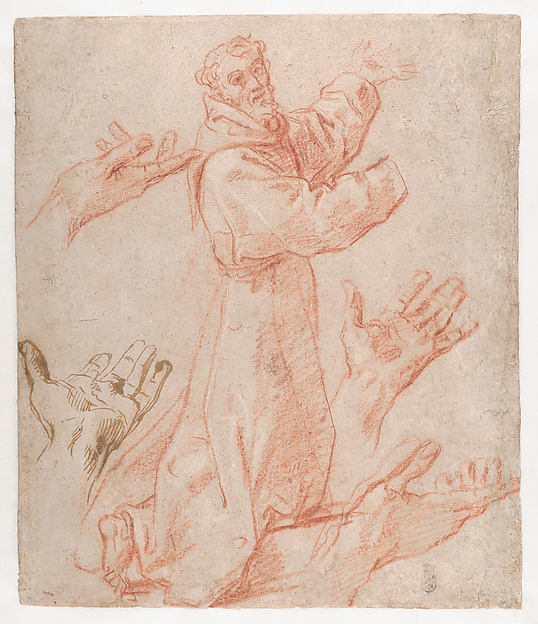
Image title: Studies for a Figure of Saint Francis Kneeling in a Three-Quarter View and for His Hands (recto); Studies for a Figure of Saint Francis Kneeling in Profile (verso)
Medium: Red chalk with white chalk highlights, pen and brown ink (recto); red chalk (verso)
Date: 1583–85
Source: The Met Collection
“
Just as much as we see in others, we have in ourselves.
”
— William Hazlitt
The Hands Have It: Exploring Gesture as Narrative in Renaissance Painting
The Renaissance period, spanning from the 14th to the 17th centuries, marks a profound turning point in the history of art. While facial expressions have long been studied for their emotional depiction, during the Renaissance, artists began to emphasize the role of hands in conveying complex narratives and emotions. This shift reflected not only an emerging artistic sophistication but also a deepening understanding of human psychology and storytelling. In this exploration, we will delve into how the gestural motifs within Renaissance paintings speak volumes, sometimes whispering secrets beyond the reach of words.
The Middle Ages: Foundation of Gestures
Before the Renaissance shone its light, medieval art set the groundwork for narrative gesturing. In religious icons and altar pieces, the emphasis was primarily on didactic purposes. Gesture was often used to signify religious meaning – a raised hand might denote blessing, while an extended finger could highlight divine instruction in biblical scenes. However, these gestures were mostly symbolic rather than emotive. The characters remained somewhat static, as the focus leaned towards spiritual representation over individual expression.
The Early Renaissance: Awakening of Expression
With the dawn of the Renaissance, humanism began to reshape the cultural and artistic landscape. Artists such as Giotto and Masaccio started to infuse their works with life-like dimensionality and more nuanced gestures. For instance, in Giotto’s ‘Lamentation’, the expressive postures of the mourners capture not only grief but a collective emotional turmoil. Hands clutch, point, and reach in gestures that underscore personal anguish and narrative progression, signaling a shift to more human-centric storytelling.
The High Renaissance: The Pinnacle of Narrative Gesture
The High Renaissance, marked by artists like Leonardo da Vinci, Michelangelo, and Raphael, is often considered the apex of narrative gesturing. Leonardo’s ‘The Last Supper’ offers a masterclass in storytelling through hands alone – the apostles’ gestures vibrate with emotion and unspoken tension as they respond to Christ’s revelation. These hand movements guide the viewer’s eye through the composition, weaving a complex psychological interplay effortlessly throughout the scene.
The Mannerist and Baroque Influence: Exaggeration and Drama
As art evolved into Mannerism and later Baroque, there was a tendency toward exaggeration and flourish. During this era, gestures became more dramatic, mirroring the philosophical and political turbulence of the time. Caravaggio, for example, used light and dark contrasts to amplify the impact of gesture, creating an intense emotional resonance in works like ‘The Calling of Saint Matthew.’ The raised hand becomes not just a signal but a thunderous statement of Matthew’s turmoil and divine calling.
The Legacy: Modern Interpretations
Even today, the narrative power of gesture continues to inspire and inform. Contemporary artists explore the evocative capabilities of hands, creating works that still echo the Renaissance mastery of storytelling. This heritage serves as a testament to how the simplicity of a gesture can convey layers of meaning, revealing the richness of human experience. The Renaissance’s legacy reminds us that while faces may convey emotions, it is often the position of the hands that tells the true story.

Image description: Touchpad gestures Zoom out
Artist: Ccompagnon
Credit: Own work
License: CC0
Source: Wikimedia Commons
Useful links: