
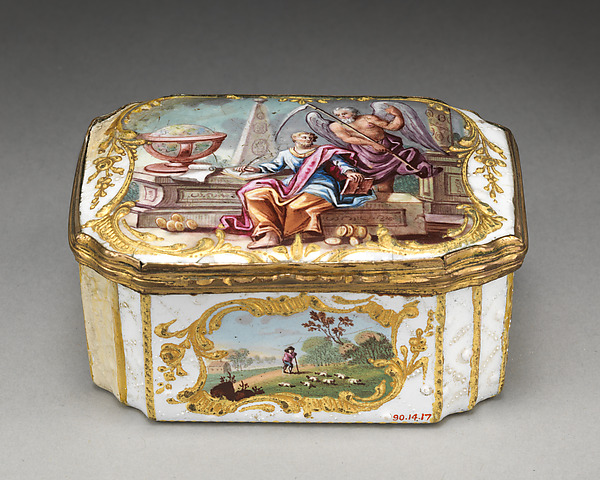
Image title: Snuffbox with allegorical figures of History and Time
Medium: Copper, enamel
Date: ca. 1765–1770
Source: The Met Collection
“
History is written by the victors.
”
— Winston Churchill
Color Revolutions: A History Through Pigments
Introduction: The Vibrant Palette of History
From the deep lapis lazuli blues that adorned the gowns of Renaissance Madonnas to the shocking new hues of modern acrylics, colors have always spoken a language of their own. They define moods, symbolize eras, and carry stories locked in their vibrant or muted tones. In this blog post, we journey through the history of pigments, unraveling the tales of trade, discovery, and innovation that have colored our world over the centuries.
Chapter 1: Earth, Ochre, and the Dawn of Color
The earliest humans meticulously crushed minerals and earth to create ochre, a pigment that marked the interiors of caves from Lascaux to Altamira. Spanning from prehistory through to the ancient civilizations, natural pigments like chalk and charcoal were mixed into concoctions that served not only to decorate but to communicate. These pigments were not merely artistic tools but were part of ritualistic and symbolic language that hinted at the rich spiritual lives of early humans.
Chapter 2: The Lure of Lapis and the Medieval Mind
The journey transported artists from humble earth tones to the opulence of ultramarine in the Middle Ages. Extracted from the semi-precious stone lapis lazuli found exclusively in Afghanistan at the time, this pigment was more valuable than gold. Artists like Giotto and Michelangelo coveted it, and it was often reserved for only the most sacred subjects, marking art with a divine glow. The intricate trade routes and high cost of ultramarine underscore how pigment influenced not just aesthetics but economics and religious devotion.
Chapter 3: The Renaissance and the Alchemy of Color
The Renaissance era saw dramatic shifts not only in thought and culture but also in the pigments available to artists. Innovations in chemistry led to the creation and refinement of new colors. Florence became the center of artistic exploration and experimentation, with workshops applying scientific methods to art. Italian Renaissance masters were at once artists and chemists, transforming mundane minerals into masterpieces that defined Western art.
Chapter 4: Innovation in the Age of Enlightenment
The Age of Enlightenment was a time of scientific discovery that brought synthetic pigments to the fore. Prussian blue, discovered accidentally in the early 18th century, was a watershed moment. It provided artists with the ability to depict dramatic contrasts and vibrant skies unlike ever before. The philosophical shift during this time—emphasizing reason, science, and intellectual interchange—coincided with a palette that celebrated the natural world and the expanding horizons of human possibility.
Chapter 5: The Explosion of Modern Color
With the industrial revolution came mass production, and access to color was transformed. New synthetic dyes and pigments sprang up, offering artists an unprecedented range of hues. The modern era embraced these developments, with movements like Impressionism and later Abstract Expressionism challenging traditional uses of color. Now, painters like Monet and Kandinsky thrived on bold, new pigments and dyes, pushing artistic boundaries toward pure expression and emotion.
Conclusion: The Continuing Spectrum
The luminous saga of pigments continues in the modern day, where digital technologies and sustainable practices are charting new paths for creators. Our fascination with color is as vibrant as ever, continuing to inspire breakthroughs as scientific knowledge and innovative technology discover the new ‘impossible hues’ of tomorrow.

Image description: Pigments for sale on market stall, Goa, India.
Artist: Dan Brady
Credit: https://www.flickr.com/photos/11853009@N07/1382064216/
License: CC BY 2.0
Source: Wikimedia Commons
Useful links: