
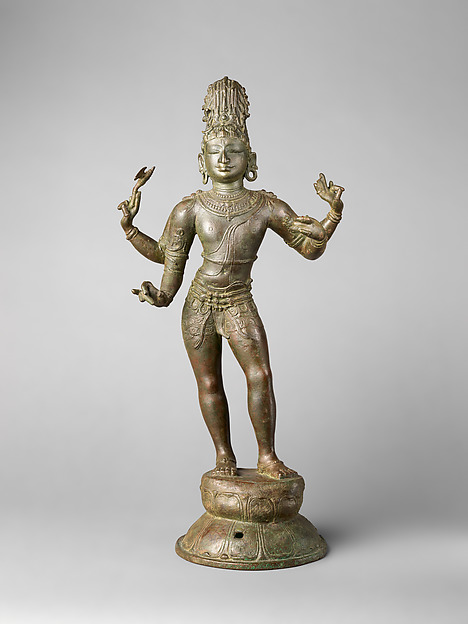
Image title: Shiva as Vanquisher of the Three Cities (Shiva Tripuravijaya)
Medium: Copper alloy
Date: ca. 1000–1020
Source: The Met Collection
“
Pitching is the art of instilling fear.
”
— Sandy Koufax
The Symmetry of the Divine: The Role of Mathematics in Islamic Art
Introduction: The Interweaving of Art and Mathematics
Islamic art is renowned for its intricate geometric patterns, a vivid testament to the sophisticated interplay between mathematics and spirituality. At the heart of this art form lies sacred geometry—mathematical principles that not only shape aesthetic experience but also reflect profound philosophical beliefs. This article delves into the fascinating world of Islamic art, examining how mathematical concepts have been interwoven with artistic expression throughout history.
The Golden Age of Islam: Birth of a Mathematical Art Form
The Islamic Golden Age, spanning from the 8th to the 14th century, was a period marked by significant developments in science, technology, and philosophy across the Islamic world. Mathematics flourished during this time, particularly in the fields of algebra and geometry. Scholars such as Al-Khwarizmi and Omar Khayyam not only transformed mathematics but also deeply influenced artistic traditions. In this era, geometric patterns became a primary feature in Islamic art, blending mathematical precision with artistic creativity to symbolize the infinite and unbroken nature of the divine.
Patterns of Faith: Mathematics Reflecting Spiritual Beliefs
In Islamic art, geometry is more than mere decoration; it serves as a symbolic medium reflecting the philosophical foundations of Islam. The repetition and symmetry found in geometric designs are not only pleasing to the eye but also encapsulate spiritual beliefs. The use of patterns such as the well-known eight-point star and various tessellations highlights themes of unity and continuity. These patterns echo the Islamic perspective of Tawhid—the oneness of God—and reflect a universe where everything is interconnected.
From Palaces to Mosques: Geometry as a Unifying Element
Throughout history, geometric patterns in Islamic art have adorned everything from mosques and palaces to everyday objects. The Alhambra Palace in Spain and the Mosque of Ibn Tulun in Egypt are prime examples of how geometry is employed to enhance architectural spaces. The use of tessellations and interlocking shapes not only creates visually stunning effects but also unites diverse architectural elements into a coherent whole. This unity in design resonates with the broader Islamic axiom of harmony in diversity, embodied through mathematics.
A Modern Renaissance: Technology and Islamic Geometric Art
In contemporary times, technology is breathing new life into traditional Islamic geometric patterns. Artists are using computer algorithms to innovate and experiment with these designs, allowing for unprecedented complexity and variation. Digital tools enable artists to explore infinite combinations, pushing boundaries while maintaining cultural heritage. This fusion of ancient traditions with cutting-edge technology illustrates the enduring relevance of sacred geometry and its capacity to evolve with society.
Conclusion: Beyond Aesthetic Appeal
Understanding the role of mathematics in Islamic art reveals a deep-seated relationship between science and spirituality. It highlights how artistry can transcend visual beauty to express universal truths and philosophical ideals. From historical masterpieces to modern interpretations, Islamic art continues to captivate and inspire, driven by the timeless principles of sacred geometry that speak to both heart and mind.

Image description: Victoria and Albert Museum Artefacts geometry in Islamic art and architecture
Artist: Sourabh.biswas003
Credit: Own work
License: CC BY-SA 4.0
Source: Wikimedia Commons
Useful links: