
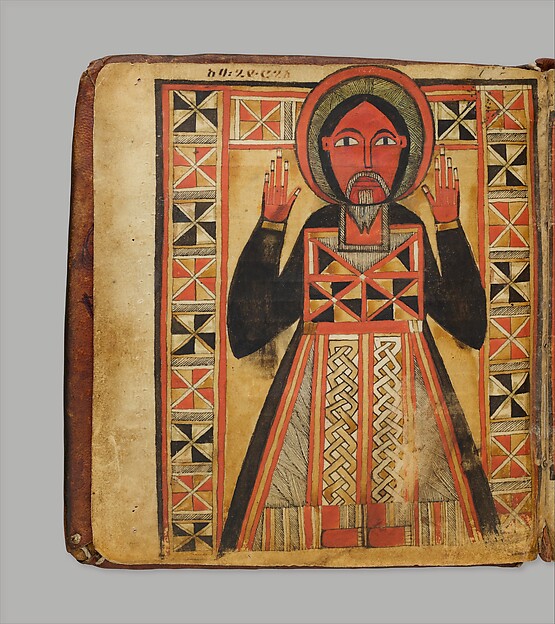
Image title: Arganonä Maryam (The Organ of Mary) prayer book
Medium: Parchment, pigment ink, wood, leather, fiber
Date: late 17th century
Source: The Met Collection
“
The art challenges the technology, and the technology inspires the art.
”
— John Lasseter
Sacred Algorithms: Exploring Religious Themes in Generative Art
Generative art, often seen as the purest expression of digital creativity, intertwines the worlds of mathematics, algorithmic processes, and aesthetics. Yet, in this burgeoning artistic field, a profound spiritual dialogue has quietly emerged. Artists are ingeniously leveraging algorithms not just to create visually stunning pieces but to evoke and explore themes of faith, harmony, and the divine.
Chapter 1: The Birth of Generative Art
The origins of generative art trace back to the early experiments with computers as creative partners in the mid-20th century. Figures like Manfred Mohr and Vera Molnár became pioneers, using rudimentary code to dictate the artistic process. Though initially focused on abstraction and symmetry, the potential for embedding deeper, spiritual narratives was acknowledged even in these nascent stages.
In these early works, the artist’s role was akin to a modern-day composer. The algorithm served as an unpredictable instrument that could introduce variations akin to the spiritual concept of chance encounters or divine orchestration. With the dawning of more sophisticated computing, artists began imagining more complex themes, including those of spirituality and religion.
Chapter 2: Spirituality in the Digital Age
As digital technology advanced, so did the themes explored by generative artists. The 21st century witnessed a heightened interest in how technology and algorithmic art could reflect spiritual and religious experiences. Contemporary artists like Mario Klingemann have experimented with neural networks to create visual analogies for spiritual awakening and transcendence.
In these works, generative processes are harnessed to simulate the natural and mystical laws prevalent in religious and spiritual narratives. By doing so, they present digital realms as spaces for divine interpretations, similar to ancient cathedrals, where art and faith unite to reflect humanity’s search for meaning.
Chapter 3: Mathematics as Mysticism
For centuries, mathematics has been closely linked with spirituality. Numerology, sacred geometry, and the Golden Ratio are all examples of religious philosophies impacting visual arts. In generative art, artists use mathematical formulas not just as tools, but as spiritual guides. By doing so, they mirror a universal order found in various religious beliefs.
Stunning examples include Jonathan McCabe’s cellular automata-based artworks, which are deeply rooted in the repetition and symmetry found in nature—a recurring symbol in many spiritual traditions. Here, algorithms act as contemporary hieroglyphs, encoding spiritual messages in a language of numbers and sequences.
Chapter 4: The Role of Symbols and Icons
The transition to digital art hasn’t diminished the impact of religious symbols and icons; rather, it has transformed them. Artists are reinterpreting these age-old symbols within a digital context. The results extend our conception of sacred iconography by confronting traditional meanings with digital reinterpretations.
These works challenge and expand the boundaries of religious art. Rather than static depictions, sacred symbols evolve as algorithms generate endless variations, suggesting the infinite nature of spirituality and encouraging an ongoing exploration of faith.
Chapter 5: A New Sacred Space
As generative art ventures further into spiritual territory, it reimagines what sacred spaces might look like in a digital age. Virtual reality installations and interactive experiences are constructing digital temples for audiences to reflect and engage with spiritual themes in new, dynamic ways. This fusion of art, code, and faith breathes life into virtual spaces, creating a dialogue between viewer, artist, and the divine.
Generative art stands at the vanguard of a movement embracing faith in the digital realm. By intertwining sophisticated algorithms with spiritual exploration, this art form challenges our perceptions of the sacred and invites us to see the digital world as an emerging sanctuary for the eternal questions of faith and existence.

Image description:
Digitized by Google.
Electronic reproduction
Mode of Access: Internet
Subjects: Lord's Supper — Catholic Church; Lord's Supper
Artist:
Gerbet, Olympe Philippe, 1798-1864
Credit: Internet Archive identifier: ConsiderationsOnTheEucharist
https://archive.org/download/ConsiderationsOnTheEucharist/ConsiderationsOnTheEucharist.pdf
License: Public domain
Source: Wikimedia Commons
Useful links: