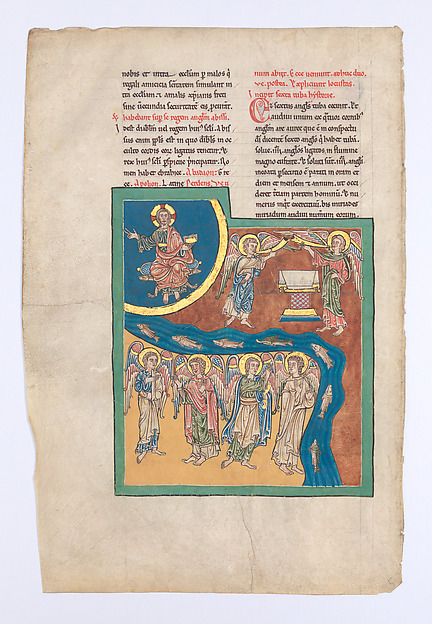
Image title: Leaf from a Beatus Manuscript: the Sixth Angel Delivers the Four Angels that had been Bound at the River Euphrates; an Altar Appears in the Heavens as the Enthroned Christ Raises His Hand in Blessing
Medium: Tempera, gold, and ink on parchment
Date: ca. 1180
Source: The Met Collection
“
The world is but a canvas to the imagination.
”
— Henry David Thoreau
Impressionist Astronomy: Capturing Celestial Phenomena on Canvas
In the late 19th century, a remarkable movement transformed the way we perceive the natural world. Impressionism, with its characteristic loose brush strokes and vivid use of color, sought to capture the fleeting effects of light and atmosphere. While this movement is often associated with pastoral landscapes and urban scenes, its painters also turned their eyes skyward, capturing celestial phenomena with their innovative techniques.
1. The Dawn of Impressionism: A New Way of Seeing
The Impressionist movement emerged in France in the 1860s and 1870s, with artists like Claude Monet, Pierre-Auguste Renoir, and Camille Pissarro at its helm. They rejected the rigid constraints of academic painting, seeking instead to portray the ‘impression’ of a scene — the changing effects of light and color — as perceived at a specific moment in time.
This approach was revolutionary. By focusing on light itself as the subject, Impressionists not only transformed terrestrial landscapes but also ventured into capturing the movement of the skies. This perpetual shifting of light and shadow, seen in such works as Monet’s famous Water Lilies, mirrored the exquisite dance of celestial bodies across the heavens.
2. Monet’s Moonlight: Celestial Reflections and Impressions
Claude Monet, one of the pioneers of Impressionism, often painted scenes at varying times of day, capturing how the light altered the atmosphere. While Monet may not have painted the night sky as one primary subject, his mastery of capturing light’s transient beauty is evident in works depicting dusky landscapes.
The ‘Impression, Sunrise’ not only gave the movement its name but also underscores how Monet perceived the celestial influence on earthly scenes. His delicate interplay of color and light reflects the soft glow of dawn, providing a grounded counterpart to the mystery of the night sky.
3. Pioneering Starscapes: Painting Astral Phenomena
While Monet’s nocturnal endeavors were less specific, lesser-known contemporaries explored the night sky directly. Painters like Félix Vallotton and Charles Angrand delved into the beauty of twilight and starlight, marking an interesting niche within the Impressionist narrative.
The Pointillist technique, employed by Georges Seurat and later Angrand, even more architecturally broke light into its components, creating dazzling depictions of night skies. This technique mirrors the scientific advancements of the era, harnessing new understandings in optics to recreate vibrancy akin to starlights glimmering against the cosmos.
4. Cultural and Philosophical Influences
The fascination with celestial phenomena was not solely based on aesthetics; it was deeply intertwined with the philosophical movements of the time. The 19th century was a period of scientific awakening. Emerging disciplines like astronomy captivated the public imagination, inspiring artists to incorporate celestial themes into their works.
Additionally, Romanticism, an earlier movement, emphasized the sublime power of nature, and this ethos persisted in Impressionism. By capturing celestial events, Impressionist artists were tapping into a broader cultural dialogue about humanity’s place in the universe.
5. Legacy and Modern Inspirations
The legacy of Impressionist interpretations of celestial phenomena endures to this day. Contemporary artists continue to draw inspiration from the movement’s commitment to capturing the ephemeral beauty of light and atmosphere. Advances in technology, from astrophotography to digital art platforms, have opened new frontiers for artists wishing to explore the cosmos on canvas or screen.
The Impressionist ethos, rooted in the appreciation of the momentary and the transient, remains pertinent. As we look to the skies and ponder our place amongst the stars, these artists remind us of the beauty inherent in fleeting moments of light.

Image description:
This photograph showcases an ornate bronze armillary sphere, a classical astronomical instrument used to model objects in the sky and represent the celestial coordinates. The sphere consists of multiple intersecting metal rings arranged to depict the equator, meridians, and other celestial circles, all encased within a larger spherical framework. The instrument is dramatically supported by two intricately sculpted dragons on either side, their fierce faces, flowing manes, and detailed scales rendered in dark bronze. The dragons appear to be holding or presenting the sphere, giving the piece a distinctly East Asian aesthetic, likely Chinese in origin or inspiration. The dark, weathered patina of the bronze speaks to the piece’s age and craftsmanship, while the warm lighting highlights the complex geometry of the rings and the sinuous forms of the dragon supports. The background suggests the instrument is displayed in a museum or exhibition setting, allowing viewers to appreciate both its scientific significance and its exceptional artistic beauty.
License:
CC BY-SA 4.0
Source:
Wikimedia Commons
Useful links: