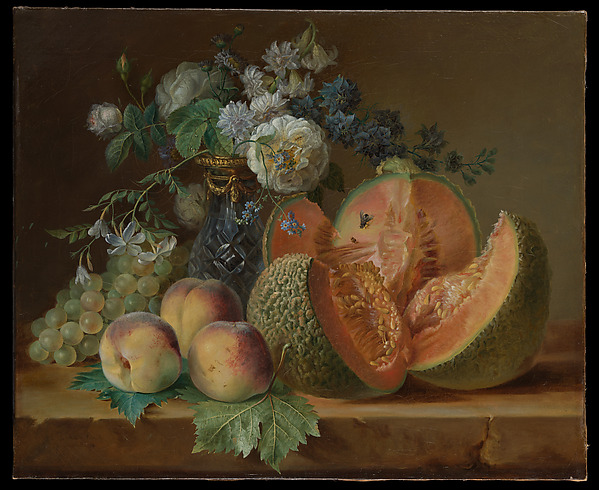
Image title: Still Life with a Vase of Flowers, Melon, Peaches, and Grapes
Medium: Oil on canvas
Date: 1780
Source:
The Met Collection
“
Every great advance in science has issued from a new audacity of the imagination.
”
— John Dewey
‘Frankenstein Palettes’: Artworks Forged from Salvaged Science
Introduction: Alchemy in the Studio
Throughout history, artists have scavenged from the world around them—plundering pigments from earth and plants, collecting objects for assemblage, and even inventing new media. But in recent decades, a unique breed of creators has foraged not in the natural world, but in the dumpsters behind laboratories and hospitals. Inspired by the madman-genius of Frankenstein, these artists breathe new life into orphaned lab glassware, worn microscope slides, chemical residues, and diagnostic imagery. Their hybrid works challenge the boundaries between art and science, repurposing the debris of inquiry into vessels of visual wonder.
19th Century Origins: The Age of Scientific Illustration
The intersection of art and science first found fertile ground in the 19th century, as advances in microscopy and chemistry revealed new visual worlds. Artists like Ernst Haeckel, whose lush lithographs of radiolarians and medusae adorned both scientific journals and art salons, blurred the line between mere documentation and aesthetic invention. Meanwhile, pigments derived from synthetic chemical processes (such as mauveine, the first aniline dye) transformed the artist’s palette, blending the laboratory and the studio. While these works observed the natural world, they already foreshadowed a future where the tools—and even the byproducts—of scientific progress would become material for creative reimagining.
The Postwar Avant-Garde: Assemblage Meets Laboratory Detritus
Fast forward to the mid-20th century, and the rise of assemblage art brought junk materials into the heart of serious art making. In postwar Europe and America, artists like Joseph Cornell and Jean Tinguely began incorporating industrial cast-offs into their creations. Medical supplies and laboratory refuse, in particular, provided evocative forms: Louise Bourgeois’ “Cells” installations often housed glass objects reminiscent of apothecary jars and slides, exploring themes of memory and the body’s interior. These “Frankenstein Palettes” recognized the symbolic and aesthetic potential of biomedical debris, transforming objects of precision and experiment into emblems of human vulnerability and technological anxiety.
The Digital Turn: Code, Imaging, and Data as Artistic Medium
The late 20th and 21st centuries witnessed another seismic shift as artists adopted not only scientific objects but also their digital byproducts. Medical imaging (MRIs, X-rays, sonograms), once strictly diagnostic, became source material for works meditating on identity, mortality, and the boundaries of self. Susan Aldworth has printed EEG brain scans onto fabric, merging neurobiology with textile craft. Eduardo Kac famously produced a glowing rabbit using genetic modification, generating debate about art’s capacity to intervene at a molecular level. Here, the “Frankenstein Palette” is not just composed of discarded objects, but of code, data, and even manipulated DNA.
Contemporary Alchemists: Environmental Ethics and Sci-Art Hybrids
Today, with greater awareness of environmental impact and e-waste, many artists salvage laboratory cast-offs as a critique of industrial waste and excessive consumption. Installation artists such as Anicka Yi use agar, petri dishes, and bacterial cultures to create immersive, living tableaux that evoke both the fragility of the biosphere and the unpredictability of scientific process. Others, like artist David Maisel, reinterpret X-rays and MRI scans of polluted landscapes, transforming toxic traces into haunting aesthetics. The new “Frankenstein Palettes” are hence both inventive and polemical, sparking debate about where art belongs in the age of rapid technological advance and ecological uncertainty.
Conclusion: Creativity’s Laboratory
From 19th-century scientific imagery to present-day biotech installations, artists working with “Frankenstein Palettes” continuously reframe the legacy of scientific exploration as one of both danger and wonder. By transforming discarded science into art, they ask us not just to see, but to question—to marvel at the tangled evolution of knowledge and creativity, and to reflect on the costs and possibilities of our curiosity. In their hands, even the leftovers of the laboratory become the crucibles of imagination.

Image description:
Barbara McClintock (1902-1992), Department of Genetics, Carnegie Institution at Cold Spring Harbor, New York, shown in her laboratory. This photograph was distributed when McClintock received the American Association of University Women Achievement Award in 1947 for her work on cytogenetics. (From http://siarchives.si.edu/collections/siris_arc_306310)
License:
Public domain
Source:
Wikimedia Commons
Useful links: