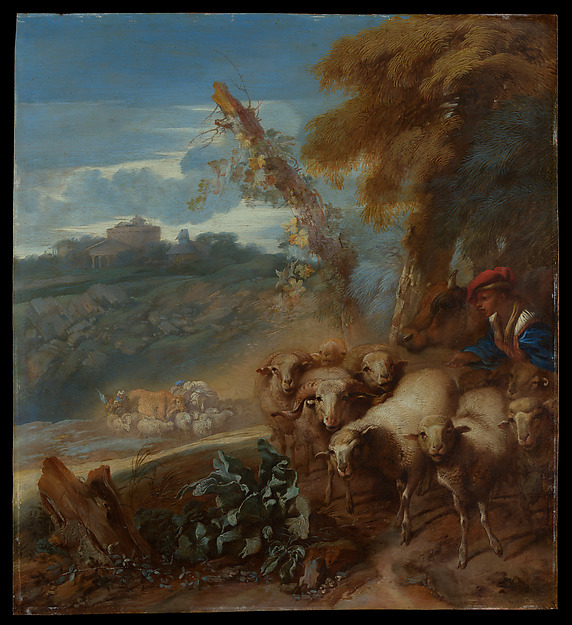
Image title: Roman Landscape with a Shepherd and Sheep
Medium: Oil on copper
Date: late 1640s
Source:
The Met Collection
“
Habit, if not resisted, soon becomes necessity.
”
— Augustine of Hippo
Eco-Activist Art: When Land Becomes Canvas—and Protest
Introduction: A World in Crisis, a Canvas Unfurled
In an age defined by environmental urgency, artists across the globe have transformed landscapes into bold statements—not merely to beautify, but to provoke and awaken. Eco-activist art, a potent blend of creativity and protest, uses earth, flora, and even the scars of human industry to demand attention to climate change and ecological destruction. This movement transcends mere aesthetics; it is a call to action, drawing upon historical roots and evolving with time, culture, and technology.
Land Art and the Radical Roots (1960s–1970s)
The story of eco-activist art begins in the 1960s and 1970s, amid a cultural shift toward environmental consciousness. In the American West, artists like Robert Smithson and Nancy Holt created monumental works such as Smithson’s Spiral Jetty (1970), a coiling earthwork on Utah’s Great Salt Lake. While not overtly activist, such land art confronted viewers with questions about human intervention and the temporality of natural systems. In parallel, the works of Agnes Denes, particularly her Wheatfield—A Confrontation (1982) in Manhattan, provocatively transformed urban spaces into ecological statements—unmistakable metaphors about the cost of progress and the vulnerability of the natural world.
Global Echoes: Environmental Art Spreads (1980s–1990s)
As environmental crises intensified, artists from diverse cultural backgrounds embraced the landscape itself as a means of protest. In Australia, the collaborative works of indigenous artists and Western eco-artists raised awareness about sacred land and the effects of mining. Europe saw the rise of Hans Haacke and Nils-Udo, who integrated ephemeral organic materials—ice, soil, leaves—directly into urban and rural settings. These works were often intentionally transient, symbolizing both ecological fragility and the fleeting nature of public attention. The increasing awareness of indigenous philosophies—emphasizing stewardship and interconnectedness—profoundly influenced the ethos of eco-activist art.
Turning Points: The Digital Age and Globalization (2000s–2010s)
The turn of the millennium brought new tools and urgency. Satellite imagery and drones enabled artists like Maya Lin and John Gerrard to create immersive installations and digital landscapes highlighting environmental devastation on a global scale. In Kenya, artists such as Cyrus Kabiru crafted sculptures from recycled waste, blending activism with commentary on local and global consumption. Technology allowed for global collaboration and unprecedented visibility, while social movements like Extinction Rebellion began to integrate art directly into protest actions—be it giant pink boats blocking city streets or mass participatory performances on beaches, spelling out messages visible only from above.
Contemporary Flourishing: Art as Direct Action (2010s–Present)
Today, eco-activist art is both protest and intervention. Guerrilla gardening, seed bombing, and living installations reclaim neglected urban landscapes, turning derelict areas into havens for biodiversity. Icelandic-Danish artist Olafur Eliasson’s Ice Watch (2014–) transported melting glacier blocks to city centers, letting viewers confront climate change by touching its icy evidence. Monica Jahan Bose’s collaborative performances along Bangladesh’s rivers unite local women, water, and sari fabric in acts highlighting rising tides and climate injustice. These works, often ephemeral or participatory, exist to spark dialogue and foster community resilience.
Philosophical Reflections and the Future
Eco-activist art is more than landscape painting or monumental sculpture. It is an evolving philosophy—melding urgency with hope, science with spirit. In a world shaped by ecological uncertainty, such art compels us to abandon the illusion of nature as passive backdrop and see ourselves as co-creators and caretakers. As technology advances and the climate crisis deepens, artists will continue to blur boundaries between protest, performance, and activism, ensuring that the living world itself remains both subject and medium.
Conclusion: Art that Endures, Protest that Grows
From the deserts of the American West to the riverbanks of Bangladesh, eco-activist art challenges, unsettles, and inspires. Whether in the form of monumental land art, fleeting organic sculptures, or digitally enhanced global protests, these works invite us all to see the Earth not only as a canvas but also as a responsibility. In their wake, they leave seeds—of awareness, of outrage, and perhaps, of renewal.

Image description:
Pieza de Land art con monedas, de Grethel, en El Sabinal
License:
CC BY-SA 4.0
Source:
Wikimedia Commons
Useful links: