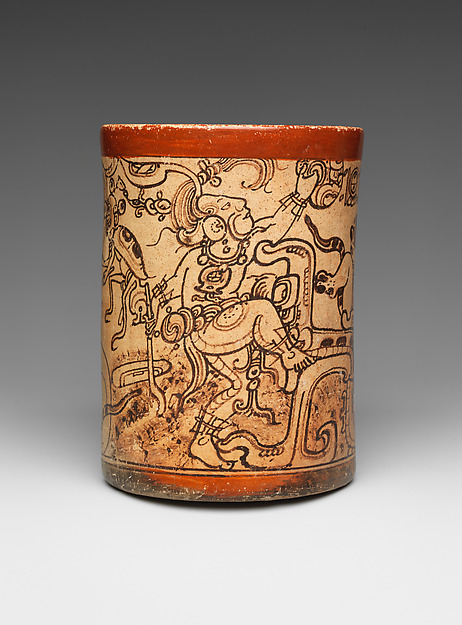
Image title: Vessel with mythological scene
Medium: Ceramic, slip
Date: 600–800 CE
Source:
The Met Collection
“
To fly, we have to have resistance.
”
— Maya Lin
Postcolonial Clay: Ceramics as Resistance Across Latin America
1. Clay Before Colonization: The Sacred Material of the Americas
Long before the arrival of European colonizers, clay was a sacred, living material in the Americas. From the Andean highlands to the Mayan lowlands, indigenous civilizations used ceramics not only for domestic purposes but also for spiritual and political expression. In these early societies, clay vessels were seen as extensions of the human body — porous, breathing entities connecting the earthly with the divine. Moche pottery depicted everyday life and ritual scenes with anthropomorphic precision, while Mayan urns carried symbols of cosmic order. Clay was both archive and offering, repository of myth and material memory.
In many indigenous traditions, particularly those of the Quechua and Mapuche, clay was a mediator between humanity and the natural world. Its tactility reinforced community and continuity across generations. The precolonial potter was not merely an artisan; she was a philosopher shaping cosmology with her hands.
2. Colonial Disruption: The Displacement of Indigenous Craft
When European colonizers arrived, they brought new materials, forms, and hierarchies of art. Indigenous ceramics were viewed as primitive, relegated to the realm of craft rather than fine art. The church and colonial authorities redirected artistic production toward religious iconography and utilitarian ware for export economies. Indigenous traditions persisted in remote regions but were often stripped of their cosmological meanings.
In this context, clay became a site of silent resistance. Local potters continued to embed native symbols and motifs beneath colonial glazes. A vessel might appear European in form but retain the curvature of ancestral rhythms. These hidden continuities reveal how colonized artists asserted identity within imposed systems. Clay’s humbleness—its earthiness—allowed it to hide rebellion in plain sight.
3. Twentieth-Century Resurgence: Craft, Modernism, and Identity
By the mid-twentieth century, Latin America’s artistic scene began to reclaim indigenous forms as emblems of authenticity. Ceramicists such as Lía Correa Morales in Argentina and Jorge Wilmot in Mexico merged pre-Columbian techniques with modernist aesthetics. The rise of indigenismo— a cultural and political movement celebrating indigenous heritage—transformed ceramics into a dialogue between past and present.
These artists emphasized material sovereignty. Clay, as a substance mined from local soils, symbolized resistance to cultural homogenization and industrial capitalism. The handmade quality of ceramic art stood in defiance of mechanized production. In Cuba and Colombia, post-revolutionary workshops promoted ceramics as both social enterprise and cultural healing, reconnecting communities to ancestral earth practices.
4. Contemporary Reclamations: Decolonizing Through Clay
Today’s Latin American ceramicists work consciously within postcolonial frameworks. Artists like Zizipho Poswa (in dialogue with global decolonial art), Mercedes Azpilicueta in Argentina, and Colectivo Cerámica Anónima harness clay to critique historical erasures. Their works fuse indigenous symbolism, feminist narratives, and ecological awareness. Clay becomes a site of epistemic resistance—challenging how knowledge, value, and beauty have been defined through colonialism.
Digital technologies have also transformed the field. Artists scan and 3D print ceramic fragments of destroyed pre-Columbian artifacts, creating hybrid pieces that question authenticity and ownership. Others experiment with sustainable, locally sourced clays that reject extractivist practices. Their work reveals a deep understanding: to reclaim clay is to reclaim land, culture, and memory.
5. The Philosophical Soil: Clay as Memory and Future
Postcolonial ceramics in Latin America personify what philosopher Walter Mignolo calls “epistemic disobedience.” They operate outside Western categories of art and craft, proposing clay as a living archive of decolonial thought. The act of shaping clay transforms the artist into both historian and healer—restoring the relationship between body, material, and territory.
As global audiences rediscover the tactile power of ceramics, Latin American artists continue to remind us that every shard carries a history of resistance. In the plasticity of clay lies resilience; in its fragility, a testament to survival. Through these artists’ hands, clay ceases to be mere matter—it becomes manifesto.
Useful links: