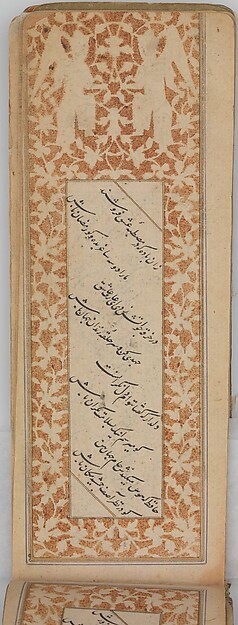
Image title: Anthology of Persian Poetry in Oblong Format (Safina)
Medium: Ink, watercolor, and gold on paper.
Binding: leather
Date: dated 905 AH/1499–1500 CE
Source:
The Met Collection
“
Setting goals is the first step in turning the invisible into the visible.
”
— Tony Robbins
Scripts on Silk: Islamic Calligraphers Turning Poetry into Power
Introduction: Letters that Wove Empires
Throughout history, few artistic traditions have transformed the written word into living art quite like Islamic calligraphy. Swirling across silk, parchment, and architectural domes, calligraphic scripts did more than adorn – they conjured spiritual presence, encoded the philosophies of saints and sultans, and even acted as diplomatic currency. “Scripts on Silk” travels across centuries and continents – from the blazing gold of Ottoman imperial decrees to Sufi poetry whispered on Persian scrolls – to uncover how Islamic calligraphers wielded words as both mystical invocation and persuasive power.
I. Early Blossoms: The Abbasid Era and the Philosophy of Beauty
The genesis of Islamic calligraphy grew from the fertile intellectual ground of the Abbasid Caliphate (8th–13th centuries). In Baghdad, reed pens danced over parchment as scribes forged scripts like Kufic and Naskh. Philosophers such as Al-Kindi and Al-Farabi mused that form and meaning could not be separated: to write beautifully was to honor the divine. Calligraphy became a direct route to transcendence. Qur’anic verses, meticulously rendered in geometric allure, whispered mystical truths to those who beheld them.
II. Persian Flourishes: Sufi Thought and the Elegance of Nastaliq
The Persianate realms gave birth to Nastaliq – a script often called the ‘bride of calligraphy.’ In the courts of Tabriz and Isfahan, poets Rumi and Hafez saw their ecstatic verses spun into silver on silk panels. For Sufis, the grace of Nastaliq was no accident: each curve mirrored the cosmic flow between lover and beloved, mortal and divine. The meditative act of copying poetry became a spiritual exercise, while royal edicts in flowing script aimed to persuade as much by aesthetic allure as by content.
III. Ottomans: Imperial Authority Inscribed in Gold
No empire brandished calligraphy as a symbol of both faith and political might like the Ottomans. Innovations like the tughra – the Ottoman ruler’s ornate monogram – adorned treaties, coins, and silken banners. These inscriptions were diplomatic masterpieces: the sultan’s signature was both a sacred invocation and a warning of imperial reach. Master calligraphers gained the status of elite courtiers, translating poetry and Qur’anic prose into public spectacle, etched onto the Hagia Sophia’s domes and the delicate walls of Topkapi Palace.
IV. Westward Winds: Maghrebi Style and Scripts as Social Contracts
In North Africa and Al-Andalus, the Maghrebi script unfurled. Broad, angular, and marked by dramatic contrasts, Maghrebi calligraphy carried both local flavor and legal authority. On silk garments, manuscripts, and city gates, calligraphic poems by Ibn Arabi channeled Andalusian mysticism. Across Morocco and Tunisia, the art of the script became not only a conduit for philosophical exchange but a way to formalize pacts, contracts, and the unspoken rules binding society together.
V. South Asian Splendors: Multilingual Scripts in Courtyard Gardens
The Mughal courts of South Asia became melting pots for Persian Nastaliq, Arabic Naskh, and indigenous scripts like Devanagari. On Kashmiri shawls, calligraphy turned fabric into living prayers. Emperors such as Akbar and Shah Jahan sponsored calligraphic masterpieces, including the inscriptions draping the Taj Mahal. Here, words bridged languages, religions, and communities, weaving mystical poetry and imperial edicts into a shimmering tapestry that was as visual as it was verbal.
Conclusion: The Modern Revival and Digital Rebirth
Today, the tradition of Islamic calligraphy is experiencing a renaissance, as artists harness digital tools to reimagine ancient scripts. Contemporary practitioners merge code and ink, bringing poetry to wearable fabrics, public murals, and even social media. “Scripts on Silk” reminds us that the power of words lies not only in their meaning but in their form – a persistent, transcendent force shaping culture, spirituality, and diplomacy across centuries.

Image description:
Ambigram Escher with two reversible hands drawing right side up and upside-down. Ambiguous image based on a symmetry of 180 degrees. Photomontage with an ambigram tessellation showing the name “Escher” in two colors using negative space upside down. M. C. Escher’s work features mathematical objects and operations including impossible objects, explorations of infinity, reflection, symmetry, perspective, and tessellations. This composition is a tribute inspired by Drawing Hands, a famous creation by Escher featuring two reversible hands drawing each other (archive).
License:
CC BY-SA 4.0
Source:
Wikimedia Commons
Useful links: