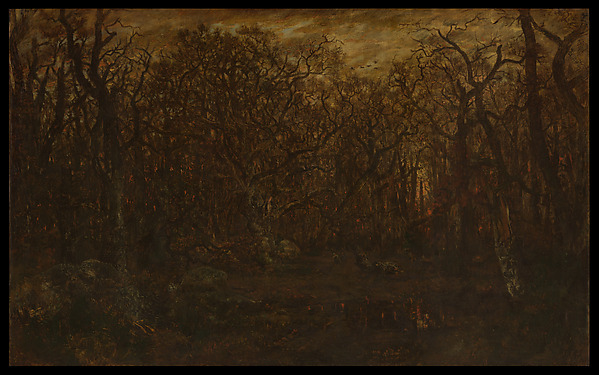
Image title: The Forest in Winter at Sunset
Medium: Oil on canvas
Date: ca. 1846–67
Source:
The Met Collection
“
With every experience, you alone are painting your own canvas, thought by thought, choice by choice.
”
— Oprah Winfrey
Visual Encryption: Secret Codes in Renaissance Painting
Introduction: The Enigmatic Language of Renaissance Art
Look closely at a Renaissance masterpiece and you may find more than sublime faces and immaculate landscapes. Beneath the lush colors and serene figures lies a hidden world of symbols, codes, and allegories — carefully constructed by artists seeking to communicate subversive messages while sidestepping the wary eyes of church and state. This world of “visual encryption” transformed painterly works into secret letters and mirrored the intellectual ferment of the age. Join us as we unravel how Renaissance painters hid complex meanings, engaged the philosophically minded, and challenged the boundaries of censorship.
1. Medieval Roots and the Emergence of Allegory
The roots of encrypted imagery stretch back to the Middle Ages, when religious art relied on a symbolic lexicon intelligible to the devout. Navigating the rigid constraints of ecclesiastical authority, artists conveyed sacred narratives through allegory: lambs for Christ, lilies for purity, flaming swords for divine wrath. Yet, Renaissance humanism ushered in a new intellectual climate, encouraging curiosity, ambiguity, and the belief that art could conceal as much as it revealed. The era’s scholars, versed in both scripture and pagan myth, became adept at reading layers of meaning — and soon, visual allegory was no longer a mere teaching tool but a playground for sophisticated secrets.
2. Humanist Philosophy and the Rise of Cryptic Symbolism
The Renaissance’s philosophical tides, buoyed by rediscovered classical texts and a spirit of scientific inquiry, inspired artists to weave increasingly complex codes into their art. Inspired by Neoplatonism and the Hermetic tradition, painters like Botticelli and Leonardo da Vinci populated their canvases with enigmatic iconography: why, for instance, does Botticelli’s ‘Primavera’ feature a mysterious number of oranges, or Leonardo’s ‘The Last Supper’ contain swirling gestures that echo mathematical ratios? Such paintings became dialogues with the learned elite, who took delight in decoding metaphors, mathematical principles, and moral riddles — art as both visual delight and intellectual challenge.
3. Patronage, Power, and Political Encryption
As city-states like Florence, Venice, and Milan vied for cultural dominance, art became inseparable from politics. Elite patrons, from the Medici family to the papacy, sought works that masked political messages in allegory or portraiture. Painters armed themselves with the visual equivalents of passwords: a laurel in a sitter’s hand might signal allegiance, while a background cityscape could signify claims to territory. Lorenzo Lotto’s ‘Portrait of Andrea Odoni’ alludes to secret affiliations and philosophical commitments via scattered antique statuettes. In this charged atmosphere, the brush became both shield and sword — protecting dissent, advertising loyalty, or discreetly mocking authority.
4. Technology: Printing, Perspective, and New Codes
The spread of print technology enabled rapid dissemination of images, further stimulating the desire for visual encryption. Artists like Albrecht Dürer embraced engravings and woodcuts as vehicles for complex emblems, visible to those who possessed the necessary key. Meanwhile, the evolution of linear perspective and anatomical precision offered new platforms for disguise: perspective lines could direct viewers to a “hidden” figure, while subtle distortions hinted at heretical ideas. The technological ingenuity of the period allowed artists to embed visual puzzles — from reversed texts to optical illusions — that would be grasped only through careful study.
5. The Legacy of Secret Codes: Interpretation and Influence
Centuries later, the study of art history is still shaped by Renaissance encryption. Decoding paintings has become an interdisciplinary pursuit, drawing on philosophy, linguistics, science, and psychology. The enduring allure of these mysteries reminds us that communication is never fully explicit — that, as with Renaissance art, meaning often lies beneath the surface, awaiting discovery by an attentive eye. Today, artists, activists, and cryptographers all inherit this legacy: the understanding that symbols can sway, protect, and provoke in equal measure, making the language of images as rich and clandestine as ever.
Conclusion: The Ongoing Art of Secrecy
Visual encryption in Renaissance painting was more than clever subterfuge—it reflected deep anxieties and revelations of an age grappling with knowledge, power, and spiritual uncertainty. Through symbols and codes, artists communicated with the elite and preserved dangerous ideas for posterity. As we gaze anew at these masterpieces, we step into an age-old conversation—one still ripe with secrets, for those who dare to look closer.

Image description:
The metadata below describe the original scanning. Follow the “All Files: HTTP” link in the “View the book” box to the left to find XML files that contain more metadata about the original images and the derived formats (OCR results, PDF etc.). See also the <a href=”https://archive.org/about/faqs.php#140″ rel=”nofollow”>What is the directory structure for the texts?</a> FAQ for information about file content and naming conventions.
Bibliography: p. [343]-349
Subjects: Christian art and symbolism; Animals in art; Church architecture
License:
Public domain
Source:
Wikimedia Commons
Useful links: