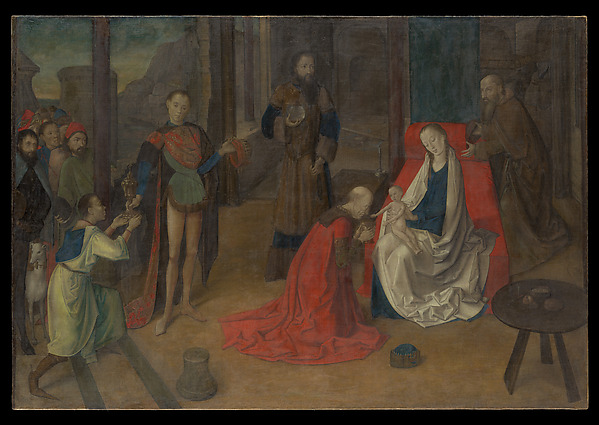
Image title: The Adoration of the Magi
Medium: Distemper on canvas
Date: 1472–74
Source:
The Met Collection
“
If you don’t design your own life plan, chances are you’ll fall into someone else’s plan. And guess what they have planned for you? Not much.
”
— Jim Rohn
Mirrors of Heaven: Islamic Geometry and Cosmic Design
Introduction: The Geometry of the Infinite
From the tiled courtyards of Andalusian mosques to the honeycomb vaults of Persian madrasas, Islamic geometric art evokes an overwhelming sense of order and transcendence. Unlike Western representational art traditions, Islamic artisans built visual worlds around pattern, proportion, and repetition—forms that symbolize a divine order beyond the human figure. Geometry became both devotion and design: a scientific exploration of the infinite, rendered with compass and rule. These symmetries reflect an ancient understanding that beauty arises from harmony, and that harmony itself echoes the structure of the cosmos.
Chapter I: The Early Foundations — From Byzantium to Baghdad
The origins of Islamic geometric ornamentation lie in the fertile intellectual currents of the early Islamic empire. When the Abbasid caliphs established Baghdad in the eighth century, they inherited the mathematical traditions of Greece and Rome through Byzantine intermediaries. Under their patronage, scholars translated Euclid and Ptolemy, merging geometry with the new monotheistic worldview of Islam. Early architectural examples, such as the Great Mosque of Kairouan, reveal geometric bands and interlaced forms that not only embellish sacred architecture but also embody the rhythms of divine creation.
Chapter II: The Persian Apex — Infinity in Tile and Light
By the Seljuk and later the Safavid dynasties, mathematicians and artisans in Persia developed geometric styles of astonishing sophistication. The madrasas of Isfahan and the domes of Yazd bear intricate star patterns—5-, 7-, and 10-pointed—woven seamlessly into architectural logic. Here, geometry functions as a disciplined meditation. Craftsmen used girih tiles—combinations of decagons, pentagons, and rhombi—to structure infinitely extendable patterns. The spiritual architecture of the period wove light and reflection into this geometry, transforming surfaces into metaphysical spaces that dissolve the boundary between earthly matter and celestial order.
Chapter III: The Andalusian Synthesis — Science and Ornament at Al-Andalus
In medieval Spain, Islamic geometry reached radiant expression in the Alhambra of Granada. Its walls unfold in a cascade of muqarnas vaults and glazed arabesques, forming an encyclopedic display of mathematical thought. The architects of Al-Andalus absorbed North African, Persian, and local Iberian influences, translating them into an architecture of contemplation. The scientists of nearby Córdoba—a center of astronomical and mathematical study—shared intellectual space with artisans who transformed numbers into beauty. In these halls, pattern serves not mere decoration but revelation: each motif mirrors the order of the heavens as perceived through both reason and faith.
Chapter IV: Ottoman Innovations — From Calligraphy to Structure
Under the Ottomans, the principles of geometric order evolved to include calligraphic harmony and complex architectural integration. The tilework of the Süleymaniye Mosque and the designs of Iznik pottery reveal balance between geometry and arabesque, mathematics and text. Here, geometry became the unifying language linking ornament, calligraphy, and architecture. Symbolically, these designs conveyed the empire’s philosophy of universal order rooted in divine unity—’tawhid’—through endlessly repeating yet perfectly balanced forms. The mathematics of the infinite found structural expression, merging visual perfection with spatial transcendence.
Chapter V: Modern Resonance — From Pattern to Algorithm
In the twentieth and twenty-first centuries, the logic of Islamic geometric design has found renewed inspiration among artists, architects, and digital designers. Figures such as M.C. Escher, fascinated by tessellation, and contemporary Muslim artists using generative software, reinterpret traditional motifs through mathematical algorithms. Technology now allows us to model what ancient craftsmen did by hand—the creation of infinite, self-replicating systems that evoke celestial harmony. The geometry that once adorned mosque domes now animates virtual spaces, reminding us that the visual languages of spirituality and science often share the same syntax of numbers and proportion.
Conclusion: Unity Reflected in Pattern
Islamic geometric art stands as one of humanity’s most profound visual meditations on cosmic unity. Each shape, each repetition, becomes a mirror of divine logic—an expression of order arising from the infinite. Whether viewed on the glazed tiles of Isfahan or within the digital codes of modern design, these patterns remain radiant mirrors of heaven, inviting us to glimpse the sacred mathematics underlying the universe itself.
Useful links: