Image title: Lupona (royal seat)
Medium: Wood, metal studs
Date: ca. 1840–1870
Source:
The Met Collection
“
Never say there is nothing beautiful in the world anymore. There is always something to make you wonder in the shape of a tree, the trembling of a leaf.
”
— Albert Schweitzer
The Shape of Memory: Sculpting Trauma in Postwar Europe
Introduction: The Weight of Remembering
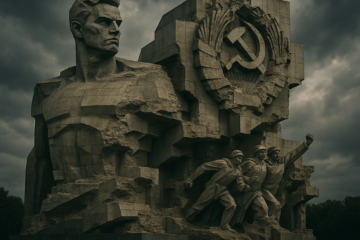
In the ashes of the Second World War, Europe became a continent of ruins—not only of buildings and bodies but of meaning. Artists faced an urgent question: how could form, weight, and texture express the unspeakable? Sculpture, with its tactile engagement with material and space, emerged as a crucial art form for working through trauma. The postwar generation of sculptors redefined memory itself, transforming industrial remnants—steel, iron, concrete—into vessels of grief and testimony. This was not sculpture as beauty or monumentality in the old sense, but sculpture as survival, as witness, as echo.
I. The Fragmented Body: Post-1945 Reconstruction and Existential Form
In the immediate aftermath of 1945, artists such as Alberto Giacometti and Germaine Richier explored the human form as a kind of ruin. Limbs were elongated, torsos dismembered, faces erased—a reflection of Europe’s spiritual and physical disintegration. Giacometti’s spindly figures seemed to resist solidity, hovering between presence and absence, as if sculpted from the same dust that covered bombed cities. These were not heroic nudes in the classical sense, but emblems of existential fragility. Philosophically, this mirrored Jean-Paul Sartre and Simone de Beauvoir’s existential humanism: the idea that we must invent meaning in the void left by catastrophe.
II. Monuments of Steel and Silence: Industrial Memory and Modernist Minimalism
As Europe rebuilt in the 1950s and 1960s, a new material reality took shape—factories, highways, steel bridges. Sculptors turned to these materials, not to celebrate industry but to replay its ambiguities. Richard Serra’s titanic steel arcs, for instance, evoke both the power of modern production and the menace of confinement. Meanwhile, the German artist Fritz Koenig’s memorial works, such as those for concentration camps, wielded cold metal as an emblem of endurance and warning. The resonance of rust, oxidation, and weight became metaphors for historical process: time itself engraving its own memorials into matter.
III. Abstract Grief: The Turn Toward Minimal and Conceptual Forms
In the 1960s and 1970s, memory took on an abstract dimension. Sculptors began to strip away figuration altogether, seeking to evoke trauma through absence rather than representation. British sculptors like Antony Caro and Eduardo Paolozzi assembled found elements of war machinery, while Polish and Czech artists worked covertly under authoritarian regimes, embedding veiled commentaries on violence within abstract geometries. This period corresponded to the emergence of psychoanalytic and structuralist thought in Europe: the recognition that memory may be more spatial than narrative, more felt than seen. The sculpture became a site—an architectural void—where the viewer’s own recollection was invited, even demanded.
IV. Memory in Public Space: The Rise of the Memorial as a Social Sculpture
By the 1980s, Europe’s trauma had become official, institutionalized in memorial commissions across the continent. This era saw the emergence of the memorial as a form of social sculpture—an engagement with history that also demanded public participation. Jochen Gerz and Esther Shalev-Gerz’s project The Invisible Monument in Saarbrücken, for instance, inverted the idea of permanence by burying engraved metal plaques beneath the square. Such gestures drew from the conceptual lineage of Joseph Beuys, who declared that ‘everyone is an artist’ in shaping collective consciousness. Memory was no longer static; it was an evolving dialogue between past and present, body and site.
V. From Ashes to Algorithm: Digital Reconstruction and the Future of Memory
Today, the legacy of postwar sculptural practice extends into digital and virtual realms. Artists employ 3D scanning, augmented reality, and recycled materials to evoke the persistence of memory in an age of simulation. The industrial scrap of mid-century memorials has become data and light, yet the ethical question remains identical: how to remember without monumentalizing suffering? Projects that map destroyed cities through digital sculpture—such as those by Polish and Baltic new media artists—echo the midcentury sculptors’ determination to give trauma a form that resists closure.
Conclusion: The Shape That Endures
The sculptors of postwar Europe transformed the detritus of war into art that could still breathe, speak, and witness. Their work redefined the purpose of sculpture—from the celebration of heroes to the acknowledgment of wounds. In the industrial age, art seized materials of destruction to articulate continuity; in the digital age, we inherit that same impulse through code and simulation. The shape of memory, in the end, is not fixed but continually forged—each generation chiseling its own silhouette of survival into the landscape of history.
Useful links: