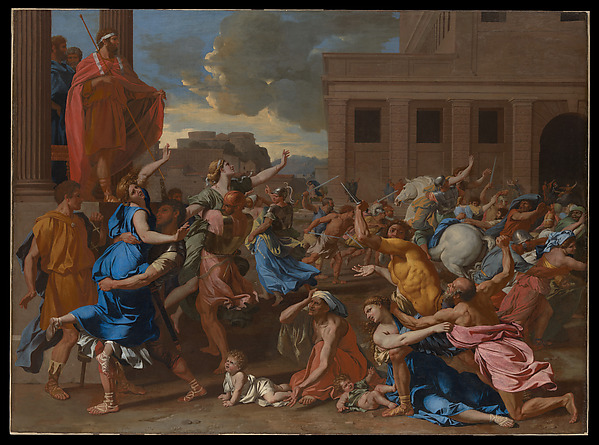
Image title: The Abduction of the Sabine Women
Medium: Oil on canvas
Date: probably 1633–34
Source:
The Met Collection
“
If you have a harem of 40 women, you never get to know any of them very well.
”
— Warren Buffett
Women with Hammers: Rewriting Sculpture’s Gender Narrative
1. The Marble Ceiling: Women at the Margins of Sculpture
For centuries, sculpture was considered the ultimate test of artistic strength—a domain defined by physical power, endurance, and mastery over heavy materials. From the Greek canon of Phidias and Praxiteles to the Renaissance revival under Michelangelo, sculpting was not only about artistry but also about control over matter itself. Women, bound by social and educational limitations, were systematically excluded from the chiseling of stone and casting of bronze. The tools of the trade—mallets, chisels, and anvils—became emblematic of masculine creativity. Despite these barriers, women found peripheral participation through less monumental forms such as clay modeling and craftwork, laying the groundwork for future breakthroughs.
It was not an absence of talent that kept women from sculpture, but rather the rigid architecture of artistic institutions. Access to life drawing classes—a crucial foundation for sculptural study—was often denied to them until the late nineteenth century. Sculpture’s gender narrative, thus, began as one of exclusion, silence, and constrained potential.
2. Chisels in Hand: The 19th Century and Female Emergence
The late nineteenth century marked a shift in access and perception. As industrialization reshaped labor and education, women gained opportunities to study art formally in Europe and America. Sculptors like Harriet Hosmer, Edmonia Lewis, and Camille Claudel entered the scene, embodying new possibilities. Hosmer’s neoclassical works radiated both technical precision and intellectual ambition, while Lewis, of African American and Native heritage, defied racial and gender stereotypes in Rome’s expatriate art community. Claudel, once viewed only through her connection to Rodin, was in fact a radical innovator who infused emotional intensity and psychological nuance into marble.
This period saw women claiming their place in the studios, modeling workshops, and exhibitions that had long excluded them. Marble ceased to symbolize male dominance alone; it became a medium for female assertion and storytelling. The sculptural hammer was, at last, held by new hands.
3. The Modern Break: Material, Identity, and the Language of Form
With the rise of modernism in the early twentieth century, sculpture’s boundaries expanded—and with them, the opportunities for women artists. Barbara Hepworth and Louise Nevelson epitomized this transformation. Hepworth’s organic abstractions embodied both harmony and resistance, integrating notions of motherhood, landscape, and spirituality. Nevelson, meanwhile, turned discarded wood into monumental arrangements, transforming the detritus of industrial civilization into complex psychological landscapes.
Their work questioned not just gender norms but also art’s essence—what materials could signify, and who could command them. Sculpture evolved from a mere manipulation of stone and bronze into a language of form, space, and rhythm. Women no longer sculpted in defiance of tradition; they redefined tradition itself, emphasizing process over monumentality and intuition over hierarchy.
4. Fragmented Bodies, Reconstructed Identities: Post-1960 Feminist Sculpture
The rise of feminist art in the 1960s and 70s further dismantled the patriarchal underpinnings of artistic creation. Where male modernists pursued formal autonomy, feminist sculptors infused art with lived experience, body politics, and narrative. Artists like Lynda Benglis, Eva Hesse, and Faith Ringgold blurred the lines between fine art and craft, reclaiming materials historically coded as feminine—latex, fabric, resin—as vehicles of conceptual power.
These artists introduced a sculptural vocabulary based on multiplicity and impermanence, resisting the permanence that once symbolized male authorship. Their works did not merely occupy space; they questioned who was allowed to claim space. The hammer became both a metaphor and a manifesto—an emblem of dismantling oppressive forms while forging new ones.
5. Digital Chisels and Contemporary Resonance
Today, the hammer takes many forms: 3D modeling software, robotic carving tools, and augmented reality installations have expanded what sculpture means. Contemporary sculptors such as Simone Leigh and Rachel Whiteread continue to interrogate materiality, heritage, and memory. Leigh’s ceramic and bronze works, rooted in African diasporic traditions, assert the cultural strength of Black womanhood, while Whiteread’s casts of domestic spaces transform absence into monumental presence.
The digital age introduces new questions—what does authorship mean when machines model stone? How do gender and identity manifest within virtual sculpture? Women are not merely reclaiming sculpture’s past; they are reshaping its future by redefining both process and meaning. The hammer, once a symbol of exclusion, has become a tool of liberation, invention, and storytelling.
6. Conclusion: Forging a New Legacy
The history of sculpture, long dominated by masculine mythology, now unfolds as a dialogue of equity and innovation. Women with hammers have not only rewritten art’s gender narrative—they have expanded the very language of sculpture itself. From marble to algorithms, from silence to resonance, their journey continues to shape how we understand creation, power, and the enduring human desire to give form to thought.
Useful links: