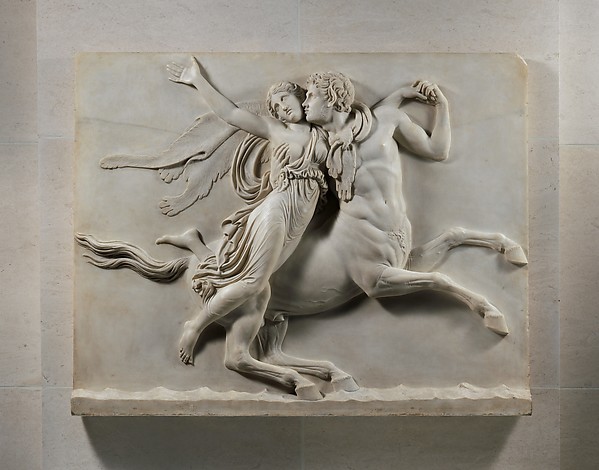
Image title: Nessus Abducting Dejanira
Medium: Marble
Date: modeled 1814–15, carved 1821–23 or 1826
Source:
The Met Collection
“
Myths which are believed in tend to become true.
”
— George Orwell
Clay and Cosmos: Sculpting Myths of the Universe
1. Shaping the Skies: Cosmic Imagery in Ancient Mesopotamia
In the cradle of civilization—ancient Mesopotamia—artists shaped their beliefs about the cosmos into enduring forms of clay and stone. Among the earliest sculptural records of the universe are Babylonian reliefs and cylinder seals depicting cosmic deities such as Anu, the sky god, and Ishtar, the bright morning star. These artists worked at a time when the heavens were not yet abstract concepts but living presences influencing earthly affairs. Through clay tablets inscribed with star charts and reliefs carved on palace walls, the divine order of the heavens was manifested in tactile form. Sculpture here was a form of communication—an attempt to give substance to the unseen architecture of celestial power.
Clay was more than material; it was myth made tangible. The same earth used to build cities was shaped into cosmic beings, illustrating the intertwined relationship between creation, ritual, and the vast unknown above. Sculptors, by manipulating earth, were in some sense participating in the divine act of forming the world.
2. Celestial Harmony in the Classical and Eastern Traditions
As civilizations expanded, so too did their visions of the cosmos. In ancient Greece, the sculpted figure of Atlas, condemned to bear the heavens, served as both myth and metaphor—a testament to human endurance beneath celestial weight. Greek sculptors, devoted to proportion and harmony, viewed their art as the embodiment of cosmic order. The perfection of the human body echoed the balance of the spheres described by philosophers like Pythagoras and Plato.
Meanwhile, in ancient India and China, sculptors sought to reveal the interconnectedness of all existence. In Buddhist art, cosmic mandalas were carved into temple walls, their symmetrical geometry reflecting the infinite cycle of life and cosmic rebirth. Chinese sculptors of the Han and Tang dynasties translated cosmological belief into bronze and jade, creating miniature models of heaven and earth that bridged spiritual and material realms. In all cases, sculpture functioned as a cosmic map, guiding the viewer from the human plane toward transcendence.
3. Renaissance to Enlightenment: From Cosmic Allegory to Empirical Awe
The Renaissance brought a new fascination with both the physical and metaphysical universe. Artists like Michelangelo infused divine creation with human anatomy, fusing science, religion, and art into a single language of cosmic beauty. Sculpture became an act of philosophical exploration—probing the relationship between divine intelligence and material substance.
As Europe shifted into the age of reason, the celestial sphere was no longer seen purely as mythic territory but as a measurable domain. Planetary models and orreries—often beautifully sculpted in brass and wood—embodied this new curiosity. Yet, even as telescopes expanded the limits of perception, sculptors continued to translate cosmic wonder into tangible form. Baroque artists dramatized heavenly ascent through spiraling compositions, mirroring the infinite motion of galaxies yet to be discovered.
4. The Modern Turn: Cosmic Forms in a Technological Universe
By the twentieth century, sculptors confronted a cosmos transformed by physics and technology. The mythic heavens of old had become dynamic systems of energy, matter, and space-time. Artists like Constantin Brâncuși, Barbara Hepworth, and Isamu Noguchi turned to abstract forms to express universal relationships—curves and voids suggesting gravitational pull, space, and emergence. Brâncuși’s “Bird in Space,” for instance, conveys the upward thrust of cosmic energy, bridging earth and sky through minimalist transcendence.
At the same time, the discoveries of Einstein and Hubble reshaped visual imagination. Sculptors began to explore relativity, quantum mechanics, and the birth of galaxies through their materials. Welding, casting, and industrial fabrication allowed them to mimic natural processes of stellar formation, while the new discipline of kinetic sculpture brought motion—and by extension, the passing of cosmic time—into art.
5. Contemporary Horizons: Clay, Code, and the Infinite Unknown
Today, the cosmos is more than symbol—it is subject, medium, and metaphor. Contemporary sculptors and ceramicists fuse traditional materials with cutting-edge technology to explore humanity’s place in the universe. Artists form black hole-inspired clay vortexes, sculpt galactic spirals in porcelain, or use 3D printing to recreate astronomical data in tactile form. The boundary between myth and science dissolves once again, recalling the ancient intertwining of story, star, and substance.
Philosophically, this era represents a return to origins. Clay—earth’s most primordial material—is used to imagine the cosmos not as a distant abstraction but as part of our collective body. Digital tools allow artists to model the invisible structures of spacetime, while ceramics ground those visions in tactile truth. As ancient Babylonian reliefs once did, these contemporary works remind us that to sculpt the universe is to shape our understanding of existence itself—a cosmic journey inscribed in the enduring language of form.
Useful links: