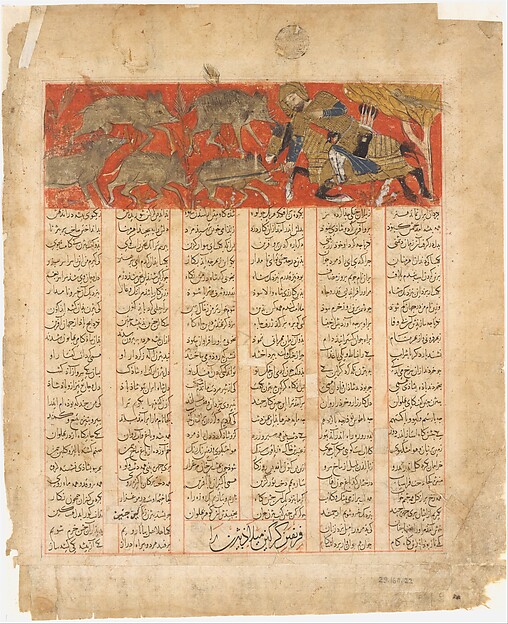
Image title: “Bizhan Slaughters the Wild Boars of Irman”, Folio from a Shahnama (Book of Kings)
Medium: Ink, opaque watercolor, and gold on paper
Date: dated 741 AH/1341 CE
Source:
The Met Collection
“
The art challenges the technology, and the technology inspires the art.
”
— John Lasseter
Tattooed Histories: Body Art as Living Archive
Introduction: The Skin as Canvas and Chronicle
For millennia, the human body has served not only as a vessel for life but also as a canvas for cultural memory. Tattoos, more than ephemeral fashion statements, have functioned as markers of identity, ritual, and resistance—from the tribal inkings of ancient societies to the avant-garde performances of modern artists. The skin becomes an archive, each line and symbol a record of personal and collective history. This exploration journeys through centuries of tattooing, tracing how body art evolved as a dialogue between the individual and society, the sacred and the aesthetic.
Chapter I: Origins in Ritual and Tribe
The earliest evidence of tattooing dates back to around 3300 BCE, discovered on the preserved body of Ötzi the Iceman. His skin bore carbon ink marks that likely held therapeutic significance. Meanwhile, Indigenous cultures across the world—from the Māori in Aotearoa New Zealand to the Inuit in the Arctic—used tattooing as a vital aspect of social and spiritual life. For the Māori, the intricate moko represented genealogy and social rank, with each spiral and line mapping ancestral stories onto the body. Similarly, in Polynesian and Philippine societies, tattooing was a rite of passage, denoting bravery and belonging. The act of piercing the skin was both sacred and communal, embedding cultural continuity directly into human flesh.
Chapter II: Colonial Encounters and the Body as Resistance
When European explorers reached the Pacific, they encountered tattooing as a profound cultural art form—an art they misunderstood and often suppressed. Tattoos, once symbols of pride, were reinterpreted through the lens of colonial moralism as signs of savagery. Yet for many Indigenous peoples, the persistence of tattoo traditions became a quiet form of rebellion. In the late 19th century, Polynesian and Native American communities revived ancestral designs as an assertion of heritage and autonomy, making the skin itself a site of anticolonial resistance. Even among sailors, who adopted tattooing from their encounters abroad, body art became a badge of travel, endurance, and defiance—marking one’s body with the same permanence as the horizons they crossed.
Chapter III: Tattooing and the Modernist Eye
The 19th and early 20th centuries saw tattooing enter Western urban life, transforming from taboo to curiosity to art. The invention of the electric tattoo machine in 1891 by Samuel O’Reilly revolutionized accessibility and precision. Suddenly, tattoo parlors appeared in major cities from New York to London, and tattooers like Charlie Wagner gained notoriety for combining folk craft with graphic design. Modernist artists observed this shift with fascination. The surrealists admired body art for its direct emotional rawness—a living surrealism in motion. For figures such as Jean Dubuffet, tattooed bodies represented a challenge to the rigidity of academic art, blurring boundaries between trained and vernacular creativity.
Chapter IV: From Counterculture to High Art
In the latter half of the 20th century, tattoos became entwined with subcultures—sailors, bikers, punks, and queer communities reclaiming their bodies as sites of self-definition. Artists like Sailor Jerry and Ed Hardy contributed to the visual lexicon of modern tattoo styles, blending Japanese woodblock influences with Western iconography. Later, performance artists such as Orlan and Stelarc expanded tattooing into conceptual territory, treating the body as a mutable object—enhanced, mapped, and inscribed to expose the instability of identity. The avant-garde began to view the tattooed body as both artwork and archive, its ink a script of lived philosophy and rebellion against conformity.
Chapter V: Digital Ink and the Future of Body Art
Today, tattooing stands at a crossroad between tradition and technology. In Indigenous communities, tattoo revitalization movements are restoring spiritual and cultural practices once erased by colonial powers. Simultaneously, tattoo artists use digital tools to plan and simulate complex designs, merging ancestral craftsmanship with precision technology. Experimental practices—bio-luminescent inks, augmented reality tattoos, and data-encoded designs—extend the concept of inked skin into the realm of bio-art. Yet, at its core, tattooing remains what it has always been: an act of storytelling. Whether etched by stone or laser, the tattoo marks a personal covenant with time itself—a reminder that history can live and breathe beneath the surface of the skin.
Conclusion: The Archive That Breathes
As we consider tattooing across centuries, its dual role as expression and documentation becomes evident. Each work of body art inscribes more than aesthetic beauty—it maps the flow of cultural memory. From Indigenous cosmologies to performance art galleries, tattoos unite the human desire to record existence with the need to belong. In every indelible mark is both history and hope: a living archive, written not on parchment or canvas, but on the most intimate surface of all—the human body.
Useful links: