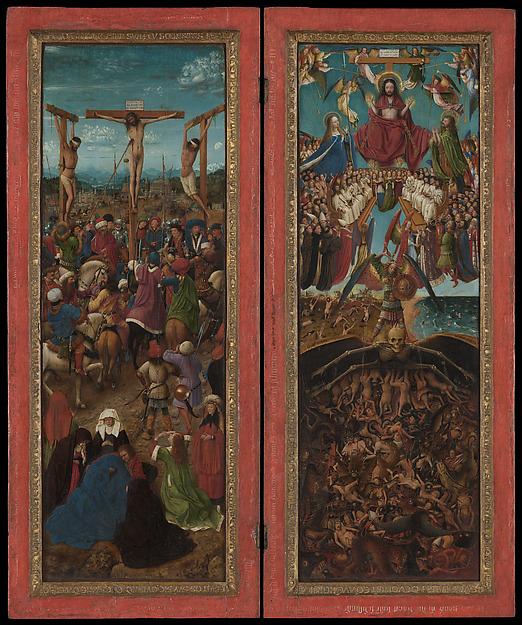
Image title: The Crucifixion; The Last Judgment
Medium: Oil on canvas, transferred from wood
Date: ca. 1436–38
Source:
The Met Collection
“
In all chaos there is a cosmos, in all disorder a secret order.
”
— Carl Jung
From Cosmos to Canvas: Astronomical Themes in Islamic Geometric Design
Introduction: Mapping the Heavens through Art
Throughout Islamic history, geometry functioned as both a language and a philosophy. At its core, it expressed divine unity—the oneness of God—through an ordered, mathematical beauty that resonated with the very structure of the cosmos. Medieval Islamic scholars, who were equally mathematicians, astronomers, and artists, saw no division between scientific observation and spiritual reflection. Their geometric designs on tiles, domes, and manuscripts were not mere decoration but an artistic manifestation of the order and harmony they discerned in the universe above.
In this exploration, we journey through the evolution of astronomical and geometric art in Islamic civilization, tracing how cosmic wonder inspired visual perfection and transformed into patterns that quietly mirrored the heavens.
Chapter 1: Geometry and Revelation in the Early Islamic World
Following the rise of Islam in the 7th century, intellectual and artistic efforts converged on a single principle: tawḥīd, or divine unity. The Qur’an’s references to cosmic order—the stars fixed in their celestial courses, the mighty balance of creation—encouraged scholars to seek knowledge about the structure of existence. Mathematicians from Baghdad’s Bayt al-Hikma, the House of Wisdom, began translating Greek and Persian works on geometry and astronomy. From Euclid’s “Elements” to Ptolemy’s “Almagest,” the mathematical order of the universe became a spiritual key to envisioning the infinity of God’s creation. This scientific grounding soon infused artistic practice. Early mosques such as the Great Mosque of Kairouan integrated intricate mosaics whose repeating geometric forms suggested infinite continuity—an earthly reflection of the cosmic order itself.
Chapter 2: The Golden Age—Science, Art, and the Infinite Pattern
By the 9th to 12th centuries, Islamic cities like Baghdad, Cordoba, and Cairo became crucibles of intellectual fusion. Astronomers such as Al-Khwarizmi and Al-Battani refined mathematical precision, creating trigonometric tools that would later guide artisans in constructing complex geometric patterns. The golden age saw a cultural conviction: geometry was not just structure—it was revelation. Artists used compass and straightedge to build star polygons, radiating tessellations, and interlacing lines that echoed planetary orbits and celestial spheres. The mosque dome, an architectural symbol of the heavens, often bore elaborate muqarnas—stalactite-like decorations that fragmented light as if to imitate the vast constellations above. These visual symmetries made each surface a reflective cosmos, uniting sacred architecture with the harmony of the stars.
Chapter 3: Andalusian Brilliance—Crossroads of Physics and Faith
In Muslim Spain, or Al-Andalus, the dialogue between science and art reached new levels of sophistication. Granada’s Alhambra Palace, built between the 13th and 15th centuries, remains one of the finest manifestations of cosmic geometry. The mathematical artistry of its tilework employs repeating decagons, pentagons, and stars—forms that subtly allude to planetary motion and the celestial balance of the universe. Andalusian scholars such as Ibn Rushd (Averroes) and Ibn al-Haytham contributed to optical science and philosophical thought, influencing how light, symmetry, and space were conceived in artistic terms. In Al-Andalus, geometry was both metaphor and model: infinite repetition suggested divine infinitude, while precise ratio and proportion mirrored the balance that sustains the heavens.
Chapter 4: Cosmic Knowledge in Persian and Central Asian Art
By the 15th century, regions like Persia, Central Asia, and the Ottoman Empire inherited—and expanded—the fusion of astronomy and aesthetics. In Timurid and Safavid manuscripts, celestial charts became works of art, blending gold illumination with accurate astronomical diagrams. Mathematical treatises like those by Ulugh Beg, the scholar-king of Samarkand, not only advanced star mapping but also elevated the geometric arts to a cosmological level. Persian tile work, with its deep azure hues and radiating mandala-like forms, visually linked earth and sky. The madrasas of Isfahan glimmered like cosmic maps, their rhythmic arabesques channeling the silent choreography of planets and stars. Here, geometry transcended mere decoration; it embodied a universal logic believed to harmonize with divine reason.
Chapter 5: Legacy and Modern Resonance
The endurance of Islamic geometric design into modernity reveals its profound adaptability. Today, artists, architects, and digital designers draw on medieval Islamic geometry to explore the dialogues between science, religion, and technology. The ordered infinity of pattern-making anticipates principles of fractal geometry and algorithmic design, suggesting Islam’s historical pattern-makers were, in essence, early computational artists. Contemporary installations, from London to Doha, reinterpret these forms through laser-cut metalwork and digital projection, transforming ancient geometry into living, luminous constellations of light. The universe continues to inspire the canvas, reminding us that the search for pattern—for meaning in the cosmos—remains eternally human.
Conclusion: The Art of the Infinite
From the domes of Samarkand to the tiles of Granada, Islamic geometric design reflects an enduring human impulse to map the heavens not only as astronomers but as artists. Medieval mathematicians turned the abstraction of numbers into the poetry of form, translating the cosmos into art. Through their work, the boundary between science and spirituality dissolved, leaving behind a visual symphony where each repeating pattern whispered of divine order—an infinite geometry extending from the heavenly to the human realm.
Useful links: