The Bauhaus Legacy: Streamlining the Modern World

Introduction: A Revolution in Form and Function The Bauhaus was more than a design school—it was a radical movement that reshaped the visual language of the 20th century. Founded in 1919 in Weimar, Germany, by architect Walter Gropius, the Bauhaus emerged at a time when European society was grappling with the aftermath of the First World War. The school’s mission was clear: to reunite art and craft in the service of a new, industrialized society. Read more…

Velázquez and the Mirror: Power and Illusion in ‘Las Meninas’

Introduction: The Puzzle of the Spanish Court Diego Velázquez’s 1656 masterpiece, Las Meninas, is often described as a visual enigma—a profound meditation on perception, authorship, and hierarchical power hidden within the canvas of a royal portrait. Created during Spain’s Golden Age, the painting transcends any traditional label of ‘portrait’ or ‘genre scene’; instead, it occupies a shifting threshold where viewer and subject trade places, where mirrors reflect more than light, and where illusion becomes a Read more…

Fresco & Awakening: The Renaissance Ceiling as Political Metaphor

Introduction: Architecture of the Divine and Earthly Power When one tilts their head to gaze upon the Sistine Chapel ceiling, they are not merely admiring a masterpiece of religious art—they are entering a potent visual dialogue between theology, humanism, and political authority. During the Renaissance, frescos painted on ceilings became more than decorative artistry; they were immersive cosmologies that symbolized the convergence of divine order and earthly rule. Michelangelo’s famed frescoes do more than illustrate Read more…

From Cave Walls to Code: A Brief History of Art’s Evolution

Introduction: The Eternal Urge to Create Art has always been a mirror of humanity’s inner world—a visual language through which societies record, question, and redefine their place in the cosmos. From the flickering linework on prehistoric cave walls to the infinite permutations of generative AI compositions, the story of visual art is inseparable from the story of human consciousness and technology. As we trace art’s trajectory through history, we uncover not only changing aesthetics but Read more…

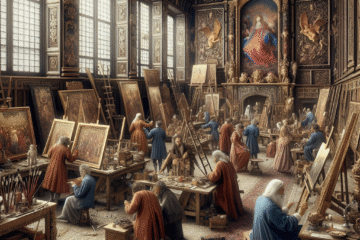
The Studio as Sacred Space: Artists and Their Creative Sanctuaries

From the paint-splattered walls of 17th-century ateliers to the immersive installations of today’s visionaries, the artist’s studio has long been more than a mere room—it is a sanctuary where gestures become history and sparks of imagination ignite revolutions. The studio, whether sparse or elaborate, reflects the psyche of its inhabitant and becomes an extension of their creative world. In this exploration, we delve into the evolution of the artist’s studio across five eras, revealing how Read more…

Kandinsky and Synesthesia: Painting the Music of the Soul

Introduction: The Colors That Could Sing Imagine a world where colors hum, shapes resonate like tones, and a canvas becomes an orchestral stage. For Wassily Kandinsky (1866–1944), this wasn’t imagination—it was experience. Recognized as one of the pioneers of abstract art, Kandinsky based his oeuvre on a unique fusion of senses known as synesthesia, where stimulation of one sensory pathway involuntarily triggers another. In his case, colors sounded and music painted images on the canvas Read more…

The Global Baroque: Beyond Europe

Introduction: Rethinking the Baroque When we speak of the Baroque, images of opulent cathedrals in Rome, shadow-laden canvases by Caravaggio, or the grandeur of Versailles often spring to mind. Yet, Baroque was never just a European phenomenon. As empires expanded, trade flourished, and missionaries traveled, the Baroque style traversed continents—morphing, adapting, and merging with local traditions in astonishing ways. What emerges is a picture of a fluid artistic language, simultaneously global and deeply local. This Read more…

From Cave Walls to Code: A Brief History of Art’s Evolution

Introduction: Art as a Mirror of Human Consciousness From the moment early humans etched images on cave walls, visual art has served as much more than mere decoration—it has been a mirror of collective consciousness, a vessel for spiritual yearning, and a chronicle of societal change. Over millennia, as humans evolved, so too did their tools, beliefs, and modes of expression, leading to an extraordinary journey of artistic transformation. From soot and stone to pixels Read more…

Rebels with a Cause: Caravaggio and the Birth of the Baroque

Introduction: A Shadow Falls Across the Renaissance When Michelangelo Merisi da Caravaggio stormed onto the art scene in late 16th-century Rome, he didn’t just add to the ongoing artistic conversation—he upended it. In an era marked by the refined grace of Mannerism and the lingering ideals of Renaissance classicism, Caravaggio painted saints as earthy peasants, gave villains the dignity of Greek gods, and bathed his canvases in unrelenting, theatrical light. His work spawned both admiration Read more…

Kazimir Malevich’s Black Square: Nothing or Everything?

Introduction: A Square That Shook the World When Kazimir Malevich unveiled his painting Black Square in 1915, the art world gasped—some in admiration, others in outrage, and many in disbelief. A black square on a white background, unadorned by detail or figure, the painting was unlike anything the public had seen. Yet in its stark minimalism, it represented something monumental. Was it a declaration of artistic death or the genesis of a new visual language? Read more…