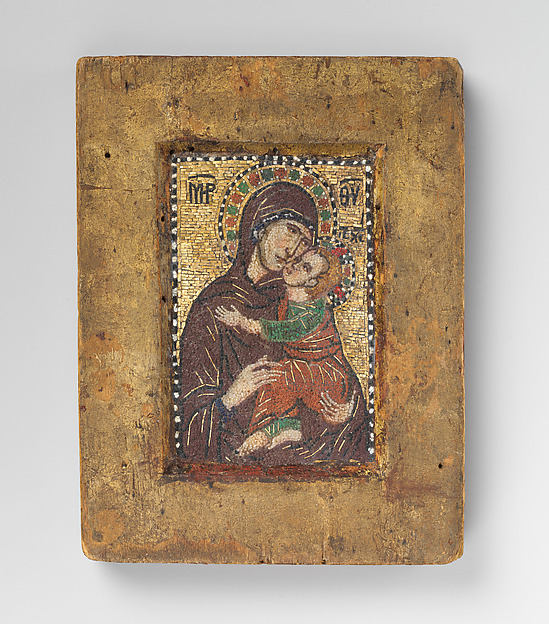
Image title: Portable Icon with the Virgin Eleousa
Medium: Miniature mosaic set in wax on wood panel, with gold, multicolored stones, and gilded copper
Date: early 1300s
Source:
The Met Collection
“
To listen well is as powerful a means of communication and influence as to talk well.
”
— John Marshall
From Mosaics to Motherboards: Byzantine Influence on Digital Design
The Timeless Allure of Byzantine Mosaics
As we examine the tapestry of visual art history, Byzantine mosaics emerge as a luminous chapter, their influence extending far beyond their own era. Born in the Eastern Roman Empire, these intricate artworks are lauded for their vivid colors and theological narratives. Rendered primarily in glass tesserae, these mosaics were designed to capture and reflect flickering candlelight within domed cathedrals, creating an atmosphere of the divine. They elevated the materials they were made from, translating faith into imagery that shimmered with spiritual resonance. Their timeless appeal lies not only in their aesthetic but in their symbology, a quality that continues to echo through contemporary visual languages.
Byzantine Principles in Modern Design
Today, the qualities of Byzantine mosaics manifest in digital design, resonating through pixels in a manner similar to ancient tesserae. The meticulous attention to detail, vivid color palettes, and complex narratives employed by early Byzantine artists mirror the practices of contemporary digital creators. Modern designers employ similar techniques of compartmentalization and intricate detailing to engage users, crafting interfaces and visuals that guide our experiences with clarity and beauty. In many ways, the pixel has become the digital tessera, with each unit representing a part of the larger narrative, akin to mosaics in a grand basilica.
Technological Bridges: From Craftsmen to Coders
The transition from tangible mosaic to intangible pixel reflects broader shifts in how we engage with art and technology. Byzantine artisans worked with a physical medium that was tangible and permanent, while today’s digital artists shape an impermanent medium of data and light. This transformation from craftsmanship to coding illustrates a new form of artistry—one that retains the depth and richness of its historic antecedents while embracing innovation. The construction of intricate digital worlds through programming languages and software can be viewed as a technological parallel to the construction of grand mosaic compositions.
Cultural Reimaginings: Beyond the Religious
While Byzantine mosaics were deeply rooted in religious contexts, reflecting theological stories and spiritual ideals, digital design often extends into the secular, reshaping how we consume and interact with content. However, the principle remains the same: to convert abstract concepts into a visual form that resonates with its audience. This continuity highlights how digital artists draw from cultural archives, embedding layers of meaning that enrich the user’s experience. This is not dissimilar to how Byzantine artists embedded theological meaning in their artwork, providing layers of interpretation and engagement.
The Future of Digital-Mosaic Aesthetics
As technology continues to evolve, so will the aesthetic principles derived from our historical roots. Byzantine mosaics, with their captivating complexity, offer a timeless blueprint for enduring digital design. Artists and designers are increasingly turning to these ancient techniques, merging them with cutting-edge technology to create immersive experiences that capture the essence of human storytelling. Whether through augmented reality or immersive VR environments, the legacy of Byzantine mosaics lives on, a testament to the interconnectedness of our artistic past and digital future.

Image description:
Lamb of God mosaic in presbytery of Basilica of San Vitale (built A.D. 547) Ravenna, Italy. UNESCO World heritage site.
License:
CC BY-SA 4.0
Source:
Wikimedia Commons
Useful links: