“
What we see depends mainly on what we look for.
”
— John Lubbock
Algorithmic Curatorship: Who Decides What We See in Digital Museums?
Introduction: The Invisible Curator
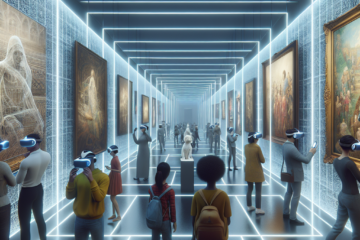
In the age of digital culture, the role of the curator is shifting from a human gatekeeper of taste to an algorithmic aggregator. What once required specialized training, philosophical reflection, and aesthetic judgment is now often managed through recommendation systems optimized for engagement. The emergence of digital museums and data-driven exhibition strategies has introduced a radical new form of curatorship—one guided not by connoisseurship, but by code. This article explores how this transformation has evolved across historical and technological eras, from early museum traditions to the algorithmic environments of today.
I. From Enlightenment Cabinets to Modern Museums: The Origins of Curatorial Power
The Enlightenment period marked the birth of the museum as a civic institution. Collections, once the private property of monarchs or aristocrats, were gradually opened to the public. The curator, often a scholar or naturalist, decided what was worthy of display—a role deeply rooted in the intellectual ideals of classification and order. Every exhibition reflected an implicit worldview: that art and knowledge could be cataloged and hierarchized. These early curators set the foundations for taste and authority, establishing a model where human judgment was central to shaping cultural meaning.
II. Industrialization, Mass Culture, and the Democratization of Taste
By the 19th and early 20th centuries, industrial printing, photography, and mass exhibitions began to expand public access to art. The World’s Fairs and grand museums in Paris, London, and New York blurred the boundary between education and entertainment. This era revealed both the power and peril of accessibility—while more people could see art, curators still framed what was considered worthy of attention. The rise of cultural institutions like the Louvre and the British Museum created full-scale systems of cultural visibility, reflecting national identity more than aesthetic diversity. Yet, this democratization of viewing also sowed the seeds for future algorithmic sorting—an early indication that cultural value might one day be determined by scale and visibility rather than expertise alone.
III. The Digital Turn: Virtual Galleries and Database Aesthetics
The late 20th century saw the convergence of art and technology through the creation of digital archives and online exhibitions. Institutions digitized their collections to improve access and preservation, but digitality introduced its own aesthetic logic. Art historians such as Lev Manovich described the database not just as a tool but as a cultural form—a way of seeing and organizing reality. The curator in the digital age became not just a selector of objects, but a designer of interfaces. By the 2000s, virtual museums allowed audiences worldwide to navigate collections from personal devices, initiating a shift in how art was encountered: spatially flattened, but exponentially expanded in reach.
IV. The Reign of Algorithms: Data-Driven Taste and Personalization
Today, many of our art experiences are mediated by algorithms. Platforms like Google Arts & Culture, social media feeds, and streaming art platforms rely on data-driven curatorship. Instead of an individual expert deciding what to display, machine learning models predict user preferences based on past behavior. This “algorithmic gaze” introduces a new kind of cultural bias: one driven by patterns of attention rather than artistic merit. As scholar Kate Crawford notes, artificial intelligence reflects the values and limitations of its data. While recommendation systems can increase accessibility and personalization, they also risk creating echo chambers where art that aligns with popular taste is amplified, while the challenging or obscure remains unseen.
V. Beyond the Algorithm: Rethinking Curatorship in the Age of Data
The future of curatorial practice lies in navigating this tension between automation and artistic integrity. Hybrid models that blend human insight with algorithmic tools may offer a way forward—where machines analyze scale and access, while humans preserve the nuance of interpretation and context. Some museums have begun to experiment with transparent algorithms, inviting public scrutiny of how works are recommended or highlighted. Philosophically, this moment raises profound questions: Who defines cultural value when decisions are delegated to systems? Can art be truly democratized if visibility depends on metrics of engagement? Perhaps the challenge for 21st-century curatorship is to reassert meaning over measurement, ensuring that digital museums do not simply mirror our preferences but expand our capacities for discovery.
Conclusion: The New Aesthetics of Choice
Algorithmic curatorship signals a decisive transformation in how society encounters art and culture. What began as a matter of scholarly discernment has evolved into a sophisticated network of data-driven visibility. As digital museums continue to evolve, the most critical challenge will be to balance technological efficiency with the cultural mission of art—to provoke, to educate, and to reveal what lies beyond the predictable. In this delicate negotiation between human and machine, our understanding of taste and artistic value is being rewritten—one recommendation at a time.
Useful links: