
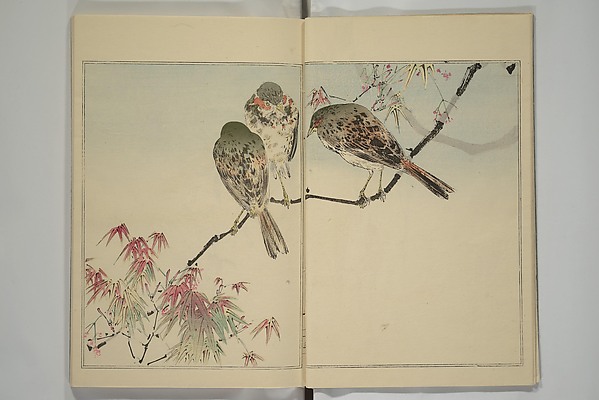
Image title: Picture Album of Birds and Flowers (Kachō gafu)
Medium: Woodblock printed book; ink and color on paper
Date: 1903 (Meiji 36) 11th month
Source: The Met Collection
“
The thoughts we choose to think are the tools we use to paint the canvas of our lives.
”
— Louise Hay
Pixel Perfect: The Evolution of Digital Art from MS Paint to NFTs
Chapter 1: The Dawn of Digital Art
In the late 20th century, the world witnessed the birth of digital art—a groundbreaking epoch in visual creativity that promised to revolutionize the art world. This transformation began with rudimentary computer graphics programs, most notably MS Paint and its contemporaries in the early 1980s. MS Paint, a staple of early operating systems, held a significant place in the hearts of budding digital artists. Its basic toolset—simple yet innovative for its time—enabled users to experiment with pixel-by-pixel manipulation, laying the foundation for more complex digital art forms.
Chapter 2: The Rise of Software and Pixel Art
Following the initial foray into digital creativity, the 1980s and 1990s saw the evolution of software that expanded the capabilities of digital artists substantially. Programs like Adobe Photoshop, CorelDRAW, and others started servicing professional artists, offering a more refined palette of tools and effects. At the same time, pixel art emerged as a distinctive style, influenced by the graphical limitations of early video games. Here, artists like Tsutomu Kouno and Rita Wu explored the captivating combination of digital innovation and artistic mastery, popularizing digital sprites that became iconic in gaming history.
Chapter 3: Digital Artists and the Rise of the Internet
As the internet began to mature in the late 1990s and early 2000s, it became a new frontier for artists, offering a public platform for showcasing work across the globe. Many pioneering digital artists, such as Ferenc Boros and the collective art network DeviantArt, harnessed this connectivity to push the boundaries of what art could be. Digital media began merging styles—combining photography, drawing, painting, and 3D rendering into cohesive pieces now known as digital mixed media.
Chapter 4: The Emergence of 3D and Virtual Worlds
Entering the new millennium, the advancement of GPU technology and software facilitated the rise of 3D art and animation. Programs such as Blender, Autodesk Maya, and ZBrush became industry standards, enabling artists to create hyper-realistic models and animations. During this period, virtual worlds like Second Life gave a new dimension to digital art by introducing virtual galleries and interactive installations. Digital art was no longer confined to two-dimensional screens; it extended into immersive environments where users could interact and engage with art in unforeseen ways.
Chapter 5: NFTs and the Digital Renaissance
The 2020s began with a digital art revolution akin to the renaissance of the classical era, driven by the emergence of Non-Fungible Tokens (NFTs). These unique, blockchain-based digital assets have transformed the art market by providing a method for artists to authenticate and sell digital artwork like physical pieces. Artists like Beeple, whose NFT artwork sold for millions, have catapulted digital art into the limelight, altering how art is valued and traded worldwide. This era represents a pivotal moment where technology has interwoven financial ecosystems with art, creating new opportunities—and debate—about ownership and the future of art.
Digital art’s evolution from MS Paint to NFTs encapsulates a journey marked by technological innovation, artistic expression, and cultural adaptation. As digital artists continue to explore new frontiers, this dynamic field promises endless possibilities for the future of creativity.

Image description: File:Benjamin Franklin 1767.jpg
Artist: David Martin
Credit: The White House Historical Association
License: Public domain
Source: Wikimedia Commons
Useful links: