
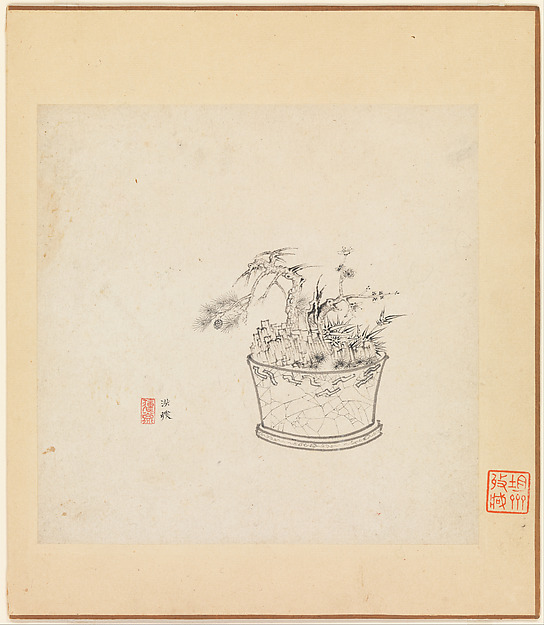
Image title: Miscellaneous Studies
Medium: Album of twelve paintings; ink on paper
Date: one leaf dated 1619
Source: The Met Collection
“
Silence is deep as Eternity; Speech is shallow as Time.
”
— Thomas Carlyle
Artful Reflections: Mirrors as a Medium Across Time and Cultures
Introduction: Beyond Reflection
Mirrors have served as more than mere objects for personal reflection; they are profound symbols and deliberate mediums in artistic endeavors across centuries. From ancient mythologies to modern installations, the mirror’s role in art not only reflects our physical selves but extends to cultural and philosophical dimensions. This article delves into the mirrored journey across diverse cultures and eras, examining its evolution and profound implications in the world of art.
Chapter 1: Mirrors in Antiquity – Reflecting Divinity and Power
The use of mirrors in art dates back to ancient civilizations where they symbolized divine truth and power. In Egyptian culture, mirrors were believed to unlock the mysteries of the heavens. Craftspeople created mirrors from polished metals, integrating them into the ornaments of the elite. Similarly, in Greek mythology, the tale of Narcissus underscores the mirror’s role as a cautionary symbol of self-obsession and vanity, themes that artists have revisited throughout history.
Chapter 2: Mirrors in the Renaissance – Exploring Humanism and Perception
The Renaissance ushered in a new understanding of space, light, and perspective, with mirrors playing a critical role in this exploration. Artists like Jan van Eyck integrated mirrors into their compositions to challenge perception and introduce complex symbolic meanings. Van Eyck’s ‘The Arnolfini Portrait’ is a masterpiece incorporating a convex mirror, cleverly reflecting the room and inviting viewers to ponder notions of reality and illusion. It was an era where mirrors served both as tools and subjects to express the burgeoning humanist philosophy.
Chapter 3: Baroque Opulence and the Play of Light
During the Baroque period, art became more dramatic and grandiose, with mirrors epitomizing opulence and the play of light. Louis XIV’s Hall of Mirrors at Versailles stands as a testament to this era’s extravagance. Artistic depictions from this period utilized the mirror’s ability to enhance the dynamism of light and perspective, symbolizing the grandeur of divine presence and the illusion of space within two-dimensional art.
Chapter 4: The Symbolist’s Dream – Mirrors as Psychological Landscapes
In the 19th century, mirrors evolved into psychological tools in art, echoing the Symbolist movement’s focus on the human psyche and inner reflection. Edvard Munch and Fernand Khnopff used mirrors to delve into human consciousness, emotions, and the unconscious mind, mirroring art’s transformation into introspective and philosophical domains. These works questioned the boundaries of reality, at times presenting the mirror as a threshold to unknown realms.
Chapter 5: Contemporary Reflections – Technology and Identity
In contemporary art, mirrors continue to serve as a versatile medium to explore themes of identity, technology, and society. Artists like Yayoi Kusama and Anish Kapoor utilize mirrors in installations creating immersive environments that challenge viewers’ perceptions. Kapoor’s ‘Cloud Gate’ and Kusama’s ‘Infinity Rooms’ illustrate how technology aids in transforming mirrors into tools for artistic exploration of infinite space and self-identity, blurring the lines between observer and observed.
Conclusion: Mirrors, Medium, and Metaphor
Across time and cultures, the usage of mirrors in art has evolved from divine symbols to profoundly personal mediums. They remain metaphors for self-examination and cultural reflection. By capturing both the physical and philosophical, artists encourage deeper introspection and invite contemplation of our own reflections in the mirror of human experience.

Image description: Street crowd reflecting in the polyhedral mirrors of Tokyu Plaza Omotesando, Harajuku station, Tokyo, Japan, a sunny Sunday afternoon. Designed by architect Hiroshi Nakamura.
Artist: Basile Morin
Credit: Own work
License: CC BY-SA 4.0
Source: Wikimedia Commons
Useful links: