
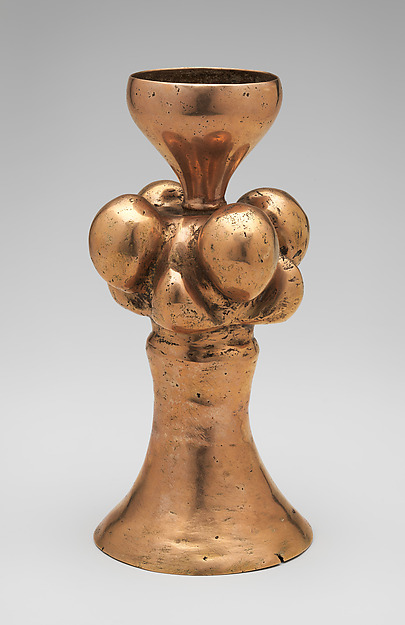
Image title: Neck of Poporo (Lime Container)
Medium: Gold alloy
Date: 300 BCE–700 CE
Source: The Met Collection
“
In the middle of every difficulty lies opportunity.
”
— Albert Einstein
Enchanted Beads: How Microcosms Inspired Middle Eastern Jewelry Traditions
Introduction: Gems of the Past
The intricate world of Middle Eastern jewelry is an art form that whispers tales of microscopic wonders and cultural grandeur. Historically, the Middle East has long captivated artisans who transformed the complex interplay of nature’s microcosms into tangible forms of beauty and symbolic language. Journey with us as we explore how these tiny worlds have shaped elaborate jewelry designs over centuries, marvellously preserving both history and cultural identity.
Chapter 1: The Pre-Islamic Elegance
In the epochs preceding Islam, jewelry was rarely mere ornamentation; it was an emblem of status, power, and protection. The ancient Sumerians, for instance, were pioneers in adorning themselves with beads using lapis lazuli and carnelian that showcased exceptional craftsmanship and an almost mystical appeal. Beetles, seeds, and intricate geometric patterns were replicated on minuscule scales, hinting at a reverence for the minute wonders of nature.
Chapter 2: The Islamic Golden Age
With the rise of the Islamic Empire, jewelry design flourished into an exquisite art, embodying the diversity of the expanding region. Calligraphy and abstract design emerged as essential elements, inspired by both Quranic themes and the burgeoning field of science. Artists like Al-Khwarizmi and Al-Biruni influenced jewelers to incorporate calculus motifs, portraying the intricate universe within gemstones. The explosion of scientific knowledge facilitated artisans with technologies utilizing filigree and granulation, which allowed them to create complex designs on a microscopic scale.
Chapter 3: Ottoman Opulence
The Ottoman Empire introduced an era of unparalleled opulence, where courts were adorned with intricate jewels reflecting their geopolitical reach. During the 15th and 16th centuries, intricate patterns inspired by flora and fauna of near-mythical proportions were crafted into signature pieces. The use of precious stones like emeralds and rubies was common, chosen not only for their beauty but for their believed protective properties, embodying the mystic philosophies underlining much of the Ottoman worldview.
Chapter 4: Persian Influences and Techniques
Persian influences were particularly pronounced in techniques such as ‘Minakari’ (enamel work) and ‘Tarkashi’ (wire inlays). These methods created vibrant and colorful motifs that often depicted minute aspects of Persian artistic storytelling. These artisans leveraged miniature landscapes and closely intertwined them with tales from Persian folklore and poetry, resulting in pieces that were as much about storytelling as about adornment.
Chapter 5: Modern Interpretations and Legacy
As the 20th century unfolded, Middle Eastern jewelry continued to evolve by integrating modern artistic expressions while preserving its historical roots. The globalization of cultural motifs saw a fusion of styles where the microscopic inspirations of nature continued to shine brightly. From the preservation of ancient techniques to the revival of forgotten styles, the artistry in modern Middle Eastern jewelry connects the dots between the past and the present, eternally linked through the magic of microscopic worlds.
Conclusion: The Timeless Dance of Inspiration
The journey through these jewels highlights a timeless dance where culture, philosophy, and microscopic beauty merge seamlessly. Middle Eastern jewelry remains not only an embodiment of aesthetic excellence but a testament to the human endeavor to translate the wonders of the world into compact, wearable art—miniature universes that continue to enchant their audiences to this day.

Image description: A close-up, high-angle shot of several stacks of yellow gold bangles displayed in a jewelry store. The jewelry features repetitive, textured leaf-like or chevron patterns, characteristic of traditional and contemporary South Asian craftsmanship. The background shows more gold ornaments blurred with a shallow depth of field, emphasizing the texture of the foreground pieces
Artist: A S M Jobaer
Credit: Own work
License: CC BY-SA 4.0
Source: Wikimedia Commons
Useful links: