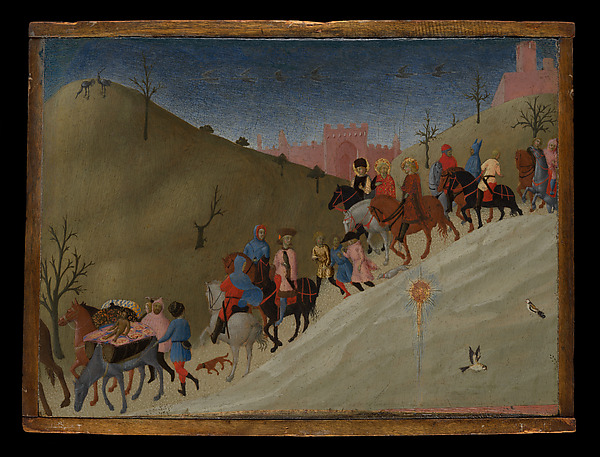
Image title: The Journey of the Magi
Medium: Tempera and gold on wood
Date: ca. 1433–35
Source:
The Met Collection
“
The journey of a thousand miles begins with one step.
”
— Laozi
A Journey Through Time: The Transformative Eras of Visual Art
Introduction: Tracing the Evolution of Vision
The story of visual art is a vivid tapestry woven with humanity’s hopes, beliefs, discoveries, and revolutions. From the flickering torchlight of prehistoric caves to the pixelated canvases of the digital age, each era of art tells not only of aesthetic transformation but of seismic cultural, philosophical, and technological shifts. In this article, we will journey through the key epochs in the history of visual art, uncovering how creators responded to and shaped the world around them through their ever-evolving visions.
1. The Dawn of Creativity: Prehistoric and Ancient Art
Visual art has its origins tens of thousands of years ago in the deep echo of prehistory. Early humans scrawled images onto cave walls—like those in Lascaux, France—using pigments blended from earth, charcoal, and animal fat. These luminous animals and ritualistic shapes reveal a culture deeply enmeshed in myth, survival, and spirituality. As civilizations blossomed, so did artistic ambition: the geometric ceramic designs of the Greeks, the monumental statues and hieroglyphic murals of Egypt, and the finely painted frescoes of Rome all bear witness to the integral role of art in expressing power, devotion, and daily life. Here, technology meant mastery of tools and materials, while philosophy and religion guided the very subjects deemed worthy of depiction.
2. The Age of Faith and Icon: Medieval Visual Traditions
With the fall of the Roman Empire, Europe’s artistic focus shifted toward the sacred. The Middle Ages were a time of illuminated manuscripts, soaring cathedrals glowing with stained glass, and stylized religious icons. Art was defined less by realism and more by symbolism—the gold backgrounds and flattened figures of Byzantine mosaics, or the mystical visions rendered in Gothic altarpieces. The relationship between art and philosophy was inseparable, as works were created to instruct, inspire, and mediate between the earthly and the divine. Meanwhile, in other parts of the world, such as the Islamic caliphates and Dynastic China, sophisticated textile patterns, calligraphy, and landscape paintings flourished as unique visual expressions of cultural ideals.
3. Humanism and Innovation: The Renaissance and Beyond
The Renaissance sparked a dazzling rebirth of artistic inquiry in Europe, fueled by philosophical shifts toward humanism and empirical observation. Masters like Leonardo da Vinci, Michelangelo, and Raphael applied new understanding of anatomy, geometry, and perspective to create works of singular lifelikeness and grandeur. The printing press, a groundbreaking technological invention, enabled the rapid spread of ideas and images, making art more widely accessible. In this era, portraits, mythic tableaux, and scenes of everyday life emerged alongside religious works, portraying an expanding curiosity about the human condition and a growing appetite for individual achievement. Global exploration also brought new materials and ideas, enriching artistic vocabulary across continents.
4. Revolution and Experiment: From Modernism to Abstract Expressionism
By the nineteenth and twentieth centuries, a series of rapid political, technological, and philosophical upheavals shattered tradition and opened dizzying new frontiers in art. Photography and later film challenged artists to reconsider their purpose: Was it still to represent the visible, or to express the invisible? Impressionism blurred outlines and celebrated fleeting effects of light, while Cubism fragmented reality entirely. Marcel Duchamp’s ready-mades and the rise of Surrealism questioned art’s very definition. In postwar America, Abstract Expressionism—epitomized by Jackson Pollock’s dynamic canvases—made the act of creation itself the focus. The rise of psychology, existentialism, and technological advances fueled an ever-widening embrace of artistic freedom and conceptual exploration.
5. The Digital and Global Present: Contemporary Visual Art
Today’s visual art is shaped by digital technology, globalization, and an ever-accelerating exchange of ideas. From immersive installations to data-driven art, the boundaries between mediums—painting, sculpture, video, VR—have blurred. Artists grapple with pressing social, ecological, and political issues, while the internet has transformed both creation and viewing into a global, interactive experience. Philosophically, art now asks not only “What is beautiful?” but “What matters?”, “Who decides?”, and “What is real in a virtual world?” In this era, visual art is more accessible and diverse than ever, building upon the innovations and values of all those who came before—yet always looking forward.
Conclusion: Art as Memory and Mirror
The journey through the history of visual art is nothing less than the story of humanity itself. Each era—marked by its own philosophies and technologies—has transformed how we perceive the world and our place within it. As we continue to create and contemplate, visual art remains our memory and our mirror: the eternal record and the ever-changing reflection of what it means to be human.

Image description:
title page of the book Art as a factor in the soul’s evolution by Curuppumullage Jinarajadasa
License:
Public domain
Source:
Wikimedia Commons
Useful links: