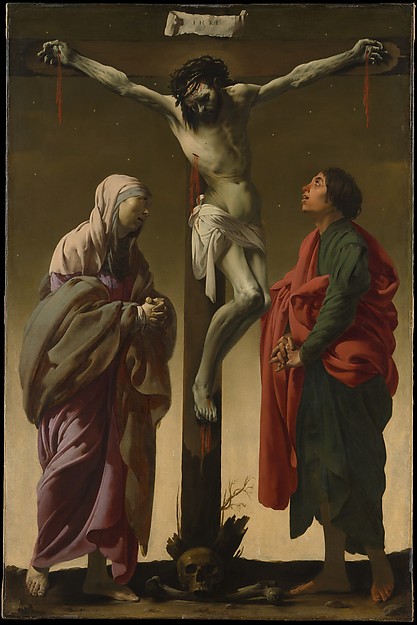
Image title: The Crucifixion with the Virgin and Saint John
Medium: Oil on canvas
Date: ca. 1624–25
Source:
The Met Collection
“
The journey of a thousand miles begins with one step.
”
— Laozi
A Journey Through the Ages: Transformations in the History of Visual Art
Introduction: The Ever-Evolving Canvas
Visual art is a testament to humanity’s creative pulse, tracing both our collective memory and individual aspirations. Over millennia, the visual arts have evolved alongside dramatic shifts in culture, philosophy, and technology. By tracing its major transformations, one can map humanity’s journey—our advances, our anxieties, and our celebrations—etched into stone, painted on frescoes, stretched on canvas, and rendered in pixels. This article explores the major epochs of visual art, illuminating the remarkable eras that have shaped artistic expression and its societal resonance.
The Dawn: Prehistoric and Ancient Art
The origins of visual art lie in the deep shadows of prehistory, where early humans used art to interpret and imprint meaning onto the world. Cave paintings in Lascaux and Altamira, dating back tens of thousands of years, feature animals, handprints, and enigmatic symbols. These works served ritualistic, communicative, and even magical purposes, bridging the material and spiritual realms or marking communal stories.
Ancient civilizations elevated art through monumental structures and sculpture—the colossal pyramids of Egypt, the lyre-bedecked reliefs of Mesopotamia, and the naturalistic marbles of Greece. Art became intertwined with religion, power, and societal order, reflecting technological advancements (such as bronze casting) and the quest for permanence in a transient world.
The Classical to Medieval World: Order, Divine Inspiration, and Symbolism
The Greeks imbued art with harmony, proportion, and realism, motivated by philosophical ideals of beauty. This classical ethos continued through Roman mosaics, frescoes, and portraiture—where innovations such as perspective and anatomical accuracy hinted at future revolutions.
With the fall of Rome and the dawn of the Middle Ages, visual art turned its gaze toward the heavens. Byzantine mosaics shimmered in candlelight, Gothic cathedrals soared in pointed arches, and illuminated manuscripts teemed with biblical allegories. The role of art shifted, emphasizing spiritual instruction over earthly representation—techniques followed a codified symbolism that prioritized religious mysteries over physical reality.
Renaissance and Enlightenment: Humanism and Scientific Perspective
The Renaissance marked a seismic transformation in artistic thinking. Inspired by rediscovered classical texts and humanist ideals, artists like Leonardo da Vinci, Michelangelo, and Raphael championed realism, emotional depth, and scientific observation. Linear perspective emerged, allowing painters to simulate three-dimensional space on flat surfaces—a marriage of artistry and early optics.
This era witnessed art’s growing independence from ecclesiastical patronage as merchants, nobles, and even revolutionary thinkers began to commission works. The Enlightenment’s emphasis on rationalism and empirical inquiry further galvanized artists to explore new subjects, infusing canvases with political ideals and individual narratives.
From Impressionism to Modernism: Breaking the Mold
The late 19th and early 20th centuries saw a dramatic departure from established conventions, spurred by industrialization, urbanization, and philosophical upheaval. Impressionists like Monet and Degas captured fleeting moments in light and color, challenging the rigidity of academic painting. Rapid technological advances—photography, synthetic pigments, mass production—transformed both how artists worked and what they depicted.
Modernism shattered the boundaries further. Cubists fractured space and perspective; Expressionists channeled raw emotion, and Surrealists mined the unconscious. This period was marked by experimentation—a sometimes tumultuous dialogue between tradition and innovation, influenced by wars, scientific discoveries, and shifting social structures.
The Digital Age: Contemporary Visual Art
Today, visual art is arguably more diverse and democratized than ever. Contemporary artists harness digital media, artificial intelligence, and globalized platforms to create works that interrogate identity, ecology, and technology itself. Boundaries between disciplines blur as installations, performance art, augmented reality, and NFTs redefine what art can be, who can create it, and how it is experienced. Platforms like Instagram and online galleries enable creators worldwide to find audiences, challenging established hierarchies and institutions.
As we venture further into the 21st century, the essence of visual art remains rooted in transformation—reflecting both continuity and rupture. The story of art is, and always will be, a story of humanity seeking to see, understand, and shape the world anew.

Image description:
title page of the book Art as a factor in the soul’s evolution by Curuppumullage Jinarajadasa
License:
Public domain
Source:
Wikimedia Commons
Useful links: