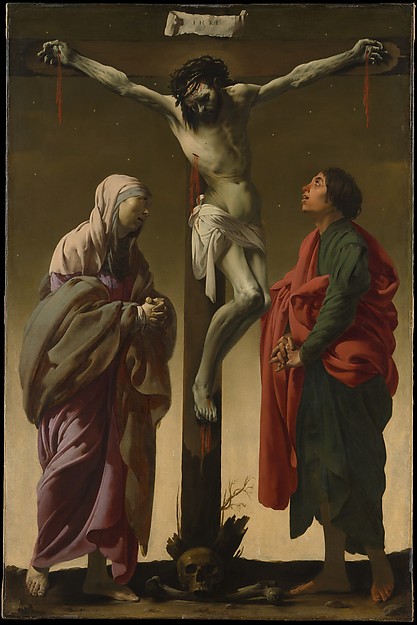
Image title: The Crucifixion with the Virgin and Saint John
Medium: Oil on canvas
Date: ca. 1624–25
Source:
The Met Collection
“
Sadness flies away on the wings of time.
”
— Jean de La Fontaine
Epochs on Canvas: The Transformative Journey of Visual Art Through Time
Introduction: The Ever-changing Face of Art
From the mysterious cave paintings of our ancestors to the digital masterpieces appearing on today’s screens, visual art has undergone countless transformations. Each era in art history stands as a window into the hopes, fears, and imaginations of societies, shaped by philosophical ideals, cultural upheavals, and technological revolutions. In this article, we embark on a journey through five pivotal eras, exploring how visual art evolved in response to the broader currents of human experience.
1. Paleolithic to Ancient Civilizations: Art as Ritual and Record
The roots of visual art stretch back over 30,000 years, to when early humans painted animals and handprints on cave walls in places like Lascaux and Chauvet. These works were more than decoration—they functioned as ritual, communication, and even proto-storytelling. As societies coalesced in river valleys, artists in Egypt, Mesopotamia, and Greece harnessed art for new purposes: honoring gods, celebrating rulers, and chronicling events. Techniques such as relief sculpture and the use of perspective emerged, foreshadowing later revolutions in representation.
2. The Renaissance: Humanism and Perspective
The Renaissance, emerging in 14th-century Italy, brought a seismic shift in art’s purpose and technique. Drawing inspiration from classical antiquity, artists like Leonardo da Vinci, Michelangelo, and Raphael embraced humanism—the idea that humans, not just divine forces, were worthy subjects of art. The invention of linear perspective revolutionized how space and depth were depicted, making paintings such as “The Last Supper” and “The School of Athens” breathtakingly lifelike. The flourishing of scientific inquiry and the spread of printed books also accelerated the exchange of ideas and styles.
3. The Modern Age: Breaking Boundaries
With the Industrial Revolution came unprecedented social and technological change, reshaping the role of art. Impressionists like Monet and Degas rebelled against academic standards, using quick, visible brushwork to capture the fleeting effects of light and movement. Soon, bold innovators like Picasso and Kandinsky shattered traditional forms, ushering in Cubism and Abstract Art. This era saw art become a vehicle for personal expression and social critique, reflecting the anxieties and aspirations of the modern world.
4. The Birth of Contemporary Art: Concept over Craft
The mid-20th century marked another turn: artists challenged the very definition of art. Marcel Duchamp’s “Fountain”—a urinal signed ‘R. Mutt’—suggested that the artist’s concept, rather than technical skill, could define a work of art. Movements like Pop Art, led by Warhol and Lichtenstein, turned the lens on consumer culture, while Minimalism stripped aesthetics to their bare essentials. This period witnessed the expansion of art from painting and sculpture to happenings, performance, installation, and more.
5. The Digital Age: Screens and Infinite Canvases
Today, digital technology is again transforming the visual arts. Digital painting, AI-generated images, and virtual reality environments have opened entirely new domains for artistic exploration. Platforms like Instagram and virtual galleries have made art more accessible and democratized than ever, giving voice to diverse creators across the globe. Philosophically, artists grapple with questions about originality, authenticity, and the nature of creativity itself in an age where machines can paint and algorithms can compose.
Conclusion: Art’s Perpetual Revolution
Visual art is not a static expression but a dynamic dialogue between people, cultures, and their times. As technology continues to advance and societies evolve, so too will art—reshaping itself to capture new dreams, dilemmas, and destinies. Each era leaves its mark, a testament to our shared humanity and our endless pursuit of meaning through images.

Image description:
title page of the book Art as a factor in the soul’s evolution by Curuppumullage Jinarajadasa
License:
Public domain
Source:
Wikimedia Commons
Useful links: