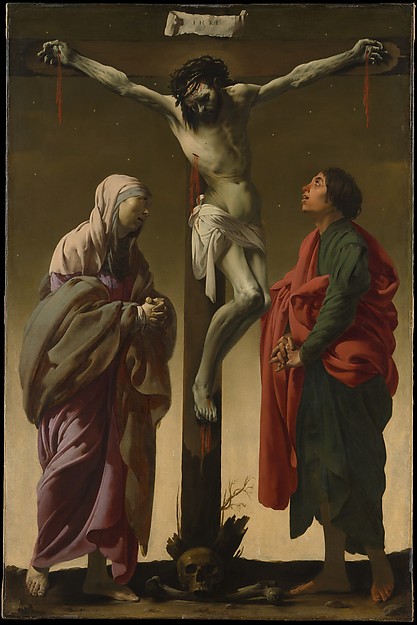
Image title: The Crucifixion with the Virgin and Saint John
Medium: Oil on canvas
Date: ca. 1624–25
Source:
The Met Collection
“
Pitching is the art of instilling fear.
”
— Sandy Koufax
The Shifting Canvas: Epochs of Transformation in Visual Art History
Introduction: Art’s Evolving Horizons
Visual art has always been more than a means of representation—it is a dynamic mirror to humanity’s changing soul. Across centuries, painting, sculpture, and other visual forms have continuously adapted and evolved, responding to cultural upheavals, philosophical inquiries, and technological innovations. Let’s journey through five pivotal eras that shaped the face of visual art, each revealing new possibilities and fresh perspectives.
I. Antiquity: The Birth of Expression
Art in the ancient world, from the haunting cave paintings of Lascaux to the grandeur of Greco-Roman sculpture, was a tool of communication, reverence, and record-keeping. Civilizations crafted images to ensure immortality, to honor gods, and to immortalize power. Egyptian reliefs and statuary displayed strict formalism, intending to link mortal and divine realms, while Greek artists pioneered naturalism, striving toward idealized forms and balance. The transformation of artistic purpose reflected humanity’s burgeoning sense of self and community, setting the foundation for future innovation.
II. Middle Ages to Renaissance: Faith and the Eye of Perspective
The Middle Ages saw religious narratives dominate artistic production. Symbolism outweighed realism, and the works—icons, illuminated manuscripts, and frescoes—functioned as windows to the transcendent. Yet, with the Renaissance, a seismic shift occurred. Inspired by renewed interest in classical antiquity, artists like Giotto, Leonardo da Vinci, and Michelangelo championed linear perspective, anatomical accuracy, and psychological depth. Humanism brought the individual to the forefront, and techniques such as oil painting and chiaroscuro illuminated the world anew. Art was no longer only in the service of God but also a celebration of the human spirit.
III. Baroque to Romanticism: Drama, Emotion, and Revolution
The Baroque period celebrated grandeur and dynamism—Caravaggio’s intense contrasts and Bernini’s swirling figures evoked theatricality, reflecting the tensions of an age shaped by religious reform and scientific awakening. The Enlightenment spurred Neoclassicism, turning to reason and republican virtues. By the 19th century, Romanticism countered rational thought with emotional intensity, as seen in the tempestuous works of Delacroix and Turner. Art became a battleground for ideas, capturing the turbulence of a world in the throes of industrial and social revolution.
IV. Modernism: Breaking Boundaries
The late 19th and early 20th centuries marked an unprecedented splintering. Impressionists shattered old conventions, focusing on perceptual experience and fleeting light. Soon after, artists like Picasso and Kandinsky pursued abstraction, challenging the very notion of representation. Technology—photography, industrial pigments, urban electrification—expanded the visual vocabulary of artists. Movements like Dada, Surrealism, and Constructivism reflected the chaos of two World Wars and a rapidly modernizing world. Art became experimental, cerebral, and self-referential, reflecting the complexities of modern existence.
V. Contemporary Art: Innovation and Interconnection
Today, visual art thrives in the context of rapid globalization, digital revolutions, and a pluralism of voices. From conceptual installations and digital media to street art and performance, boundaries have blurred further. Artists like Yayoi Kusama, Ai Weiwei, and Kehinde Wiley use their craft to interrogate identity, technology, politics, and globalization. The philosophical focus often shifts to interactivity, audience agency, and the blending of high and low culture. Visual arts now engage directly with social realities and technological possibilities, making the canvas not just a surface, but an interface with the world.
Conclusion: An Ever-Shifting Canvas
Each era of art doesn’t merely follow the previous; it questions, reconfigures, and reimagines what came before. As cultures transform and technologies arise, visual art continues to push the boundaries of what is possible—not just in form and medium, but in meaning. The journey of visual arts is a reminder: as long as there are new ways to see, there will be new ways to create.

Image description:
Opening of the art project “Dialogue epochs. Interpretation” in Minsk Art Gallery of Leonid Schemelev September 5, 2014. Gallery director Christine Lyadskaya and Curator – Tatiana Markina.
License:
CC BY-SA 4.0
Source:
Wikimedia Commons
Useful links: