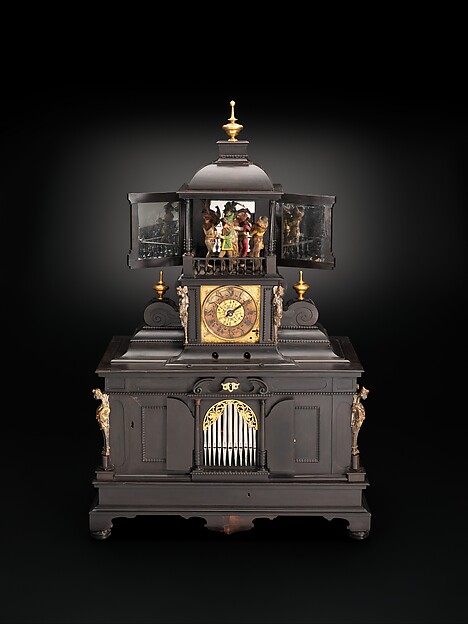
Image title: Musical Clock with Spinet and Organ
Medium: Ebony, gliding, brass, silver gilt, gilt brass, iron, various wood and metals, wire, parchment and leather
Date: ca. 1625
Source:
The Met Collection
“
A thing long expected takes the form of the unexpected when at last it comes.
”
— Mark Twain
The Sculpted Sound: When Music Takes Form in Marble
1. Introduction: Listening with the Eyes
Across centuries, artists have attempted to capture the intangible essence of music—the pulse of rhythm, the vibration of tone, and the mystery of silence—within static materials like stone, bronze, and glass. Sculpture, by its very nature, seems to stand in contrast to the ephemerality of sound. Yet, from the Baroque masterpieces of Bernini to contemporary installations that merge sound and form, artists have sought to give music volume, weight, and space. This dialogue between what is heard and what is seen invites us to feel sound as something we can walk around, touch, and contemplate.
2. Classical Harmonies: The Baroque’s Dance Between Motion and Music
During the seventeenth century, Gian Lorenzo Bernini reinvented sculpture as a medium alive with rhythm and theatricality. His works such as Apollo and Daphne and The Ecstasy of Saint Teresa seem tuned to an invisible symphony: drapery rustles, hair flows, and figures move with breathtaking syncopation. The viewer’s eye follows these visual rhythms as one might follow a melodic line. The Baroque aesthetic favored musical analogies—phrases, crescendos, and pauses—expressed through complex compositions that dissolved the boundary between sculpture, painting, and architecture. This period established the idea that sculpture could embody time and motion, just as music unfolds in them.
3. Romantic Resonances: Emotional Soundscapes in Stone
The nineteenth century brought a new preoccupation with personal expression, and sculptors responded by searching for ways to convey emotional tonality. Auguste Rodin, for example, sought not just to depict the body but to evoke the inner turbulence of human feeling, much like a romantic symphony swells with unresolved chords. The texture of his surfaces—the quick, nervous play of light across the bronze—conveys rhythm and intensity akin to musical improvisation. In his Burghers of Calais, pauses and silences become as meaningful as the gestures: each figure resonates at its own emotional frequency, creating a sculptural polyphony.
4. Modernist Abstractions: From Sound to Structure
With the rise of modernism in the early twentieth century, artists turned their attention to pure form and rhythm. Constantin Brâncuși’s sleek, elongated shapes—like Bird in Space—suggest sound’s ascension, its gradual escape from matter into vibration. The Futurists, especially Umberto Boccioni, explored dynamic motion through sculptural lines of force, seeking to translate mechanical and urban noise into visual rhythm. As music itself began to abstract into new tonal languages, sculpture too became more minimalist and formal, turning sound into geometry. Kandinsky’s theories of synesthesia—where color and form correspond to musical tone—deeply influenced this movement, encouraging artists to think of sculpture as frozen music made visible.
5. Contemporary Installations: The Resonant Space of Now
In the last few decades, technological innovation has allowed artists to merge sound and sculpture in literal ways. Installation artists like Janet Cardiff or Zimoun build immersive environments where audio becomes spatial, enveloping the viewer in vibrating architectures of sound. Interactive artworks may translate the viewer’s movements into tones, transforming space into an instrument. These works push beyond metaphor, revealing that sound and sculpture share the same essential quality: they shape experience through vibration and presence. Even silent sculptures carry a resonance—the hum of imagination, the echo of unseen music.
6. Conclusion: The Everlasting Symphony of Form
The dialogue between sound and sculpture reveals a deeper unity in the arts. Both disciplines organize rhythm, structure, and silence to move the human spirit. Whether carved in marble or constructed from digital streams, these works remind us that art at its best is not about static form or fleeting sound, but about the pulse that animates both—the heartbeat of creation itself, reverberating through history and space.
Useful links: