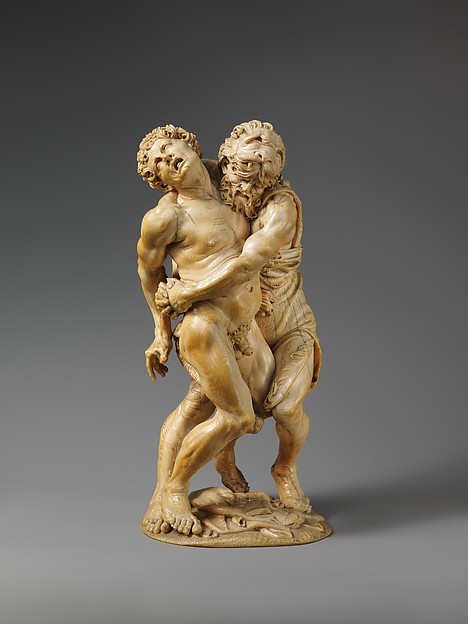
Image title: Hercules and Achelous
Medium: Ivory
Date: probably mid-17th century
Source:
The Met Collection
“
A man should look for what is, and not for what he thinks should be.
”
— Albert Einstein
The Politics of Restoration: Who Decides What Art Should Look Like?
Introduction: The Fragile Curtain of Authenticity
Every brushstroke of history is vulnerable—not only to the erosion of time, but to the shifting values of those who preserve it. The act of art restoration is never neutral; each decision reflects a dialogue between the past and the present. Whether revealing vibrant pigments beneath centuries of soot or repairing the cracks of a Renaissance fresco, restorers stand at the threshold between conservation and intervention, guardians and interpreters of cultural memory.
The question is not simply how art should be saved, but who holds the authority to decide its final appearance. The relationship between authenticity, aesthetics, and ethics lies at the heart of this enduring debate—a politics of restoration that stretches from the frescoed chapels of Renaissance Italy to the algorithms of today’s digital reconstructions.
Chapter I: Renaissance Reverence and the Birth of Restoration
In the 15th and 16th centuries, Europe witnessed a growing awareness of art’s permanence and fragility. The rediscovery of classical antiquity inspired an early form of restoration driven by reverence rather than scholarship. Artists such as Giorgio Vasari not only chronicled art’s great masters but also took on the role of restorer, repainting damaged frescoes and sculptures to match the styles they admired. To the Renaissance mind, restoring meant reviving—a creative act akin to reanimation.
However, this approach often blurred the line between conservation and reinterpretation. When Vasari retouched Giotto’s frescoes, he did so from his own aesthetic sensibilities, inadvertently obscuring the medieval character of the originals. In these early centuries, restoration was guided by artistic intuition rather than historical objectivity, setting the stage for centuries of debate about what constitutes authenticity.
Chapter II: The Enlightenment and the Rise of Conservation Ethics
By the 18th and 19th centuries, the Enlightenment’s rationalism introduced a new sense of responsibility toward cultural patrimony. Museums emerged as custodians of heritage, anchoring art to national identity and collective history. Figures like John Ruskin, the British critic, argued fervently against restoration, claiming that any attempt to recreate lost details corrupted the integrity of the original. For Ruskin, age and decay were integral parts of an artwork’s truth—the visible marks of its journey through time.
In contrast, French architect Eugène Viollet-le-Duc defended creative restoration, asserting that the restorer’s duty was to return a monument to a state of completeness that could embody its ‘ideal form.’ This divergence exemplified the ideological split between preservationists and interventionists: one side favoring minimal interference, the other valuing aesthetic unity and narrative coherence.
Chapter III: Twentieth-Century Science and the Art of Cleaning
The 20th century ushered in a new era of restoration informed by chemistry, physics, and art history. Restoration laboratories became as sophisticated as research institutions, and technological tools like X-rays, microscopy, and solvent analysis transformed practice. But this scientific precision did not eliminate controversy—it magnified it. The cleaning of Michelangelo’s Sistine Chapel ceiling in the 1980s, for instance, provoked international debate when the vivid hues revealed beneath centuries of grime startled the art world. Were these the true tones Michelangelo intended, or the result of overly aggressive cleaning?
For critics, the cleaned frescoes represented a loss—a bleaching of time’s patina, a stripping away of layers that had become part of the historical texture. Supporters, meanwhile, praised the restoration as a resurrection of Michelangelo’s original brilliance. The controversy exposed the tension between truth to material and truth to perception—a philosophical divide that remains unresolved.
Chapter IV: Digital Interventions and the Virtual Restoration of Time
In the 21st century, restoration increasingly involves not only canvas and pigment but code and data. Digital tools now allow scholars to simulate lost colors, fill in damaged details, and even reconstruct entire works virtually. Algorithms analyze surviving fragments and historical pigment recipes to approximate an artist’s palette with remarkable accuracy. Yet, as with their analog predecessors, these digital restorations provoke ethical questions: does a virtual reconstruction respect the original work, or does it construct a speculative narrative that risks supplanting it?
Modern projects, such as digital revivals of ancient sculptures once painted in vivid hues, challenge centuries of monochrome idealization. They also force us to reconsider cultural biases—how Western aesthetics have historically privileged whiteness and purity in marble art. In digital hands, restoration becomes a form of cultural and historical correction, guided by both science and social awareness.
Chapter V: The Future of Authenticity—Ethics in the Age of Restoration Politics
At its core, the politics of restoration reveal art as a living site of debate over identity, history, and legitimacy. No restoration is purely technical; every intervention reflects contemporary values and anxieties. Should we preserve art as a living conversation with the past, or freeze it as a museum relic? Should decay be seen as a tragic loss or an integral element of art’s biography?
As new technologies advance, and as global institutions reckon with questions of ownership and representation, the ethics of restoration will continue to evolve. The future of art preservation will demand transparency, dialogue, and humility—an acknowledgment that to restore is to interpret, and to interpret is to shape the very history we claim to protect.
Ultimately, deciding what art should look like means deciding what kind of relationship we, as inheritors of culture, choose to have with time itself.
Useful links: