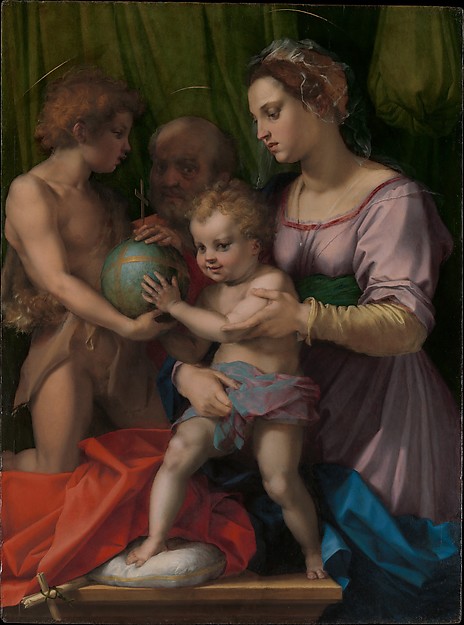
Image title: The Holy Family with the Young Saint John the Baptist
Medium: Oil on wood
Date: ca. 1528
Source:
The Met Collection
“
Only when we are no longer afraid do we begin to live.
”
— Dorothy Thompson
Virtual Museology: What Happens When Masterpieces Live Only in VR?
Introduction: A New Canvas
Once, a journey to marvel at Rembrandt’s brushwork or to stand in awe before Michelangelo’s sculpted David required pilgrimage—physical presence, shared air, and proximity to aging pigment or chiseled stone. But the 21st century has ushered in a seismic change in how we encounter art. With the rise of virtual museums, artworks are being dislodged from their physical locations and transported into pixelated realms. This transformation begs a profound question: What becomes of authenticity, aura, and the cultural dialogues once anchored to physical form?
Chapter 1: The Origins of the Museum—A Temple of Tangibility
Historically, museums emerged as temples of cultural heritage and custodians of civilizational memory. From the cabinets of curiosities in Renaissance Europe to the sprawling national galleries of the 18th and 19th centuries, museums offered the public both education and an almost sacred connection to relics and masterpieces. Tangible presence—of both the object and the viewer—was central to the museological experience. Artworks carried with them not just visual data but the weight of time, texture, and aura as described by Walter Benjamin. To see a Rembrandt in person, with its complex impasto and subtle chiaroscuro, was to engage in a conversation with the past.
Chapter 2: The Technological Turn—Digitization and Democratization
The late 20th and early 21st centuries witnessed a wave of museum digitization. Institutions like the British Museum and the Louvre began scanning and photographing their collections in high resolution. The introduction of Google Arts & Culture accelerated this trend, making previously inaccessible works viewable from any corner of the globe. Digitization broke down geographic and socio-economic barriers, democratizing access for students, scholars, and art lovers. Yet these virtual representations, though visually accurate, were removed from their material essence. A digital Vermeer offers composition and color, but can it offer the quiet intimacy triggered by standing before the canvas in a softly lit room?-
Chapter 3: Virtual Reality Exhibitions—Spatial Illusion and Artistic Simulation
With the advent of VR technology, museology is evolving into full immersion. Institutions like The Kremer Museum exist only in virtual space, housing digital renditions of 17th-century Dutch works. Instead of walking through marble halls, visitors navigate polygonal corridors, their avatars pausing before glowing pixelated replicas. VR solves many issues: preservation, accessibility, and even curatorial creativity unbounded by physical constraints. But it also redefines what it means to ‘be’ with a work of art. Is immersion in a computational space equivalent to the embodied experience of reality? Is aura a function of presence, or can it be coded into a lifelike simulation?
Chapter 4: Philosophical Dilemmas—Authenticity, Aura, and the Digital Sublime
Walter Benjamin’s seminal essay, “The Work of Art in the Age of Mechanical Reproduction,” lamented the loss of an artwork’s aura through replication. In the digital age, the stakes are higher. It’s no longer reproduction—it’s total transformation into code. VR doesn’t just replicate; it reconstructs environments, lighting, textures, and spatial contexts. But this raises critical questions: Can a simulacrum bear the soul of the original? Might a virtual Sistine Chapel inspire reverence, or is it theatre—a technologically enhanced echo of human genius?
Some philosophers argue that authenticity is not just about physical originality but experiential quality. If a VR experience enables new emotional and intellectual connections, perhaps it constitutes a new kind of authenticity—the digital sublime. Yet this does not diminish the ethical responsibility of remembering the original contexts, materials, and histories obscured beneath the digital gloss.
Chapter 5: The Future of Art Engagement—Hybrid Realities and Digital Ontologies
Looking forward, the paradigms are shifting. Rather than replacing physical art, virtual museology may augment it. Hybrid exhibitions offer both VR and physical components, blending direct experience and technological innovation. Future museums may become multi-platform environments where guests visit both in-person and through avatars, engaging with AI-generated narratives, curated paths, and interactive reconstructions.
Moreover, new forms of art native to the digital realm—net art, 3D-modelled installations, NFT-based works—demand a redefining of what constitutes a museum and a masterpiece. These are not simply digitized paintings—they are born digital, with their own aesthetic rules and philosophical implications.
Conclusion: Presence Beyond the Physical
Virtual museology invites us into a profound dialogue about the nature of presence, authenticity, and accessibility. As masterpieces like Rembrandt’s live on not just in conservation-controlled vaults but in luminous polygons and immersive headsets, we face both an existential loss and a conceptual gain. While the original canvas breathes with history, the digital variant floats freely, untethered and available to all. Perhaps the future of art appreciation is not a replacement, but a rivalry, between tangibility and transcendence. The museum, like the artwork it holds, is transforming—not vanishing.
Useful links: