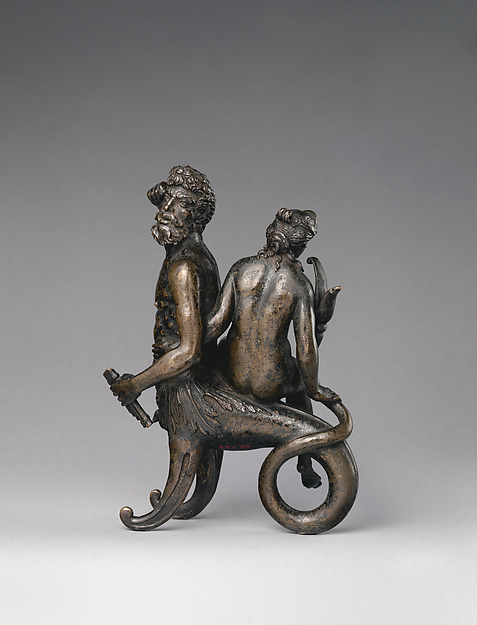
Image title: Triton and Nereid
Medium: Bronze
Date: after 1532–before ca. 1550
Source:
The Met Collection
“
When you see a man of worth, think of how you may emulate him. When you see one who is unworthy, examine yourself.
”
— Confucius
When Sculptors Drew Breath: The Sensual Biology of Baroque Marble
1. The Pulse Beneath the Stone
In the seventeenth century, marble ceased to be merely a medium for representation—it became a living substance, capable of evoking warmth, movement, and breath. At the heart of this transformation was the Baroque sculptor’s obsession with vitality. Unlike the composed serenity of Renaissance statuary, Baroque masters sought to capture an instant suspended between inhalation and exhalation. This ambition was no mere imitation of nature; it was a philosophical pursuit to reflect divine animation. To sculpt life into cold stone was to mirror, however briefly, the Creator’s act of imbuing matter with a soul.
When Gian Lorenzo Bernini first unveiled his ‘Apollo and Daphne’ in the mid-1620s, viewers were stunned—Daphne’s flesh seemed to quiver as it transformed into bark, her fingers sprouting leaves that felt fragile and translucent. Bernini’s illusionism was not simply technical; it was sensorial, rooted in an understanding of the tactile and visual responses of the human body. The sculptor’s chisel was guided by an intuitive anatomy, as if he could feel the contraction of muscle and the exhalation of breath through the marble itself.
2. The Legacy of Antiquity and the Renaissance Awakening
To understand how Baroque sculptors achieved this biological realism, one must first look back to their classical and Renaissance predecessors. Ancient Greek sculptors like Praxiteles and Lysippos had already imbued marble with a subtle sense of respiration—the slight twist of a hip, the weight distribution that made a figure seem to live within gravity. These were the seeds of what Baroque artists would amplify centuries later.
The Renaissance revived classical ideals, treating the human form as a temple of proportion and divine geometry. Artists such as Michelangelo viewed sculpture as an act of releasing life inherent within stone. But Michelangelo’s ‘David,’ though charged with latent energy, still exuded ideal restraint. In contrast, the Baroque sculptor would abandon stillness for the ecstasy of motion—a shift from the philosophical calm of balance to the vibrant imbalance of emotion. The body was no longer a vessel of perfection but of drama, desire, and vulnerability.
3. Bernini and the Science of Seduction
No artist embodied the sensual biology of marble more completely than Gian Lorenzo Bernini. He mastered not just the anatomy of the body but the anatomy of emotion. His ‘Ecstasy of Saint Teresa,’ carved between 1647 and 1652, remains a haunting display of the boundary between physical sensation and spiritual transcendence. Saint Teresa’s face and form exhibit a mingling of pain and rapture—breath catching, flesh yielding—as if divine love and physical pleasure were indistinguishable.
Contemporary accounts describe how Bernini studied the play of light across skin, the swelling of a pulse, the glimmer of moisture on lips. These observations, filtered through marble, yielded an illusion of transience rarely achieved in stone. The tactile realism was supported by the scientific fascinations of the period: anatomical dissection, advances in optics, and a growing curiosity about human physiology. Bernini’s art intersected science and faith, employing material mastery to explore the tension between body and soul.
4. The Broader Baroque Landscape: Matter, Movement, and Mysticism
While Bernini stands as the towering figure of Baroque sculpture, the era teemed with artists who shared his passion for reanimating stone. In France, François Duquesnoy sought a subtler form of spiritual vitality in his depictions of cherubs and saints, blending the idealized calm of antiquity with a soft anatomical credibility. In Spain, sculptors such as Pedro de Mena used painted wood rather than marble, yet the intent was the same—to make matter breathe, to make devotion tactile.
Philosophically, this was an age captivated by the interplay between form and emotion. The Catholic Church, responding to the Reformation, sought art that could move the faithful to religious fervor. In this context, sculptural animation was more than aesthetics; it was persuasion. The body in motion became a moral language, speaking directly to the senses. The merging of craftsmanship, religious narrative, and the illusion of beating hearts turned Baroque sculpture into a theater of divine embodiment.
5. The Echo of Breath: Legacy and the Digital Future
The Baroque fascination with sculpting life into stillness continues to echo in contemporary art. Modern sculptors and digital artists often revisit the same questions that haunted Bernini: where does matter end and perception begin? Today’s 3D scanning and digital modeling technologies allow for similar manipulations of texture and light to simulate the softness of living flesh. Yet, even with all our tools, the mystery persists—the ancient wonder that marble, cold and inert, can be coaxed into appearing warm and alive.
To gaze upon a Baroque sculpture is to encounter a paradox: stone that breathes. These works occupy a space between biology and miracle, between scientific inquiry and divine artifice. The Baroque sculptor’s touch endures not only as a testament to skill but as an eternal meditation on life itself. The breath they captured in marble continues to whisper across centuries, inviting us to believe, if only for a moment, that the impossible has taken shape.
Useful links: