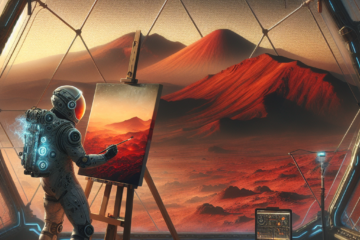
Image title: Mars and Venus United by Love
Medium: Oil on canvas
Date: 1570s
Source:
The Met Collection
“
Beauty is not in the face; beauty is a light in the heart.
”
— Kahlil Gibran
Venus on Mars: Rewriting Feminine Beauty Through Sci-Fi Aesthetics
Introduction: Beyond the Terrestrial Gaze
The traditional canon of art history has long revered feminine beauty within narrow, Eurocentric, and terrestrial constraints—casting Aphrodite-like figures in marble and painting Renaissance Madonnas in oil. But in recent decades, a growing number of feminist and queer artists have turned their gaze to the stars, blending speculative fiction with visual art to imagine bodies and identities beyond Earth’s cultural gravity. In this blog, we explore how speculative aesthetics—especially those rooted in science fiction—are reshaping our understanding of beauty, gender, and futurity through a lens that might best be described as “Venus on Mars.”
Chapter 1: Classical Ideals and the Seeds of Rebellion
The history of feminine beauty in visual art begins with idealized forms stemming from Greco-Roman sculpture and early European painting. Aphrodite (or Venus), Botticelli’s Birth of Venus, and Ingres’ Odalisque epitomize bodies conforming to the tastes of male patrons and the limitations of terrestrial gender norms. The Enlightenment and Victorian periods cemented this ideal, linking beauty to moral virtue and bodily proportion. But within these constraints, we also find early traces of resistance—women artists like Artemisia Gentileschi reinterpreted mythological scenes with more agency and psychological depth, planting the seeds for a rupture in aesthetic tradition that would come centuries later.
Chapter 2: The Postwar Futurism of Feminist Sci-Fi
With the boom of technological advancement in the post-World War II era and the emergence of the science fiction genre in literature and cinema, artists began to imagine gender and beauty outside Earth’s atmosphere. Writers like Ursula K. Le Guin and Octavia Butler crafted worlds where gender was nonbinary, mutable, or irrelevant. These narratives inspired visual artists who saw in the speculative future a blank canvas for reimagining identity. Multidisciplinary artist Lynn Randolph, for example, collaborated with feminist theorist Donna Haraway, whose “Cyborg Manifesto” (1985) called for hybrid, boundary-breaking identities. Randolph’s work featured technofemmes—part human, part machine—subverting flesh-and-blood beauty standards rooted in the past.
Chapter 3: Cyberpunk, Cyborgs, and the Alien Feminine
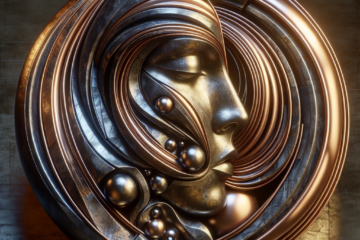
The 1980s and ‘90s saw a surge of cyberpunk aesthetics, merging punk subculture with high-tech dystopias. This was fertile ground for feminist artists exploring the alien feminine—figures marked by appendages, metallic skin, and gender-defying silhouettes. Artists like ORLAN took this to visceral extremes, using plastic surgery as performance to question ideals of beauty through “Carnal Art.” In her work “The Reincarnation of Saint-Orlan,” she altered her body to reflect composite ideals from different art historical icons, effectively constructing a post-human goddess. Similarly, the rise of video art and virtual reality provided artists such as Shu Lea Cheang with the tools to create immersive, radical reimaginings of gender in sci-fi settings, blending queer theory with digital architecture.
Chapter 4: Afrofuturism and Decolonial Beauty
Afrofuturism, popularized by Sun Ra, George Clinton, and more recently by artists like Janelle Monáe and Wangechi Mutu, introduced an urgent intersection of speculative fiction, race, and femininity. Mutu’s collages and sculptures present African diasporic female bodies fused with alien flora, cybernetic limbs, and cosmic symbolism. These hybrid figures resist colonially imposed beauty norms and embody a decolonial, diasporic, and wildly imaginative approach to selfhood. Through speculative elements, Afrofuturism critiques Eurocentric aesthetics and builds a new visual lexicon of radical beauty—off-planet and deeply grounded in ancestral memory.
Chapter 5: Digital Feminism and Virtual Goddesses
The rise of digital media in the 21st century has catalyzed a new generation of artists working with 3D modeling, augmented reality, and AI to challenge human-centric ideals of beauty. Artists like Martine Syms, Sondra Perry, and Morehshin Allahyari reinvent avatars and digital doubles that fracture, glitch, and morph beyond binary classification. Allahyari’s she-monsters in her “She Who Sees the Unknown” series resurrect mythic female figures from Middle Eastern folklore, embodying a resistance to both Western narratives and technological sovereignty. Meanwhile, Instagram-native artists like LaTurbo Avedon—an entirely virtual persona—blur the line between artist and artwork, questioning what it means to be beautiful, gendered, or even real in a post-human aesthetic economy.
Conclusion: Beauty as a Speculative Weapon
From cyborg goddesses to alien anthropomorphs, feminist artists across eras have used speculative aesthetics to decouple beauty from biology, gender from genitalia, and humanity from hegemony. These visionary acts of creative resistance not only expand our cultural imagination but also furnish tools for survival in an increasingly fluid and virtual world. “Venus on Mars” is not an exile from Earth, but a projection beyond its limitations—a bold aesthetic insurgency against static ideals. In the cosmos of speculative art, beauty is no longer a mirror; it’s a portal.

Useful links: