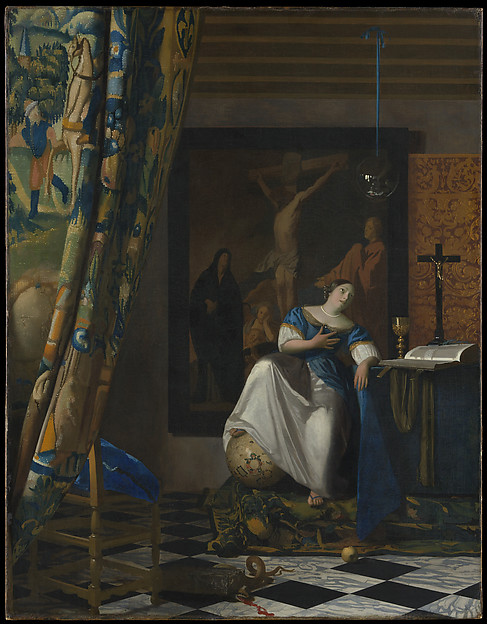
Image title: Allegory of the Catholic Faith
Medium: Oil on canvas
Date: ca. 1670–72
Source:
The Met Collection
“
Your sacred space is where you can find yourself again and again.
”
— Joseph Campbell
Velázquez vs. Vermeer: Silence, Space, and the Spectacle of the Interior
Introduction: Two Masters of the Seventeenth Century
Diego Velázquez and Johannes Vermeer stand among the most distinguished painters of the 17th century, yet their artistic visions could not be more distinct. Both artists turned their gaze inward—toward the domestic interiors and the quiet moments of everyday life—but they arrived at radically different psychological and aesthetic outcomes. Velázquez, rooted in the grandeur and intellectual fervor of the Spanish Baroque, frequently encoded power dynamics and court intrigue within his compositions. Vermeer, the Dutch master of silence and light, painted domestic life with poetic restraint and an almost metaphysical serenity. In this blog, we explore how these two artists transformed interior space into a stage for spectacle, silence, and subtle drama through distinct approaches to composition, space, and narrative.
Chapter 1: The Spanish Court and Velázquez’s Theater of Power
Velázquez’s role as court painter to King Philip IV of Spain gave him unparalleled access to the cloistered world of aristocracy and royalty. His interiors, such as those in the masterwork Las Meninas (1656), are charged with political tension and illusionistic daring. The room depicted in Las Meninas is at once a studio, a court chamber, and a philosophical meditation on the act of seeing. The figures in the space—royalty, servants, the artist himself—are engaged in silent theatre, composed within a rational yet enigmatic grid of light, shadow, and distance.
What sets Velázquez apart is his painterly looseness, a bravura handling of oil that anticipates Impressionism. His brushwork dissolves detail without losing form, suggesting a world in motion. The Velázquez interior becomes a backdrop for performance: visual information is staged rather than settled, gesturing toward drama, authority, and presence.
Chapter 2: Vermeer and the Poetics of Private Quietude
In contrast, Vermeer’s Delft was far removed from the glittering court life of Madrid. Working in a Protestant, middle-class society that valued piety and domestic order, Vermeer focused inward—both literally and philosophically. His interiors are luminous sanctuaries bathed in northern light, as seen in paintings like Woman Holding a Balance (c. 1664) and The Music Lesson (c. 1662). These rooms are meticulously constructed worlds of contemplation and quiet labor.
Vermeer’s technique was cerebral and precise. Recent studies suggest he may have used a camera obscura to aid composition, contributing to the crystalline light and photographic quality of his canvases. But beyond technical considerations, it is Vermeer’s ability to distill mood—stillness, anticipation, reflection—that defines his interiors. Where Velázquez gives us a theater, Vermeer offers a chapel of the everyday.
Chapter 3: Light as Language
Light plays a pivotal role in both artists’ work, yet their use of it diverges significantly. Velázquez employs directional, sometimes dramatic chiaroscuro to evoke depth and tension. His rooms breathe through gradients of shadow, giving mass to space and figures. The light in Las Meninas does not only illuminate; it orchestrates hierarchies and directs our gaze with cinematic verve.
Vermeer’s light, by contrast, is diffused, celestial, and consistent. It enters typically from the left, casting a spiritual clarity across his scenes. The effect is less theatrical and more meditative, reminiscent of how light operates in religious iconography—but redirected toward the profane world of domestic labor, study, and courtship. In this way, Vermeer spiritualizes the mundane, transforming daily rituals into acts of grace through the soft alchemy of natural light.
Chapter 4: Psychological Space and Viewer Engagement
Velázquez engages the viewer directly, often collapsing the space between artwork and observer. In Las Meninas, the painted canvas we cannot see (but which characters are reacting to) may well be a portrait of us. Velázquez implicates us in the act of looking, forcing a confrontation with presence, perception, and power.
In contrast, Vermeer keeps the viewer at a contemplative remove. His subjects are often absorbed in thought or task, unaware of our gaze. This creates a psychological barrier that paradoxically draws us in—we become eavesdropping witnesses to a moment poised delicately between temporality and eternity. These are quiet revelations, where emotional depth resides not in action, but in the stillness between moments.
Chapter 5: Reflection and Influence
While neither artist achieved widespread fame in their own lifetimes, their respective influences have been immense. Velázquez shaped the Spanish tradition and later inspired artists like Goya, Manet, and Picasso. His interiors became blueprints for modern explorations of illusion, identity, and authorship. Vermeer, nearly forgotten until the 19th century, became a touchstone for realism, photography, and minimalist aesthetics. His interiors have influenced everyone from Proust to Tarkovsky.
In our age of digital screens and constant overstimulation, both Velázquez and Vermeer offer counterpoints: one through intellectual theatrics, the other via luminous stillness. Their interiors—seen side by side—construct a dialectic of space and silence, a reminder that our surroundings shape not only what we see, but how we feel, think, and remember.
Conclusion: Beyond the Threshold
The legacy of Velázquez and Vermeer offers more than painterly technique or historical flavor. It gives us two radically different ways to inhabit interior space—emotionally, intellectually, and spiritually. As windows into their respective cultures—and mirrors of our own—they remind us that every room holds a language, every light a story.
Useful links: