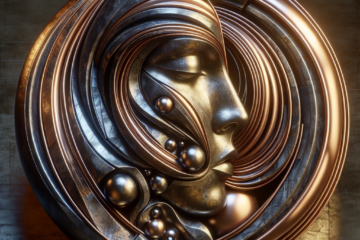
Image title: Rothschild lamp
Medium: Bronze, on a later wood base
Date: ca. 1510–20
Source:
The Met Collection
“
People grow through experience if they meet life honestly and courageously. This is how character is built.
”
— Eleanor Roosevelt
‘This Is Not a God’: Deconstructing Colonial Museum Displays Through Indigenous Eyes
Introduction: The Gaze That Froze the Sacred
Walk into any major ethnographic museum and you’ll find glass-encased artifacts often stripped of their sacred vitality, labeled with cold, encyclopedic precision. Shields, masks, totems—once living conduits of spiritual energy—now rest in eerie stillness, arranged by curators whose intentions were often more ethnological than empathetic. For centuries, these sacred objects were collected, cataloged, and displayed, not as active agents of culture but as exotic curiosities within colonial narratives. But today, Indigenous artists, scholars, and communities are demanding a decolonization not just of content, but of the very lens through which these items are viewed. This blog explores this urgent dialogue by tracing the evolution of visual art’s relationship with Indigenous artifacts, from colonial plunder to contemporary reclamation.
I. Enlightenment Eyes: Science, Spectacle, and the Birth of Ethnographic Museums
The rise of ethnographic museums in the 18th and 19th centuries coincided with the European Enlightenment, a time when empires expanded their reach and thinkers sought to classify the world. Objects seized from colonized lands were exhibited in ‘cabinets of curiosity’ before evolving into formal institutions such as the British Museum and Musée du quai Branly. These spaces presented colonized peoples not as cultural equals but as subjects to be studied, their objects reframed as anthropological specimens. The idea of “the primitive” was constructed in contrast to “civilization,” with Indigenous art seen not as art at all, but as artifacts—passive remnants of a people presumed to be disappearing.
II. The Aesthetic Turn: Modernism, Appropriation, and the Mask as Muse
In the early 20th century, European artists like Pablo Picasso and André Derain

Image description:
File:WTF Marlene Oostryck Maritime Museum display cases 1.jpg
License:
CC BY 3.0
Source:
Wikimedia Commons
Useful links: