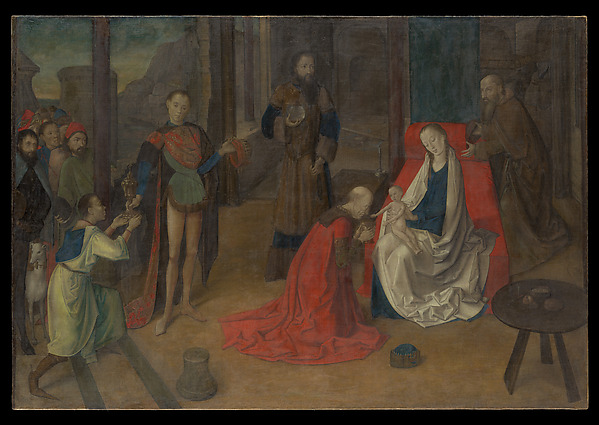
Image title: The Adoration of the Magi
Medium: Distemper on canvas
Date: 1472–74
Source:
The Met Collection
“
Love is the attempt to form a friendship inspired by beauty.
”
— Cicero
‘Third Eye’ Draftsmanship: Drawing Practices Inspired by Mysticism
Introduction: Drawing as a Portal
Throughout history, artists have not only recorded the visible world but also attempted to capture the invisible—visions, energies, and revelations that point beyond the veil of everyday perception. This mystical dimension of draftsmanship—what we might call “Third Eye” drawing—transcends representation. It seeks, instead, to mediate experiences of the sacred, the cosmic, and the subconscious. Whether in the trance-guided paintings of Hilma af Klint, the esoteric diagrams of Tantric traditions, or the automatic drawings of the Surrealists, drawing has often served as a spiritual and metaphysical practice. This article explores how these mystical approaches to drawing evolved, each reflecting cultural beliefs, philosophical attitudes, and even technological developments of their time.
1. Sacred Geometry: Drawing Divinity in Ancient Traditions
Long before drawing was employed for portraiture or landscapes, it functioned as a sacred activity in religious and mystical contexts. In Hindu and Buddhist traditions, intricate mandalas and yantras—geometric diagrams used in meditation—were not mere ornaments but portals to divine consciousness. These diagrams often contained layered symbolism: concentric shapes representing spiritual ascension, colors aligned with chakras, and sacred syllables encoded in visual form. Similarly, in the Islamic world, geometric patterns served both to honor the infinite nature of God and to encourage contemplation. Here, drawing was not about expressing individuality but interfacing with a universal order.
2. The Renaissance and Occult Symmetry
The European Renaissance, known for its revival of classical ideals, also saw an uptick in esoteric practices linking art to the mystical. Thinkers like Leonardo da Vinci explored anatomical and architectural proportions with a near-spiritual intensity, seeking divine harmony in line and form. However, artists like Albrecht Dürer and Athanasius Kircher took things a step further—using symbols, alchemical iconography, and arcane visual codes. These drawings didn’t aim to portray the real world alone but projected maps of the cosmos, the soul, and hidden knowledge. Drawing, then, became a method to rationalize mystery in a science-soaked world.
3. Theosophy and Female Visionaries: Hilma af Klint and Beyond
The late 19th and early 20th centuries witnessed a renewed hunger for spirituality in response to industrialization and materialism. Movements like Theosophy and Anthroposophy emerged, blending Eastern religious philosophy with Western esotericism. Swedish painter Hilma af Klint stands as a seminal figure in this milieu. Claiming to work under the instruction of spiritual beings during trance states, her intricate, abstract drawings predate even Kandinsky’s supposed first abstractions. Their symbols and swirling forms offer neither clear subjects nor narratives—instead, they function as transmissions from another plane of consciousness. Other artists influenced by spiritual practices, like Emma Kunz and Georgiana Houghton, also rooted their drawing in divine communication rather than academic training.
4. Automatism: The Surrealist Threshold
In the aftermath of World War I, a skeptical generation turned toward the subconscious as a new territory for exploration. Surrealism, anchored in psychoanalysis, embraced automatic drawing as a gateway to hidden inner truths. Artists like André Masson, Joan Miró, and later Henri Michaux let their hands roam paper without rational control, echoing earlier trance-based methods but recontextualized within Freudian frameworks. These drawings—improvised, jagged, and often chaotic—sought to bypass the intellect and tap into the stream of altered awareness. Though departing from religious mysticism, they emphasized the ‘third eye’ as a visionary faculty of the mind rather than the spirit.
5. Digital Mysticism and Contemporary Practice
In today’s era, marked by digital immersion and spiritual pluralism, mystical drawing practices have taken on new forms. Contemporary artists blend code and intuition, machine assistance and trance-like states. Augmented reality and generative algorithms produce complex diagrams that ask: can machines glimpse the divine? Meanwhile, a resurgence in spiritual art sees renewed interest in ayahuasca visions, ancestral symbolism, and New Age geometry—evident in the works of artists like Shantell Martin and Alex Grey. These contemporary draftspeople extend the lineage of mystical drawing into the 21st century, proving that the urge to map inner worlds remains as potent as ever.
Conclusion: Drawing Through the Inner Eye
Throughout its history, mystical drawing has inhabited a liminal space—between personal vision and cosmic law, cultural ritual and individual revelation. From tantric diagrams to surreal scribbles, these approaches to draftsmanship challenge the idea of drawing as mere depiction. Instead, they position the act as a sacred conduit—a way to open the third eye and draw upon realities unseen by the physical senses. In a world increasingly dominated by images, returning to the mystical dimensions of mark-making may not only enrich artistic practice but rekindle our connection to the numinous.

Image description:
File:Hendrick Goltzius – Mystical Marriage of Saint Catherine, 1599 – Teylers Museum.jpg
License:
Public domain
Source:
Wikimedia Commons
Useful links: