“
The smaller the mind the greater the conceit.
”
— Aesop
The Painter’s Algorithm: How AI Reimagines Abstract Expressionism
Introduction: A Dialogue Between Canvas and Code
For centuries, artists have grappled with the ineffable—the transmission of feeling through pigment, gesture, and texture. Abstract Expressionism, born in the mid-twentieth century, sought to liberate painting from representation, focusing instead on pure emotion and gesture. Today, this spirit of liberation finds an unlikely extension in artificial intelligence. Machine learning models, trained on vast archives of human creativity, are now producing images that evoke chaos, rhythm, and emotion. But can code, a structure of logic and pattern, truly replicate—or even reinterpret—the spontaneous essence of human expression? This question stands at the heart of the painter’s new algorithmic epoch.
Chapter I: The Birth of Gesture — Abstract Expressionism in Context
In postwar America, artists like Jackson Pollock, Willem de Kooning, and Mark Rothko redefined the purpose of painting. Gone were the clear subjects of Renaissance art or the structured compositions of Impressionism. The canvas became a stage where emotions found form through improvisation. Pollock’s drips and splatters were not planned but discovered through motion. The body, not the brush, became central. The artist was both performer and philosopher. Abstract Expressionism was less about image and more about existential introspection. It reflected an age of anxiety and possibility—a search for meaning after the disillusionment of war.
Chapter II: From Analog to Algorithm — The Digital Turn
By the late twentieth century, digital tools began to infiltrate art-making, altering how artists engaged with materiality. Early computer art, pioneered by figures like Harold Cohen, explored generative systems and randomness—a concept not far removed from the freedoms that Pollock had pursued on the floor of his studio. Yet digital art of this period still served as a tool, not a collaborator. The artist commanded the code; the machine executed. It was not until the advent of machine learning that the dynamic truly shifted, giving rise to forms of artificial creativity that could surprise even their creators.
Chapter III: The Age of Neural Brushstrokes — AI as Abstract Artist
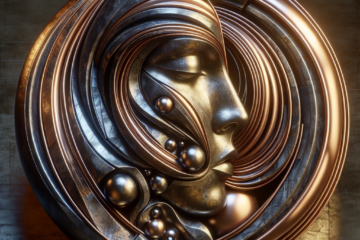
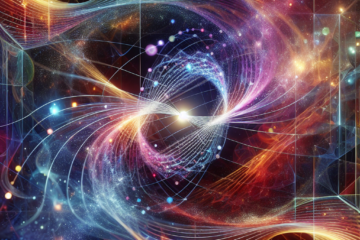
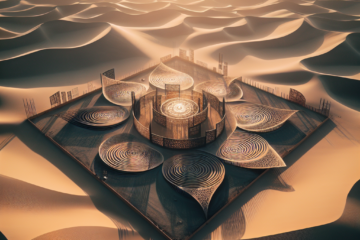
Machine learning, particularly through neural networks and diffusion models, has introduced new types of visual abstraction. These systems analyze millions of images, detect patterns invisible to human perception, and synthesize novel forms that evoke emotion without direct reference. The brushstroke is now a line of code; the gesture, a computational operation. When an AI generates an abstract painting, it does not act from impulse but from probability. Yet the results can be disarmingly evocative, resembling the open rhythms of Pollock’s drip paintings or the deep meditative fields of Rothko’s color planes. This convergence raises an unsettling question—can a machine, devoid of consciousness, still capture the essence of human feeling?
Chapter IV: Emotion, Entropy, and the Illusion of Chaos
Abstract Expressionism thrived on chaos—the unpredictable meeting of body and material. AI, however, operates with mathematical precision. Its “chaos” is simulated, emerging from complex but ultimately rule-bound systems. Philosophically, this difference matters. Human creativity is embedded in lived experience—trauma, joy, memory—while AI’s creative output is statistical. Yet paradoxically, both rely on randomness: Pollock’s arcs of paint follow laws of physics as surely as a neural network obeys its algorithms. Perhaps what we perceive as emotion in art is less an attribute of the creator than an emergent property of perception itself. In that sense, the viewer’s interpretation bridges the divide between human intention and machine output.
Chapter V: Beyond the Canvas — The Future of Gesture
As we step further into the twenty-first century, the conversation between artists and machines grows more nuanced. AI art generators are not replacing painters but expanding the vocabulary of gesture. Artists now collaborate with algorithms, treating them as co-creators rather than tools. Just as Abstract Expressionists sought freedom from representation, contemporary digital artists seek liberation from authorship. The painter’s algorithm, then, is less a replacement for human creativity than a mirror—one reflecting our endless desire to understand emotion through form, logic, and the ever-evolving dialogue between chaos and control.
Conclusion: The Algorithm as Muse
The legacy of Abstract Expressionism lies in its devotion to authenticity of gesture. AI cannot feel—but it can interpret the patterns of feeling embedded in century upon century of artistic effort. As machine learning transforms brushstrokes into data and motion into metrics, we are reminded that art has always striven to externalize the ineffable. The algorithm may never weep, but it may well paint something that makes us weep. In that paradox, perhaps, lies the new frontier of human imagination.
Useful links: