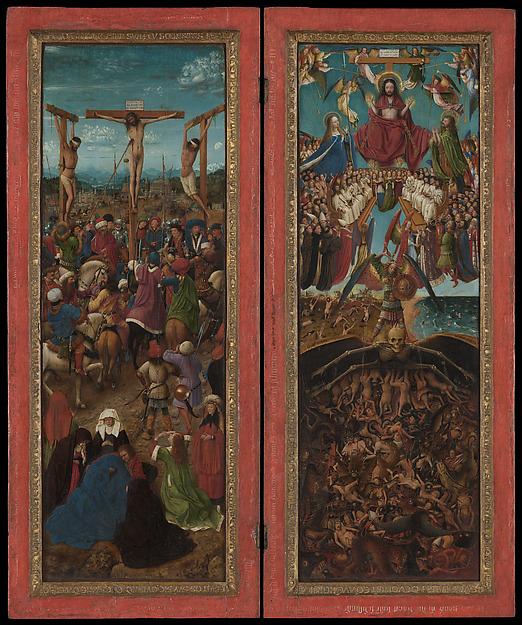
Image title: The Crucifixion; The Last Judgment
Medium: Oil on canvas, transferred from wood
Date: ca. 1436–38
Source:
The Met Collection
“
Think in the morning. Act in the noon. Eat in the evening. Sleep in the night.
”
— William Blake
The Painted Cosmos: Astronomical Imagery in Medieval Manuscripts
Introduction: Heaven Above, Ink Below
Long before Galileo turned his telescope to the stars, artists of the Middle Ages envisioned the cosmos with quill and pigment. Medieval manuscripts, painstakingly illuminated by scribes and monks, represent some of the most imaginative visual interpretations of the universe prior to the scientific revolution. These intricate depictions, woven from religious, philosophical, and observational threads, offered a means by which the cosmos could be understood and marveled at—through both divine revelation and human curiosity. In this article, we explore the celestial iconography of medieval manuscripts and how they mirror humanity’s quest to grasp the mysteries of the heavens.
1. Cosmology Roots: Classical Echoes in Early Medieval Art
Medieval ideas of the cosmos were heavily influenced by Greco-Roman thought, particularly the works of Aristotle and Ptolemy. These philosophies, preserved and translated by Islamic scholars, made their way back into Europe in the early Middle Ages. Manuscripts such as Isidore of Seville’s “Etymologiae” offered schematic diagrams of a geocentric universe—firmly placing Earth at the center, surrounded by concentric spheres representing the moon, planets, and stars. Often these diagrams appeared in encyclopedic texts or philosophical treatises and were stylized with geometric precision and symbolic ornamentation, representing the cosmos as an ordered, divine system.
2. Sacred Spaces: Theological Visions of the Universe
For medieval people, the universe was not merely a physical domain; it was the theater of divine creation. This spiritual lens shaped how artists interpreted astronomical ideas. The “Hortus Deliciarum” by Herrad of Landsberg, a 12th-century abbess, includes dazzling illustrations of the firmament populated with angelic beings orbiting divine centers. These celestial charts blurred the lines between observation and exaltation. Similarly, the “Bede’s De Natura Rerum” contained rich diagrams that interwove Christian cosmology with natural philosophy. In these works, stars and planets were not distant bodies of gas but signs of heavenly order, fulfilling a divine plan comprehensible through scripture and artistry alike.
3. The Zodiac and the Liturgical Year
One of the more surprisingly practical applications of astronomical images in medieval manuscripts was the integration of zodiac signs into calendars. Found prominently in “Books of Hours,” such as the Très Riches Heures of the Duke of Berry, these images linked celestial events to the religious and agricultural calendars. Each month was aligned with a zodiac sign and seasonal labor, blending astrology, timekeeping, and liturgy into richly painted folios. These depictions not only mapped the heavens but helped inhabitants of the medieval world orient their lives in harmony with celestial rhythms.
4. Transmission and Transformation: Influence of Islamic Science
The 12th and 13th centuries saw an intellectual revival in Europe through contact with the Islamic world, which had preserved and advanced classical astronomical texts. The translation movement, centered in places like Toledo and Palermo, introduced works by Al-Farghani, Al-Zarqali, and others to Christian Europe. Artists and scholars began incorporating more sophisticated instruments such as the astrolabe and armillary sphere into manuscript illustrations. Manuscripts like the “Alfonsine Tables,” commissioned by King Alfonso X of Castile, illustrate a growing interest in empirical observation. This marked a subtle but crucial shift in astronomical imagery—from symbolic to semi-scientific depictions, all still rendered with exquisite artistry.
5. Toward the Renaissance: The Cosmos Expands
By the late Middle Ages, as scholasticism bloomed and universities spread across Europe, a more nuanced cosmological vision emerged. Artists like Jean Fusoris and manuscripts such as the “Cosmographia” of Claudius Ptolemy (in its Latin translation) signaled a growing awareness of the universe’s complexity and scale. Illumination, once primarily a tool for religious devotion, increasingly became a medium to explore and understand the natural world. Though still framed within a theological context, these late medieval artworks began to edge toward the more observational ethos that would define Renaissance astronomy.
Conclusion: A Sky Painted with Faith and Inquiry
Medieval manuscripts offer more than ornate decoration—they are celestial cartographies shaped by the interplay of faith, inheritance, and imagination. Through these painted pages, we glimpse a world where the cosmos was at once divine mystery and intellectual pursuit. The images penned in candle-lit scriptoriums reflect not just how medieval people saw the sky, but how they sought meaning in it. In bridging cosmic wonder with artistic devotion, they revealed a universe that was as much within as above.
Useful links: