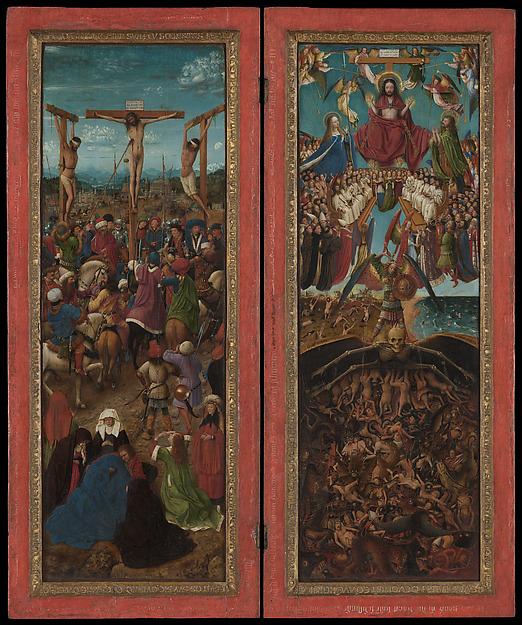
Image title: The Crucifixion; The Last Judgment
Medium: Oil on canvas, transferred from wood
Date: ca. 1436–38
Source:
The Met Collection
“
Things are as they are. Looking out into it the universe at night, we make no comparisons between right and wrong stars, nor between well and badly arranged constellations.
”
— Alan Watts
The Night the Stars Fell Into Canvas: Astronomy’s Hidden Influence on Romanticism
Introduction: When Science Met the Sublime
In the late eighteenth and early nineteenth centuries, the night sky underwent a quiet revolution. Telescopes grew more powerful, constellations were mapped with unprecedented precision, and humankind began to grasp the vastness of the cosmos. Yet this transformation was not confined to observatories or scientific treatises—it trembled through the imagination of artists. Romantic painters, haunted and inspired by these astronomical discoveries, sought to translate infinity into paint. Their canvases glowed with suns, moons, and meteors, expressing both awe and existential humility. This interplay between astronomy and art reveals how science can reshape not only knowledge but also emotion and vision.
Chapter I: Enlightenment Shadows and the Seeds of Romanticism
The Enlightenment had already elevated reason and empirical study, with figures like Isaac Newton dissecting celestial mechanics and Galileo turning his telescope toward the heavens. But the Romantics rebelled against the cold rationalism of their predecessors. For them, science did not quench the spirit—it deepened the mystery. The sense that humanity was but a small flicker amid an immense and unknowable cosmos became a Romantic obsession. William Blake’s illuminated engravings, with their swirling energy and cosmic beings, are not just spiritual visions—they echo the astronomical diagrams that had permeated public consciousness.
Chapter II: Painting the Infinite—Turner and the Sublime Sky
Joseph Mallord William Turner stands as one of the pivotal figures in Romanticism’s astronomical turn. His skies blaze with the drama of stellar birth and destruction, refracting light as though through a cosmic lens. Turner’s exposure to scientific lectures and his friendship with natural philosophers fostered his obsession with atmospheric phenomena. Paintings such as *Light and Colour (Goethe’s Theory)* and *The Fighting Temeraire* reveal his fascination with how light—both a physical and metaphysical force—could render the visible infinite. The sublime in Turner’s art is at once meteorological, astronomical, and spiritual: the heavens are no longer backdrop, but active, even sentient, participants in the human story.
Chapter III: Caspar David Friedrich and the Terra Incognita of the Soul
Where Turner saw motion and light, the German Romantics found stillness and introspection. Caspar David Friedrich’s lonely wanderers and silent mountains echo not only the melancholy of human isolation but also the cosmic quiet revealed by astronomy. The vast, star-filled expanses in Friedrich’s works convey a paradox: the heavens as both comforting canopy and cold abyss. His *Two Men Contemplating the Moon* captures this duality—its figures gazing upward, dwarfed by immensity, suggest that outer space mirrors inner space. Friedrich’s compositions are visual meditations on what it means to be a conscious being staring into an infinite unknown, a distinctly astronomical form of spirituality.
Chapter IV: The Telescope and the Palette—Technology as Inspiration
Technological advances richly informed the Romantics. The telescope, once a scientific instrument, became an imaginative portal. The discovery of Uranus, the mapping of nebulae, and the expanding catalog of celestial bodies pushed artists to envision environments beyond Earth. Publications such as John Herschel’s star atlases circulated widely, shaping even the aesthetic vocabulary of painters and printmakers. Artists began to experiment with techniques that mirrored cosmic forms: swirling vortices, diffuse mists, and luminous centers resembling celestial orbits. The language of astronomy thus became part of visual culture, marrying technical progress with emotional depth. The universe offered not just knowledge but metaphor—a theater for the struggle between order and chaos, faith and doubt.
Chapter V: Legacy and Rebirth in Modern Eyes
The Romantic fascination with cosmic imagery did not end with the nineteenth century. Impressionists and Symbolists continued to gaze upward, translating celestial awe into color and texture. In the twentieth century, artists like Georgia O’Keeffe and later Yayoi Kusama approached the infinite through abstraction, while the Space Age revived visual and philosophical interest in the cosmos. Today’s digital artists, armed with NASA imagery and data visualization tools, stand as heirs to those Romantic dreamers who first let the stars fall onto canvas. Each new depiction of space rekindles the same yearning: to find humanity’s reflection in the boundless dark, to turn the telescope inward and outward at once.
Conclusion: The Continuing Dance of Wonder
Astronomy’s influence on Romantic painters revealed an enduring truth: that art and science are not opposites but partners in awe. Both seek to comprehend what lies beyond the limits of perception. When the Romantics dipped their brushes into the night sky, they redefined not only beauty but the very scale of imagination. The stars remain our oldest teachers, and their descent into paint reminds us that wonder itself is an infinite resource—uncharted, eternal, and as luminous as the heavens they inspire.
Useful links: