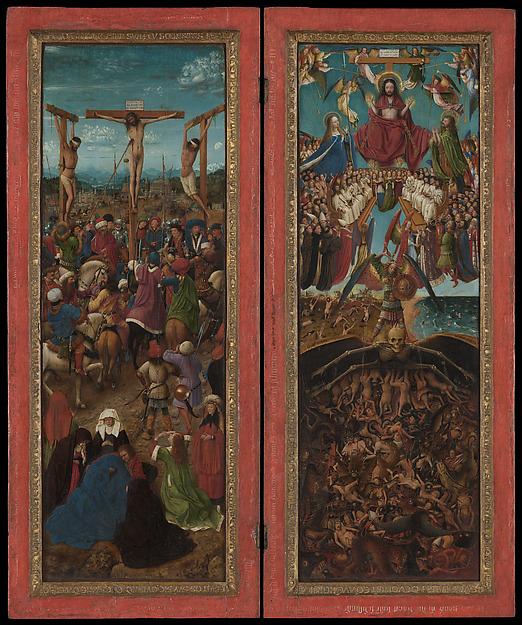
Image title: The Crucifixion; The Last Judgment
Medium: Oil on canvas, transferred from wood
Date: ca. 1436–38
Source:
The Met Collection
“
I never considered a difference of opinion in politics, in religion, in philosophy, as cause for withdrawing from a friend.
”
— Thomas Jefferson
The Futurist Who Hated Time: Speed, Violence, and Politics in Early 20th Century Italy
The Speed of Desire: An Introduction to Futurism
In the chaotic blur of the early 20th century, the art movement known as Futurism exploded onto the cultural stage in Italy. Declaring a radical break with the past, Futurist artists embraced speed, machinery, youth, and violence. They adored the automobile over the statue, war over peace, and motion over stillness. Led by the charismatic Filippo Tommaso Marinetti and soon joined by painters like Umberto Boccioni and Giacomo Balla, Futurism quickly became synonymous with an electrifying call to arms—a desire to pulverize tradition in favor of “the beauty of speed.” But behind the veneer of avant-garde rebellion lurked unsettling contradictions, as this supposedly future-obsessed movement became deeply entangled with one of the most regressive political forces of the 20th century: Italian Fascism.
Rejecting the Past, Worshipping the Machine
The Futurists positioned themselves as revolutionaries of a modern world. Marinetti’s “Futurist Manifesto,” first published in 1909 in the French paper Le Figaro, served as a clarion call. He called museums “cemeteries,” history “a deforming lie,” and declared that “a roaring motor car… is more beautiful than the Victory of Samothrace.” Their paintings, sculptures, and performances sought to capture dynamic motion. Cubism’s fracturing forms inspired Futurists to explore how objects moved through space and time. In Balla’s “Dynamism of a Dog on a Leash” (1912), multiple legs, tails, and shadows convey rapid motion, a visual grammar appropriate for an age of trains, telegraphs, and turbomachinery.
Their philosophy was also deeply technological. Futurists saw humanity as merging with the machine, long before cybernetic theory took form. Technology wasn’t just instrumental—it was aesthetic and moral. But this elevation of technology was paradoxically coupled with a militaristic embrace of destruction. War, they said, was “the world’s only hygiene.” Progress, in this warped vision, demanded not just speed, but violence.
The Politics of Acceleration
Just as Futurism celebrated breaking with the past, it became increasingly seduced by control and uniformity. This contradiction reached a crescendo in the 1920s, when many Futurists, including Marinetti himself, aligned with Benito Mussolini’s nascent Fascist movement. Marinetti even founded the Futurist Political Party in 1918, which merged with the Fascist Party shortly thereafter. What began as a cultural rebellion against ossified tradition was now helping to establish a dangerous new orthodoxy built on authoritarianism.
The rhetoric of speed and dynamism dovetailed neatly with fascist propaganda. Both valorized action over deliberation, youth over age, strength over reflection. Yet while art sought new forms of expression, fascism sought ideological conformity. Futurism’s faith in innovation now operated within a regime obsessed with order.
The Artistic Utopia That Became a Dystopia
Ironically, Futurist paintings offered little room for political subtlety. Works like Boccioni’s “Unique Forms of Continuity in Space” (1913) glorified the human body transformed through action—almost machinelike in its fluid strength. But as Fascism consolidated power, the government began exerting greater control over artistic production. While some Futurists adapted their style to the regime’s preferences, others grew disillusioned. Marinetti remained a prominent cultural figure during the Fascist decades, but he struggled to reconcile Futurism’s radical beginnings with the oppressive realities of Mussolini’s government.
Despite this, Futurist aesthetics made their mark. Their design principles—bold typography, aggressive color schemes, and kinetic compositions—shaped modern advertising, cinema, and graphic design. Even as the politics became troubling, the visual language of Futurism embedded itself into Western culture.
Futurism’s Echoes in Contemporary Art and Technology
Today, we live in a world resonating with the dreams and nightmares of Futurism. Our obsession with disruptive innovation, the promises of AI acceleration, and ‘move fast and break things’ tech culture echoes Marinetti’s vision. But as recent critiques emerge against unchecked algorithmic control and technological surveillance, Futurism’s dark side becomes newly relevant.
Contemporary artists revisit this legacy not just through aesthetic homage but by critically engaging with Futurism’s contradictions. Some explore its idealistic faith in progress. Others examine its tendency to align artistic dynamism with political authoritarianism. Meanwhile, the rising interest in speculative futures—from afrofuturism to posthumanism—offers alternative narratives, ones that seek plurality and justice rather than war and domination.
Conclusion: The Paradox of the Future
The Futurists loathed time—at least traditional conceptions of it. For them, the past was dust, the present an accelerant, and the future an explosion waiting to be ignited. Yet in their desire to dominate time, they ultimately succumbed to the temporal rigidity of ideology and state power. They became both prophets and prisoners of the future they envisioned. Their legacy is less a roadmap and more a cautionary tale: that progress, unmoored from ethics and memory, may race forward only to circle back into control, conformity, and conflict.

Image description:
Aldo Palazzeschi, Carlo Carrà, Giovanni Papini, Umberto Boccioni, and Filippo Tommaso Marinetti, 1914
License:
Public domain
Source:
Wikimedia Commons
Useful links: