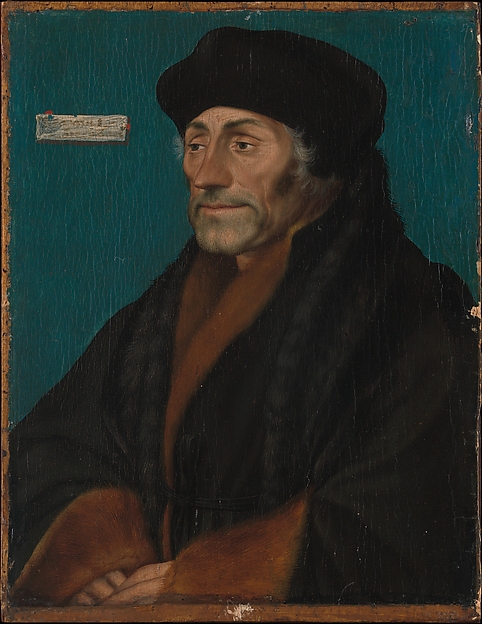
Image title: Erasmus of Rotterdam
Medium: Oil on linden panel
Date: ca. 1532
Source:
The Met Collection
“
All children are artists. The problem is how to remain an artist once he grows up.
”
— Pablo Picasso
The Algorithmic Muse: When AI Becomes the Artist
Introduction: Creativity in the Age of Code
What does it mean to be creative in the age of algorithms? With the emergence of artificial intelligence (AI) as an artistic collaborator and, increasingly, a creator in its own right, the boundaries of authorship are being redrawn. Tools like Generative Adversarial Networks (GANs) and neural style transfer have transformed how we conceive art — not just as a product of human imagination, but as a fascinating synthesis of data, pattern recognition, and machine learning. As we delve into this transformation, let’s explore how visual art has evolved across different epochs, culminating in the algorithmic era reshaping the very soul of art: originality.
Chapter 1: The Classical Bond—Skill, Individuality, and the Divine Spark
For centuries, the creation of visual art was seen as an inherently human endeavor — a divine spark channeled through practice, talent, and vision. In Ancient Greece, the ideal of techne, or craftsmanship, was central to how people understood creativity: a combination of skilled execution and emotional expression. The Renaissance elevated this further by positioning the artist as a genius, a conduit between the earthly and the divine. Painters like Leonardo da Vinci and Michelangelo were revered not just for their techniques, but for their capacity to envision the unseen. The emphasis was always on the human hand, the artist’s touch — a principle that held fast, albeit reconfigured, for centuries.
Chapter 2: Mechanization and Modernism—The First Crisis of Originality
The Industrial Revolution disrupted this narrative. As machines began to produce goods once handcrafted, questions arose about authenticity and value. The camera dramatically shifted the stakes — when a machine could replicate reality more precisely than the human eye, what was left for the painter but interpretation? In response, Impressionists and later Modernist artists like Picasso and Duchamp challenged traditional notions of representation. Duchamp’s famous ready-made Fountain (1917) asked: if the context and intent define art, does the object matter at all? This philosophical groundwork laid the path for future conversations about authenticity and authorship — essential questions activated anew by AI-generated art.
Chapter 3: The Digital Turn—Pixels, Data, and New Canvas Realities
The late 20th century ushered in a shift from analog to digital. Artists began to explore computer-based techniques, coding their own artworks or manipulating pixels and digital textures. Pioneers like Harold Cohen created AARON, an autonomous art-making program that predates today’s AI but operates on similar conceptual ground. Digital media expanded not only the tools available but also the definition of art itself. The canvas was no longer physical — it was a screen, or even code. By the early 2000s, artists were integrating interactivity and algorithms, setting the foundation for today’s AI art tools to move from niche experiment to cultural phenomenon.
Chapter 4: Machine Aesthetics—GANs, Neural Style Transfer, and the New Creators
With the rise of machine learning came tools capable of creating images not just procedurally, but aesthetically. Generative Adversarial Networks (GANs), first proposed by Ian Goodfellow in 2014, work through a kind of digital dialectic: one neural network (the generator) creates images while another (the discriminator) critiques them. Through this iterative feedback loop, the system refines its outputs — producing eerie, dreamlike, sometimes startlingly coherent artworks. Neural style transfer, on the other hand, allows users to blend the style of one image with the content of another — essentially painting a photograph in the manner of Van Gogh or Hokusai.
Artists like Refik Anadol use machine learning to create fluid, data-driven dreamscapes, while Robbie Barrat and Mario Klingemann push the boundaries of AI’s generative potential. The AI doesn’t merely mimic, it morphs — churning vast datasets into entirely new aesthetics. But this raises questions: Who owns the work? The coder? The machine? The dataset’s originators?
Chapter 5: Rethinking Authorship—Philosophy, Ethics, and the Post-Human Artist
Philosophically, AI-generated art challenges canonical ideas of creativity, agency, and expression. If creativity involves novelty and intent, can a machine truly be creative? Some argue that machine learning lacks intention — that it is human users programming aesthetics into silicon. Others counter that creativity has always been iterative, even derivative. After all, Renaissance artists trained by copying masters — much like an AI learns by absorbing thousands of examples. As the line between tool and co-author blurs, we inch toward a post-human understanding of creativity.
There are also ethical dimensions to this debate. AI art models trained on databases scraped from the internet raise issues about consent, ownership, and representation. Is it ethical to generate art in the style of an artist who never gave permission? Can something trained on bias produce objective beauty?
Conclusion: Toward a Symbiotic Future
As we stand at the intersection of art and algorithm, one thing is clear: AI is not here to replace the artist, but to augment and challenge our notions of what art can be. Just as perspective revolutionized Renaissance painting and photography rewrote realism, so too is AI altering the conditions and conceptions of art-making. Perhaps the true measure of artistry in the age of algorithms lies in collaboration — in viewing the machine not merely as a tool or threat, but as a new kind of muse, algorithmic and enigmatic.
Useful links: