“
The thoughts we choose to think are the tools we use to paint the canvas of our lives.
”
— Louise Hay
The Algorithmic Brushstroke: When AI Learns to Paint Emotion
Chapter I: From Cave Walls to Canvas – The Origins of Emotional Expression
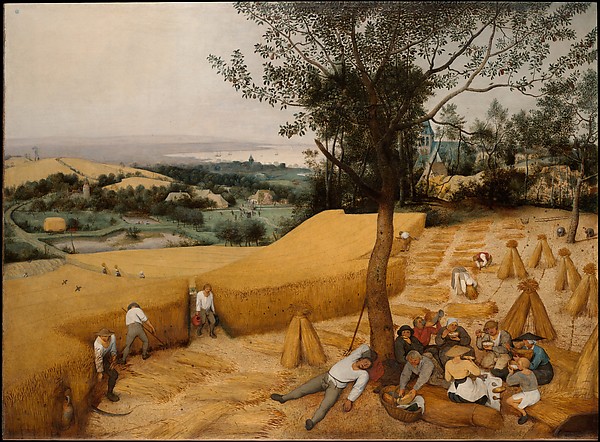
Art, as one of humanity’s oldest forms of communication, began with primal gestures—hands pressed against cave walls, pigment smeared to mark the rhythm of life and death. Those prehistoric strokes were not technical feats but instinctual expressions of emotion and survival. Over the millennia, artistic representation became increasingly refined, culminating in the Renaissance, when artists like Leonardo da Vinci and Raphael pursued perfect proportions and perspective, marrying intellect and feeling. For centuries, artists have explored ways to externalize interior states, translating emotion into composition, color, and form.
The human drive to capture emotion visually has always been tethered to technological innovation. The invention of oil paint allowed softer transitions of hue, and later, photography challenged artists to search for expression beyond realism. What began with soot and ochre has evolved, step by step, into algorithms and neural networks—our newest brushes for painting the ineffable.
Chapter II: The Mechanical Eye – When Machines Began to Imitate
The 19th and early 20th centuries witnessed the mechanization of vision. The camera, the printing press, and later cinema all transformed how artists conceived of image-making. The Impressionists responded to these shifts with spontaneity and personal perception—Monet’s shimmering water lilies were, in some ways, emotional resistance to the mechanical eye’s precision. As new tools emerged, the artist’s role morphed from documentarian to interpreter, suggesting that emotion itself was the one domain where machines could never intrude.
Yet, the seeds of algorithmic art were already sown. By mid-20th century, early computational artists like Frieder Nake and Vera Molnár began experimenting with plotters and code, creating works that seemed to have both geometric logic and poetic rhythm. Machine-generated art was no longer just imitation—it started to feel like a different form of abstraction, a visual language born of systems rather than souls.
Chapter III: Pixels and Feelings – The Rise of Digital Art
The digital revolution of the late 20th century brought a new medium into the studio. Computers enabled generative design, fractal art, and early neural networks capable of producing mimetic styles. Programs like Photoshop and later algorithmic modeling tools blurred the boundaries between human intention and machine execution. Artists began collaborating with machines not just as tools, but as co-creators.
Emotion in digital art shifted from being expressed solely through the artist’s gesture to being encoded in data. Artists trained algorithms on images of joy, grief, and ecstasy, teaching them to emulate the textures of human sentiment. Could a program that ‘learned’ Van Gogh’s brushwork reproduce not only his style but also his anguish? The question marked a turning point in how we defined authenticity and feeling in art.
Chapter IV: Neural Networks and the Dream of Empathic Machines
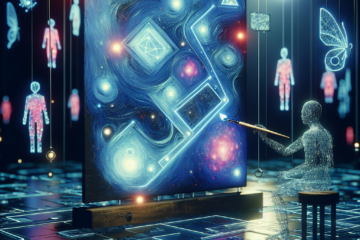
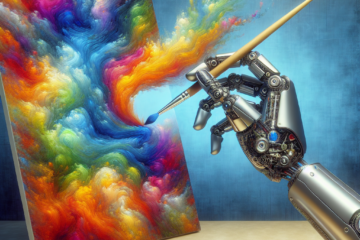
In the 21st century, artificial intelligence has evolved from a computational tool into an interpretive partner. Generative models like DeepDream, DALL·E, and Midjourney process vast datasets of visual culture, producing uncanny fusions that evoke emotional complexity. The ‘algorithmic brushstroke’ emerged—not the motion of a hand, but the statistical weight of learned perception.
These systems do not feel emotion; they calculate it. Yet, through pattern recognition, they simulate the visual markers of emotional depth. Just as a musician can move us without personally experiencing our feelings, AI paintings can seem to pulse with empathy, even though no self lies behind the image. We are left to question: is emotion in art a property of the creator or the beholder? If our interpretation completes the emotional circuit, perhaps AI has already learned to ‘paint’ emotion in the only way art has ever known—through the connection it forges with its audience.
Chapter V: Beyond the Human Horizon – Art in the Age of Intelligent Expression
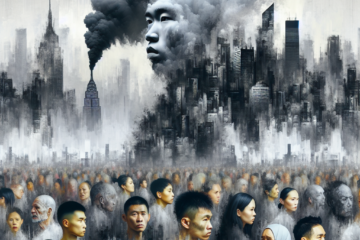
The emergence of AI-generated art confronts us with a radical rethinking of the artistic process. Instead of the solitary genius, we have distributed intelligence; instead of intentionality, we have probability. Yet, these works can still provoke tears, curiosity, even awe. The algorithm has become a mirror—reflecting not its own emotions but our desires to see something human in the inhuman.
Looking ahead, the trajectory of art seems poised between collaboration and confrontation. Artists who integrate AI into their practice explore new forms of empathy, where emotion is not transmitted from self to self but co-created between human intuition and machine interpretation. As we stand at this threshold, the algorithmic brushstroke challenges us to redefine what we mean by emotion, authorship, and ultimately, the soul of art itself.
Useful links: