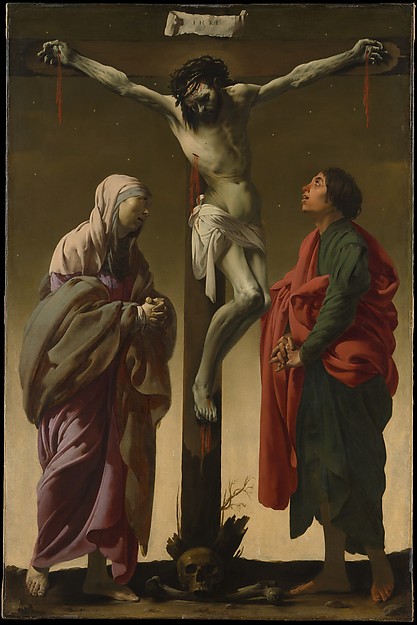
Image title: The Crucifixion with the Virgin and Saint John
Medium: Oil on canvas
Date: ca. 1624–25
Source:
The Met Collection
“
Most of the shadows of life are caused by standing in our own sunshine.
”
— Ralph Waldo Emerson
Shadows That Speak: The Hidden Language of Negative Space in Art
Introduction: The Voice Within the Void
Every artist, knowingly or not, engages in a dialogue between presence and absence. Negative space—the area around and between the subjects of an image—does not merely frame; it narrates. From the dramatic chiaroscuro of the Baroque masters to the stark silhouettes of contemporary installations, the manipulation of darkness and empty space shapes meaning as powerfully as any brushstroke or line. The history of negative space is, in essence, the story of how artists learned to make shadows speak.
Chapter 1: Baroque Light and the Birth of Pictorial Drama
The mastery of negative space gained a theatrical intensity with Caravaggio in the late sixteenth century. His paintings are more than biblical scenes—they are stage plays of contrast, where figures emerge from an abyss of darkness. This Caravaggesque chiaroscuro was more than technical style; it was visual philosophy. In a culture steeped in Catholic mysticism and Counter-Reformation fervor, the darkness surrounding divine figures was a metaphor for moral uncertainty illuminated by revelation. Artists like Artemisia Gentileschi and Georges de La Tour would adopt these techniques, turning black backgrounds into psychological abysses where light became divine speech and shadow, human doubt.
Chapter 2: The Eastern Whisper – Absence in Japanese and Chinese Aesthetics
While Western painters filled canvases with passionate light, Eastern traditions found beauty in emptiness. In Japanese ink painting and Chinese calligraphy, negative space—known as ma—is an active, breathing element. Artists such as Sesshū Tōyō and later the Zen-influenced painters of the Edo period saw absence not as void but as potential. Philosophically, ma is the pause that gives rhythm to existence, akin to silence in music. These artists painted with awareness of the unseen, suggesting that what was not painted could be as significant as what was. This contemplative approach would later inspire Western modernists, who rediscovered minimalism as a path to meaning.
Chapter 3: The Modernist Crisis – Cubism, Abstraction, and the Space Between
The early twentieth century brought both intellectual and technological revolutions that challenged artistic perception. Photography’s rise forced painters to reconsider what painting could reveal beyond realism. Artists like Picasso and Braque fractured the figure in Cubist compositions, allowing the negative space between planes to vibrate with energy. Later, in the works of Kazimir Malevich and the Bauhaus painters, the white field became not an absence but a mathematical and spiritual arena—a new language of modernity. Negative space, once a supporting actor, moved to center stage as abstraction embraced the very idea of nothingness as form.
Chapter 4: Silhouettes of Power – From Kara Walker to Postmodern Shadows
In the late twentieth and early twenty-first centuries, artists began to use negative space as social commentary. Kara Walker’s panoramic silhouettes, starkly black against white walls, transform the simplicity of shadow into potent narratives about race, gender, and historical violence. The cut paper figures evoke both innocence and atrocity, forcing the viewer to confront the darkness within cultural memory. Similarly, contemporary photographers and installation artists manipulate absence—literal and metaphorical—to address identity and invisibility. Here, negative space becomes political: what is unseen is often what has been erased.
Chapter 5: The Digital Turn – Light, Code, and Virtual Voids
Today’s artists inherit a world where light and shadow are made of data. Digital imaging, augmented reality, and algorithmic design allow creators to sculpt emptiness itself. In digital painting and media installations, black space can be interactive or infinite, coded to respond to perception. The negative spaces of cyberspace—the blank interfaces, the unfilled metadata, the dark web—echo earlier artistic meditations on presence and absence but on a global, technological scale. As artificial intelligence learns to generate images from prompts of emptiness, the question remains: can code understand shadow as meaning?
Conclusion: When Silence Speaks
The language of negative space invites us to listen to what is not said, to see in what is not shown. From Caravaggio’s moral chiaroscuro to Kara Walker’s silhouettes that haunt collective memory, art’s engagement with darkness reveals humanity’s constant negotiation between revelation and concealment. Shadows speak—and their voice, though quiet, continues to shape the future of visual storytelling.
Useful links: