“
He who lives in harmony with himself lives in harmony with the world.
”
— Marcus Aurelius
Sculpting Soundscapes: The Harmony of Visual Art and Music
Throughout history, the interaction between visual art and music has served as a profound source of inspiration and innovation. The dance between these two expressive forms has led to unique cross-pollination, where sound influences sight and vice versa, creating multidimensional experiences that transcend traditional boundaries.
The Renaissance: Birth of a New Harmony
The Renaissance period marked the revival of art and music, each deeply intertwined with the cultural shifts of the time. Artists like Leonardo da Vinci and Michelangelo were known to appreciate the parallels between painting and music. This era embraced the concept of the ‘Renaissance Man,’ where expertise in both visual and musical arts was celebrated. For instance, the mathematical precision of perspective in visual art mirrored the structured harmonies found in polyphonic music compositions, demonstrating a shared pursuit of balance and symmetry.
Baroque Brilliance: Sound as Visual Excess
In the Baroque era, extravagant and dramatic expressions dominated both art forms. Composers like Johann Sebastian Bach created intricate compositions that paralleled the elaborate detail found in Baroque paintings and sculptures. Painters like Caravaggio used the chiaroscuro technique to amplify emotion, much like how composers used dynamic contrasts to evoke deeper emotional responses. Art and music of this time sought to capture the grandeur and complexity of human emotions.
Impressionism: The Synthesis of Sensations
Moving into the late 19th century, Impressionism marked a shift towards capturing fleeting moments and perceptions in both art and music. Painters like Claude Monet and musicians like Claude Debussy took inspiration from each other, seeking to convey atmosphere and light. Debussy’s compositions, such as ‘Clair de Lune,’ are often described as ‘tonal paintings,’ mirroring Monet’s exploration of light and color. This era marked the beginning of abstraction, where art and music became more about evoking moods and impressions than depicting reality.
Contemporary Creations: A Dialogue of Disciplines
In contemporary art, the line between visual art and music continues to blur, leading to immersive experiences that engage multiple senses. Multimedia installations by artists like Brian Eno and William Kentridge use technology to blend sound and visuals into cohesive artistic experiences. Eno’s ambient music acts as a soundscape, complementing visual elements and transforming spaces into meditative environments. This holistic approach reflects a current inclination towards interdisciplinarity, where art forms cross boundaries to form new languages.
Futuristic Fusions: Technology and the Art of Sound
Looking towards the future, technology is accelerating the intersection of visual art and music. Virtual reality (VR) and augmented reality (AR) platforms allow artists to create immersive environments where visuals and sound interact in real-time. Such advancements offer audiences a participatory role, where they become part of the art itself. As these technologies evolve, they will continue to reshape how we experience the confluence of visual and auditory art, pushing the boundaries of creativity and expression.
The relationship between visual art and music is a testament to the capacity of human creativity to transcend singular forms, crafting holistic experiences that speak to the senses and the soul. As we continue to explore the synergy between these arts, we step into spaces where the line between seeing and listening becomes, delightfully, indistinct.

Image description:
Eb minor – Reflexions #2
Watercolor and oil on paper – 30x42cm
Arnaud Quercy Creations / AQC0436 / 2022
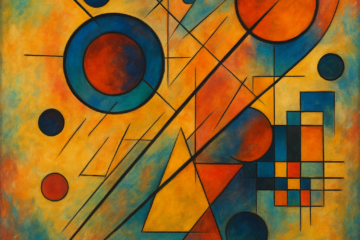
This evocative piece, titled “Eb Minor – Reflexions #2,” explores the synesthetic relationship between music and color. The composition features a delicate interplay of geometric forms and soft hues, rendered in watercolor and oil. Dominated by cool blues and accented with warm yellows and reds, the artwork visually interprets the tonal qualities of the key of E-flat minor. The abstract shapes and lines evoke a sense of harmony and introspection, reflecting the emotional depth and complexity of the musical key. This piece represents an initial attempt at mapping E-flat minor with the color wheel, highlighting the artist’s research into synesthetic experiences and the fusion of auditory and visual art forms.
License:
CC BY 4.0
Source:
Wikimedia Commons
Useful links: