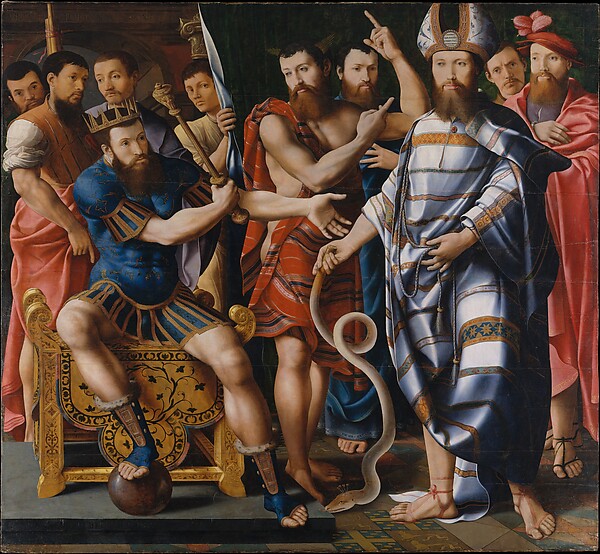
Image title: Moses and Aaron before Pharaoh: An Allegory of the Dinteville Family
Medium: Oil on wood
Date: 1537
Source:
The Met Collection
“
Success consists of going from failure to failure without loss of enthusiasm.
”
— Winston Churchill
Portraits of Power: The Evolution of Political Imagery from Pharaohs to Presidents
Introduction: The Faces That Govern
From stone-carved likenesses of divine pharaohs to the high-definition photographs of modern presidents, portraiture has long been a potent instrument of power. Across cultures and centuries, rulers have sought not merely to record their appearance but to sculpt their image—transforming the human face into a vessel of ideology. These portraits do not simply reflect personal vanity; they embody political narratives, divine sanction, and collective identity. Understanding their evolution reveals how art and authority intertwine to mold history’s perception of leadership.
Chapter 1: Divine Authority in Ancient Egypt
Few civilizations understood the link between art and divinity as deeply as ancient Egypt. Pharaohs were not portrayed as mortal men but as manifestations of gods. Sculpted in stone, their stylized faces—symmetrical, impassive, and idealized—conveyed eternal stability and cosmic order. The monumental statues of Ramses II at Abu Simbel and the iconic death mask of Tutankhamun were crafted not to capture personality but to proclaim immortality. Hieratic scale and static composition reinforced the pharaoh’s eternal role in maintaining ma’at—the sacred balance of the universe. In these portraits, art served theology as much as politics.
Chapter 2: Classical Ideals and Imperial Persona
In the Greek and Roman worlds, portraiture evolved into a dialogue between realism and idealism. Greek artists celebrated human perfection as a reflection of divine beauty, while Roman sculptors introduced the notion of ‘verism’—depicting wrinkles, scars, and the weight of age as emblems of virtue and civic duty. The busts of Roman emperors, such as Augustus and Hadrian, bridged both traditions, blending ideal proportions with personal likeness. This calculated balance projected rulers as human yet transcendent—mortal figures embodying the empire’s moral authority. Portraiture here became a political language, a form of propaganda carved in marble.
Chapter 3: Sacred Kingship and the European Renaissance
The medieval and Renaissance periods reimagined political depiction within the framework of Christian theology and humanist inquiry. Medieval monarchs like Charlemagne were depicted in illuminated manuscripts as Christ-like rulers, their halos emphasizing divine right. By the fifteenth century, however, the Renaissance refocused attention on individuality. The portraits of monarchs by Jan van Eyck or Hans Holbein the Younger combined meticulous realism with symbolic details—jewels denoting wealth, books suggesting learning, and inscriptions asserting lineage. Power was no longer merely heavenly ordained but anchored in intellect, diplomacy, and personality. The Renaissance portrait became a Renaissance manifesto: the ruler as both humanist patron and cultural symbol.
Chapter 4: Revolution, Republic, and Representation
The Enlightenment and the political revolutions that followed shifted the artistic portrayal of power from divine right to democratic image. Monarchs faced the challenge of adjusting their aesthetics to new ideals of reason and liberty. Napoleon Bonaparte, under Jacques-Louis David’s masterful brush, became the archetype of the self-made emperor—a blend of classical heroism and modern ambition. In contrast, revolutionary leaders like George Washington and Simón Bolívar adopted a restrained visual language: austere poses, muted colors, and symbols of civic virtue rather than opulence. Portraiture adapted to serve republican ideals, presenting rulers not as gods but as embodiments of collective will.
Chapter 5: The Age of Photography and the Global Image
The nineteenth and twentieth centuries revolutionized political imagery. Photography democratized representation, while mass media amplified the leader’s face into a global brand. From Abraham Lincoln’s carefully staged photographs—designed to project moral fortitude—to Winston Churchill’s famous wartime portraits by Yousuf Karsh, visual authority became about presence and authenticity. The digital era has further accelerated this evolution: modern presidents curate their image across media platforms, balancing charisma with relatability. Portraiture today merges art, celebrity, and technology. Whether through official state portraits, televised addresses, or social media feeds, the face of power continues to adapt to new visual languages while maintaining its ancient promise—to make leadership visible, compelling, and enduring.
Conclusion: The Politics of the Human Face
From divine profiles chiseled in temples to presidential selfies disseminated worldwide, the portrait remains the perennial cipher of authority. Artists, rulers, and now entire societies participate in shaping ideals of power through visual form. As the medium evolves—from pigment and marble to pixels and motion—the message persists: the face of leadership is not merely representation, but persuasion. To study portraits of power is to uncover the visual architecture of belief that sustains civilizations.
Useful links: