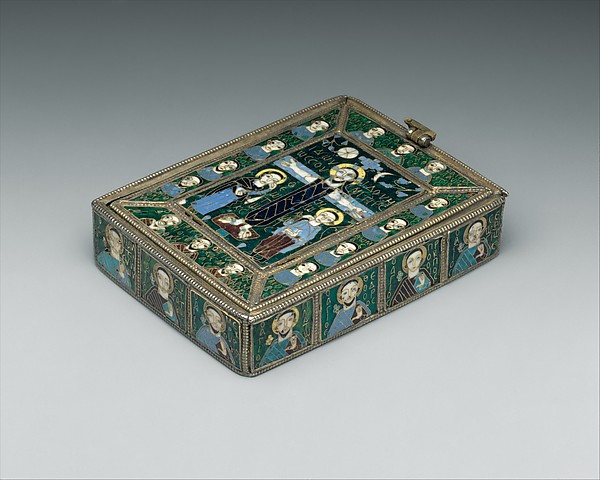
Image title: The Fieschi Morgan Staurotheke
Medium: Gilded silver, gold, enamel worked in cloisonné, and niello
Date: early 9th century
Source:
The Met Collection
“
I hear and I forget. I see and I remember. I do and I understand.
”
— Confucius
Pixels and Saints: AI Reimagines Medieval Iconography
Introduction: A New Digital Devotion
In dimly lit abbey scriptoria, monks once painstakingly illuminated manuscripts with gold leaf and rich pigments, adorning sacred stories with sublime images. Fast forward to the 21st century, and a new form of digital scribe has emerged: artificial intelligence. With machine learning algorithms now being trained on thousands of medieval artworks—ranging from illuminated Gospel books to ornate altar pieces—we find ourselves witnessing a curious fusion of the sacred and the synthetic. This blog explores how AI is revitalizing medieval iconography, not just as a novelty but as a profound commentary on history, perception, and the future of spiritual art.
Chapter 1: The Medieval Visual Lexicon
The visual language of the Middle Ages was dense with symbolism and spiritual intent. From the stiff hieratic postures of saints to the radiant halos and meticulous marginalia, every element served a theological purpose. Artists of the time were less concerned with realism and more devoted to transcendental truth. Illuminated manuscripts like the Book of Kells or the Très Riches Heures du Duc de Berry were not merely illustrated texts; they were portals to divine understanding. AI researchers today input thousands of such images into neural networks, allowing machines to learn these symbolic grammars and compositional styles.
Chapter 2: The Rise of Generative Aesthetics
The emergence of GANs (Generative Adversarial Networks) and diffusion models has revolutionized how machines interpret and recreate visual data. When trained on medieval iconography, these algorithms begin to generate uncanny digital compositions—portraits of halos with glitch-like symmetry, celestial figures emerging from Byzantine mosaics, or entirely new saints born from statistical inference rather than doctrinal lineage. These images, neither purely human nor wholly machine-made, provoke questions about authorship, authenticity, and the role of reverence in digital space.
Chapter 3: Renaissance Versus Replication
The Renaissance ushered in linear perspective, anatomical precision, and the centrality of the human figure. This artistic transformation often contrasts sharply with AI-generated medieval pastiches, leading critics to question whether machines can embrace humanist ideals central to later Western art. Unlike Renaissance masters who voyaged into the empirical world, AI art emerges from a mathematical abyss—its compositions derived from pixel-based probability rather than tactile experience. Yet, in this divergence, a new kind of mysticism arises—visuals unburdened by ego, perhaps more aligned with the divine detachment sought by early Christian ascetics.
Chapter 4: Sacred Simulacra in the Digital Age
Artists and technologists are now collaborating to create interactive installations that blend AI-generated religious imagery with immersive soundscapes and sacred texts. For instance, projects like Obvious Art’s “Artificial Icons” or Sofia Crespo’s bio-inspired religious hybrids use neural networks to craft altarpieces that never existed—images of saints that feel familiar yet entirely fictional. These works challenge our understanding of sanctity and simulacrum, concepts once reserved for theological debate and now rekindled in the digital arena. Can a saint without a story still evoke reverence? Can machine-generated sanctity resonate in an age of spiritual skepticism?
Chapter 5: Toward a Techno-Theology
Philosophers and theologians have long debated the nature of divine creativity. In a world where algorithms reinterpret the visual symbols of faith, we must ask: is this the machine’s attempt to comprehend the ineffable? Or are we merely constructing new idols of code and computation? The ethical implications of recreating sacred imagery without context or ritual provoke conversations about cultural memory, digital colonialism, and the future of religious experience. As we gaze at a glowing seraph rendered by AI, does it echo with the same gravity as its centuries-old predecessor, or has it become a secular echo in a post-spiritual world?
Conclusion: Icons for a New Era
AI-generated medieval imagery is not a replacement for sacred tradition, but a reflection—sometimes reverent, sometimes irreverent—of our evolving relationship with history, technology, and transcendence. These pixelated saints might not reside in wooden triptychs or candlelit chapels, but they remind us that art, no matter the means of creation, continues to be a mirror of our deepest human inquiries—about the divine, the beautiful, and the unknowable.

Image description:
Battle in a medieval village Midjourney generated image
License:
Public domain
Source:
Wikimedia Commons
Useful links: