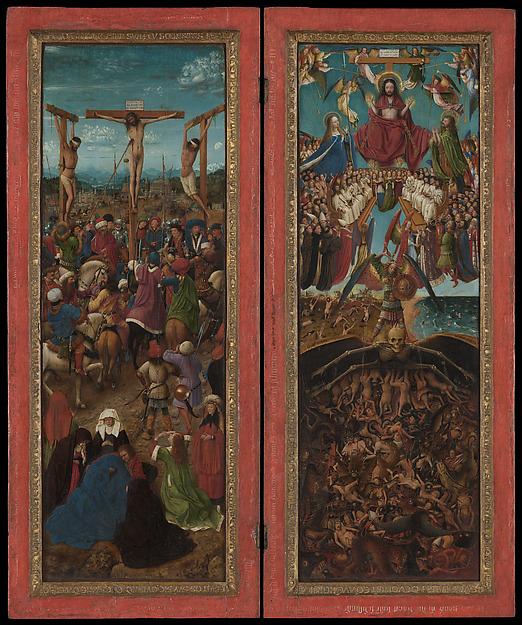
Image title: The Crucifixion; The Last Judgment
Medium: Oil on canvas, transferred from wood
Date: ca. 1436–38
Source:
The Met Collection
“
The most important thing is transforming our minds, for a new way of thinking, a new outlook: we should strive to develop a new inner world.
”
— Dalai Lama
Pixel Prophets: How Neural Networks Are Inventing a New Visual Language
Introduction: A New Era of Artistic Expression
In darkened studios and sunlit ateliers, the evolution of visual art has unfolded over centuries in the hands of painters, sculptors, and dreamers. Today, that evolution has taken a stunning pivot into silicon and code. AI-generated art—born from datasets and algorithms—is no longer on the periphery of creativity but is instead emerging as a vital and provocative new frontier. Neural networks are not only producing compelling imagery but challenging our core assumptions about aesthetics, authorship, and what it means to create.
1. From Cave Walls to Canvases: The Human Need to Visualize
The roots of visual communication stretch back over 30,000 years, to the haunting handprints and animal renderings on the walls of Chauvet and Lascaux. These early artworks were more than decoration—they encoded belief systems, knowledge, and identity. As civilizations expanded and technologies advanced, so too did the tools and techniques of visual storytelling. The invention of perspective during the Renaissance, for instance, reshaped how artists represented reality, shifting from symbolic to illusionistic depictions. Yet through all these transformations, one constant remained: the human hand.
2. The Machine as Brush: Early Experiments and Digital Collaborations
The convergence of art and technology began long before AI. In the 1960s, artists like Harold Cohen pioneered the use of computers to generate artistic forms. Cohen’s AARON, one of the earliest examples of a rules-based art program, could produce abstract drawings on its own. These early digital experiments paved the way for today’s deep-learning models. With the rise of software and interactive media, art became less about static images and more about process, systems, and viewer interaction—concepts that echo powerfully in today’s AI-generated works.
3. The Rise of Neural Aesthetics
In recent years, the development of neural networks—particularly Generative Adversarial Networks (GANs) and diffusion models—has enabled machines to not only imitate but also invent entirely new visual styles. Tools like DALL·E, Midjourney, and Stable Diffusion allow users to generate images from textual prompts, blurring the line between linguistic abstraction and visual realization. These neural ‘props’ no longer replicate the tradition; they mutate it. The resulting images often hover in a liminal space—recognizable yet surreal, echoing art history while striding into uncharted aesthetic territory. What we see is not the machine mimicking a human artist, but a new kind of non-human creativity.
4. Authorship and Authenticity in the Digital Cathedral
If medieval cathedrals were built by anonymous craftsmen, their identities subsumed into collective expression, then AI-generated art invites a similar decentralization. Who is the artist—the algorithm, the engineer, or the person who typed the prompt? This tangled web forces us to reconsider authorship altogether. Philosophers like Roland Barthes anticipated this shift in his essay “The Death of the Author,” arguing that meaning is ultimately in the hands of the reader—or now, perhaps, the viewer. In AI art, the creator is neither fully absent nor traditionally present. Instead, creation becomes collaborative, distributed, and emergent.
5. Toward a Post-Human Visual Language
In embracing neural aesthetics, we are witnessing the birth of a new, post-human visual language—a hybrid of culture and code. This language is not bound by physical materials or historical genres. Instead, it emerges from patterns, data, and recombinations, forming a vibrant dialect of pixel-based prophecy. But this transformation also brings ethical dilemmas: data provenance, the replication of biases, and the commodification of creativity. As we move forward, society will need not only critics and curators but also philosophers and ethicists to navigate the shimmering plurality of machine-made visions.
Conclusion: The Canvas Has Changed, The Question Remains
The language of art is shifting. Where once pigment and brush ruled, now vectors and neurons dominate. Yet the essential human questions remain unchanged: What is beauty? What is expression? Who are we? Neural networks do not render the artist obsolete—they redefine the relationship between imagination and execution. As we collectively stand in front of this new canvas, we must learn not just to look, but to read, interpret, and question with wide-open minds. The prophets of pixels have arrived—not to conclude art’s story, but to begin a thrilling new chapter.

Image description:
Common Visualization of Artificial Neural Network with Chip
License:
CC BY 2.0
Source:
Wikimedia Commons
Useful links: