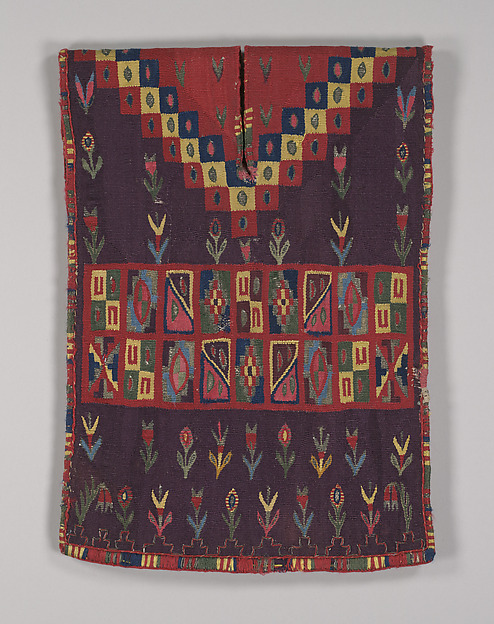
Image title: Miniature tabard
Medium: Cotton, camelid hair, silk, metal
Date: 1600–1700
Source:
The Met Collection
“
If you have a harem of 40 women, you never get to know any of them very well.
”
— Warren Buffett
Knots, Threads, and Resistance: The Radical Textiles of Latin American Women
Introduction: Textile as a Language of Resistance
Across Latin America, generations of women have taken up needles, yarns, and looms—not merely as tools of craft, but as instruments of resistance, identity, and storytelling. Often overlooked in the hierarchy of art, textile work has emerged in recent decades as a profoundly political and expressive medium, especially in the hands of female artists. Weaving, embroidery, and quilting have long served as a quiet yet radical platform for Latin American women to critique political violence, honor indigenous traditions, and reclaim narratives under the shadow of patriarchy.
This article investigates the evolution of radical textile art in Latin America in five powerful phases, each reflecting a transformative moment in the intersection between gender, power, and art.
Chapter 1: Pre-Colonial Threads — Ancestors of the Loom
Before the arrival of European colonizers, textile production in Latin America was closely tied to both daily life and the spiritual world. The ancient Andean cultures, including the Paracas, Nazca, and Inca, placed extraordinary value on textiles, with weaving considered a divine act. Women often held exclusive expertise in cloth-making, creating sophisticated pieces from alpaca and llama wool infused with cosmological symbols. Textiles functioned as both clothing and codified communication, carrying meaning through color, line, and pattern.
In these early societies, textile work was not merely decorative; it was sacred and social, often used in ritual, burial, and diplomacy. The colonial conquest violently disrupted these traditions, but threads of ancestral knowledge have remained, passed down through generations of women who wove not just for survival, but as an act of cultural preservation.
Chapter 2: Threads of Colonization — Survival Through Stitching
During colonial rule, women’s textile work became both a means of economic survival and an act of quiet resistance. Indigenous and Afro-Latina women preserved pre-Columbian weaving techniques despite the imposition of European aesthetics and Catholic iconography. This syncretic adaptation is evident in the richly embroidered huipiles of Guatemala and Mexico, which incorporate local mythology alongside Christian motifs.
By blending imposed and indigenous styles, these textiles became subversive documents of continuity and resistance. They testified to a dual reality: the overt presence of colonial power and the covert preservation of forbidden knowledge. In this period, female artisans often embedded symbols of their lineage or hidden political messages within otherwise acceptable “craft” objects—a subtle but daring form of defiance.
Chapter 3: Dictatorship and Domestic Defiance — The Arpilleristas of Chile
One of the most iconic examples of textile-based resistance emerged during the brutal dictatorship of Augusto Pinochet in Chile (1973–1990). In the face of disappearance, censorship, and violence, a group of Chilean women—many of them mothers and widows—turned to sewing as a weapon of memory. Known as arpilleristas, they stitched haunting textile collages, or arpilleras, depicting the grim realities of state repression.
Their quilts, crafted from fabric scraps and found material, were smuggled across borders by human rights organizations, amplifying muted voices onto the global stage. These were not just artworks—they were testimonies, human rights documents in fiber. They reinforced the notion that domestic tools could be repurposed into radical, confrontational art that challenged authoritarian narratives.
Chapter 4: Contemporary Voices — Stitching Identity and Feminism
In recent decades, a new generation of Latin American women artists has revived and reimagined textile work with contemporary urgency. Artists like Teresa Margolles (Mexico), Ana Teresa Barboza (Peru), and María Adela Díaz (Guatemala) incorporate weaving, embroidery, and fabric manipulation into multimedia installations that confront issues ranging from femicide to migration and environmental degradation.
Barboza, for example, threads the body into landscapes, blending embroidery with photography to question the line between human and nature. Others, like Colombian artist Olga de Amaral, elevate textile to monumental feminist architecture, transforming gold-threaded tapestries into immersive, sensorial environments. Here, thread becomes more than metaphor: it is connective tissue that binds stories, bodies, and histories together in ways that written language often cannot achieve.
Chapter 5: Digital Looms and New Media — Techno-Textiles and the Future
With the rise of digital technology, Latin American textile artists are expanding their methods, integrating circuits, code, and interactive media into their fabric works. Tecno-textiles—works that combine craft with coding—are gaining traction among artists who wish to challenge the division between hand labor and digital creativity.
Projects like “Cyber Embroidery” by Mexican collective Laboratorio de Tecnologías Eléctricas y Textiles (LETEX) demonstrate how embroidery can be used to create soft electronic interfaces that critique surveillance, censorship, and inequality. These hybrid artworks push the ancestral into the cybernetic, reconfiguring the textile arts as both homage to matrilineal tradition and speculative feminist futurism.
Conclusion: Weaving as Political Praxis
The fiber arts of Latin American women weave a powerful counter-narrative into the fabric of history. From indigenous cosmologies to postcolonial resistance, from dictatorship to digital defiance, each knot, thread, and stitch becomes a gesture of survival and assertion. In their hands, the loom is both archive and weapon—interlacing the personal with the political, the ancestral with the avant-garde. As we begin to recognize craft as art and domestic labor as dissent, the radical textiles of Latin America demand a place in the canon of contemporary resistance movements and visual culture alike.

Image description:
Sunday textile market on the sidewalks of Karachi, Pakistan.
License:
CC BY 2.0
Source:
Wikimedia Commons
Useful links: