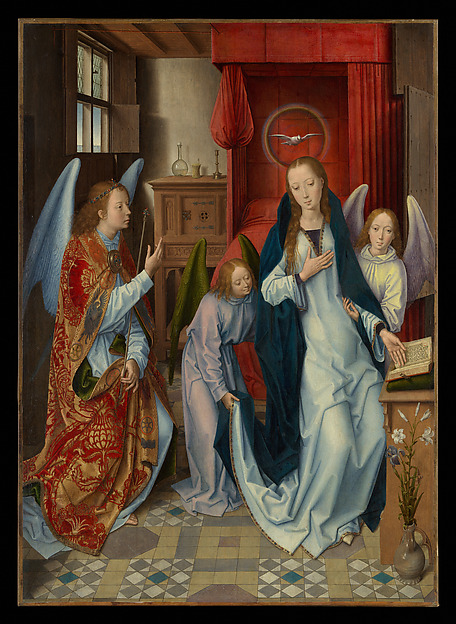
Image title: The Annunciation
Medium: Oil on panel, transferred to canvas
Date: 1480–89
Source:
The Met Collection
“
Trust only movement. Life happens at the level of events, not of words. Trust movement.
”
— Alfred Adler
From Lagos to London: The Neo-Afro-Surrealist Movement Changing Global Art Narratives
Introduction: A New Visual Language Emerges
A quiet revolution is reshaping contemporary visual culture, driven by a generation of African artists who are reimagining their identities, histories, and futures through a lens of magical realism and surrealist aesthetics. From vibrant Lagos art scenes to the minimalist galleries of London and Berlin, the Neo-Afro-Surrealist movement is a cultural phenomenon that’s challenging the Western-centric gaze and giving voice to narratives long silenced. This blog explores how artists from across the African continent, particularly Nigeria, are blending traditional mythologies, futuristic visions, and personal storytelling to redefine what it means to produce and consume art in the 21st century.
Chapter One: Echoes of Colonization and the Rise of Hybrid Art Forms
To understand Neo-Afro-Surrealism, one must trace the roots of African contemporary art through the post-colonial experience. Following the wave of independence movements in the mid-20th century, African artists began to assert themselves in ways that refused the binary of ‘traditional’ vs. ‘modern.’ Many adopted hybrid approaches—marrying indigenous visual languages with imported Western techniques. The ideologies of liberation and decolonization heavily influenced this era, planting the seeds of artistic resistance and narrative complexity that would later bloom into Neo-Afro-Surrealism. Artists like Twins Seven-Seven and Uche Okeke explored Yoruba cosmology and Igbo Uli design systems respectively, presaging a new visual vocabulary rooted deeply in African spirituality, abstraction, and coded symbolism.
Chapter Two: Surrealism Revisited—African Myth as a Portal
Surrealism, born in post-WWI Europe, originally aimed to express the irrational and the dream state, rooted in Freudian psychology and a rejection of bourgeois rationalism. But in the hands of Neo-Afro-Surrealists, this linguistic framework is reinterpreted. Artists like Wangechi Mutu, based in Nairobi and New York, and Nigerian-born Dennis Osadebe, integrate African mythology, folktales, and speculative visions with surrealist symbolism not to escape reality, but to deepen its complexity. Their work often critiques colonial archives, gender norms, and the commodification of Black bodies by crafting alternatives filled with interdimensional beings, technospiritual hybrids, and ancestral memory. Through this fusion, the African surreal becomes not an extension of European surrealism but a decolonial tool with sociopolitical force.
Chapter Three: Lagos as Incubator—The City that Dreams in Color
Lagos, Nigeria’s hyperkinetic commercial capital, has become a major hub for Afro-surreal expression. Institutions like the Centre for Contemporary Art, Lagos, and events such as Art X Lagos have helped nurture a generation of visionary artists. The city’s density, electricity, and cultural syncretism offer fertile ground for reimagining identity and place. Visual artists such as Ayobola Kekere-Ekun, who works primarily with quilled paper to create intricate narrative portraits, and Ken Nwadiogbu, known for hyperrealistic charcoal works that slip into the surreal, embody this creative shift. In a city where traditional masquerades vie with smartphone screens, Afro-surrealism offers a mirror to reality and a window into alternate futures.
Chapter Four: Diasporic Echoes—Bridging Continents through the Dreamscape
Neo-Afro-Surrealist aesthetics have moved beyond the continent, with diasporic artists amplifying and recontextualizing its frameworks within Western cultural institutions. In London, Philadelphia, Paris, and Berlin, diasporic African artists use the surreal to address themes of migration, displacement, and hybridity. Lina Iris Viktor, a British-Liberian artist, cloaks herself in mythic gold to channel both African royalty and speculative future selves. Her intricate, cosmological compositions speak not only of ancestry but of sovereignty in self-representation. These artists deploy technology—digital collages, 3D animation, augmented reality—to expand the surreal into the immersive, creating new sensorial languages that challenge the Euro-American canon.
Chapter Five: The Philosophy of Dreaming Forward—Techno-Mythologies and the African Future
Beneath Neo-Afro-Surrealist expression lies a deeper philosophical turn: a futurist drive rooted not in Western progressivism, but in African temporalities and myth cycles. Drawing from Afrofuturist thought, but often independent of it, these artists question linear notions of time, technology, and memory. They see tech as an extension of ancestry: from the ritual object to the iPad brush. As digital platforms democratize visibility, artists are reclaiming how Africa is seen—no longer as ‘developing’ but as dreaming, innovating, remembering. Virtual exhibitions, NFTs, and AI-infused projects now coexist with traditional crafts in the same oeuvre. The result is an art that’s not just visually stunning but ontologically radical.
Conclusion: Rewriting the Gaze, Reclaiming the Future
The Neo-Afro-Surrealist movement is not simply a new style or trend; it is a paradigm shift in art. It offers a mode of seeing that is deeply African yet unbounded by geography, chronological time, or genre. In doing so, these artists are not just occupying galleries—they’re reconstructing global art narratives from within. Whether in Lagos, Johannesburg, or London, their surrealism doesn’t escape the real; it transforms it, revealing possibilities for healing histories and imagining new ones. The world is beginning to listen—and dream along.
Useful links: