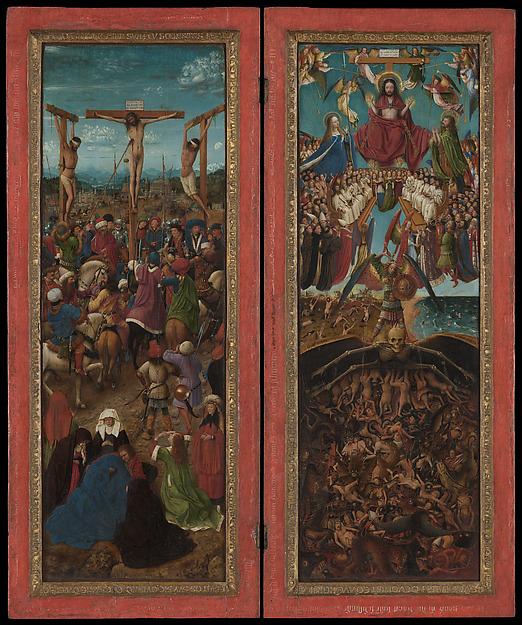
Image title: The Crucifixion; The Last Judgment
Medium: Oil on canvas, transferred from wood
Date: ca. 1436–38
Source:
The Met Collection
“
Pitching is the art of instilling fear.
”
— Sandy Koufax
From Cave Walls to Digital Canvas: The Ever-Changing Face of Visual Art
Introduction: The Timeless Journey of Visual Art
Visual art, in its capacity to capture the human experience, has metamorphosed alongside civilizations. Each era’s art not only reflects contemporaneous aspirations and anxieties, but also maps shifts in thought, technology, and society. Join us as we traverse the grand epochs of art history, from ancient pigment-bearers to today’s digital visionaries, uncovering the forces that sculpted our visual heritage.
1. Beginnings: The Mystique of Prehistoric and Ancient Art
The dawn of art emerges in darkened caves: flickering handprints and animal silhouettes painted by Paleolithic peoples over 30,000 years ago. Art began as a tool for communication, ritual, and power—a magical invocation or a social record. Ancient Egyptians, Greeks, and Mesopotamians soon formalized artistic practices. Their murals, sculpture, and pottery, bound by religious and governance motifs, demonstrated a world obsessed with the afterlife, divine order, and the ideal human form. Cultural and material circumstances—like the invention of pigments or block printing—shaped what was possible, and what was imagined.
2. Renaissance and Enlightenment: The Rebirth of Humanism
The European Renaissance (14th-17th centuries) signaled a philosophical shift: the elevation of individual genius and humanist ideals. Artists like Leonardo da Vinci, Michelangelo, and Raphael explored perspective, proportion, and anatomical accuracy, enabled by innovations in oil painting and scientific observation. Patronage by wealthy families and the Catholic Church spurred monumental frescoes and public sculptures. The spread of print media helped disseminate new artistic ideas across the continent, knitting a vibrant tapestry of creativity and competition.
3. Revolution and Experimentation: From Romanticism to Modernism
The 19th and early 20th centuries were times of social and technological upheaval. With photography’s arrival, painters such as Manet, Monet, and van Gogh rebelled, and art became an experiment in perception, emotion, and abstraction. Movements—Impressionism, Expressionism, Cubism, and Surrealism—fragmented reality and shattered academic tradition. As nations industrialized and urbanized, art responded by reflecting modern life’s anxieties and aspirations. New materials (like steel and ready-mades), and inventions like the camera and lithograph, enabled artistic risk-taking never before possible.
4. Late 20th Century: Pop, Performance, and Pluralism
After World War II, the art world fractured even further. Abstract Expressionism made painting a battlefield of emotion. Pop Art, led by figures like Andy Warhol, blurred distinctions between high art and mass culture, mirroring consumerism’s rise. Performance, conceptual, and land art redefined the boundaries of art, often making the process, idea, or setting itself the artwork. Civil rights, feminism, and global exchange shaped art’s subjects and makers, democratizing creation and discourse.
5. The Digital Turn: New Frontiers in Contemporary Art
Today, visual art lives on screens, in virtual worlds, and on social media. Digital tools—from Photoshop to virtual reality—allow artists to manipulate, reproduce, and even generate entire artworks with code or data. NFTs and blockchain now question what it means to own and share art. Cultural conversations around identity, environment, and technology coexist alongside age-old questions of beauty and meaning. As Artificial Intelligence and immersive media bloom, the very definition of ‘art’ stretches—hinting that the journey, far from ending, has only just transformed anew.
Conclusion: Art’s Living Legacy
Each transformation in visual art is a response to humanity’s shifting hopes and discoveries. As society innovates, so too does the means of creative expression. Whether on stone, canvas, or screen, visual art remains a profound testament to our enduring need to interpret and shape the world around us.

Image description:
title page of the book Art as a factor in the soul’s evolution by Curuppumullage Jinarajadasa
License:
Public domain
Source:
Wikimedia Commons
Useful links: