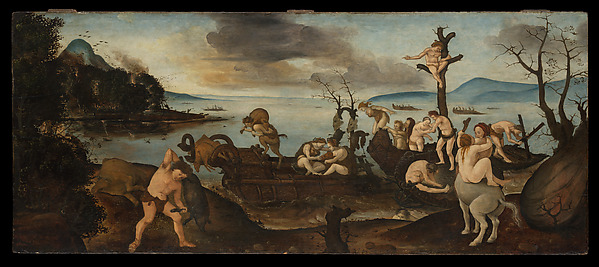
Image title: The Return from the Hunt
Medium: Tempera and oil on wood
Date: ca. 1494–1500
Source:
The Met Collection
“
Human beings, who are almost unique in having the ability to learn from the experience of others, are also remarkable for their apparent disinclination to do so.
”
— Douglas Adams
From Cave Walls to Code Walls: The Eternal Return of Human Mark-Making
I. Marks of Origin: The Handprints of Prehistory
Long before alphabets, empires, or pixels, early humans pressed their hands against cave walls, blowing pigment over their fingers to create silhouettes of presence. These images—some over 40,000 years old—speak across millennia as testimonials of life, community, and awareness. Found in places like Chauvet Cave in France and Sulawesi in Indonesia, these marks transcend decoration. They serve as expressions of being, declarations of ‘I was here.’ The birth of art, then, is inseparable from the human need to witness and be witnessed.
In these prehistoric images, scholars see both ritual and record—hunting scenes, shamanic symbols, and mythic animals etched or painted to bridge the visible and invisible. The cave became our first gallery, temple, and data archive combined, a space where information and spirituality intertwined.
II. Stone and Script: Civilization Writes Itself
As human societies gathered into cities, the mark evolved into writing. The cuneiform tablets of Mesopotamia and hieroglyphs along the Nile preserved not only stories but systems of governance, trade, and religion. Visual marks became repositories of memory and power. To make a mark on stone was to claim reality itself—to fix labor, law, and identity into permanence.
Artistic representation, too, absorbed this authority. Relief carvings on the walls of Assyrian palaces and Egyptian temples became visual propaganda, chronicling the deeds of kings as eternal truth. The mark as self-expression merged with the mark as control; inscription became both memory and mastery. What began as the echo of a handprint had become the architecture of civilization’s narrative.
III. Paint, Canvas, and the Renaissance of the Individual
With the Renaissance came a revolutionary shift—from the communal and symbolic to the personal and perspectival. Artists like Giotto, Leonardo da Vinci, and Michelangelo redefined what mark-making could mean, guiding it toward the human self as subject. The invention of linear perspective and oil painting offered new tools through which to record not only objects but perception itself.
The hand became a site of intellect, and art became a philosophical act. Every brushstroke in a portrait or landscape was now an inquiry into vision, humanity, and the divine. The mark, once collective, was now singular—a reflection of the artist’s mind. In this new order, painting became both science and poetry, expanding the meaning of presence from mere survival to introspection.
IV. Mechanization and Modernity: The Fragmented Line
The Industrial Revolution and the rise of photography transformed humanity’s relationship to imagery once again. When machines could replicate what eyes saw, artists asked not how to represent the world, but why. The Impressionists dissolved solid form into fleeting light; the Cubists fractured reality into viewpoints; the Abstract Expressionists turned pure gesture into emotion and energy. Each new mark interrogated both medium and maker.
Meanwhile, graffiti—appearing on trains, walls, and urban facades—emerged as art’s reclamation of the public sphere. In this context, to make a mark was a form of defiance, a territorial assertion of self within the machinery of the modern city. Whether on canvas or concrete, human beings continued to assert, ‘I exist, I resist, I remember.’
V. Code Walls and the Digital Continuum
Today, our marks often appear not on stone or paper but on screens and servers. Digital graffiti—spray-painted with pixels—travels faster and farther than cave pigment ever could. Street artists like Banksy find digital afterlives online, while programmers write code that generates art autonomously. NFTs turn human-made marks into cryptographic tokens, blurring authorship, originality, and possession in unprecedented ways.
Yet beneath this technological flux lies the same ancient impulse: to externalize consciousness, to inscribe existence in a medium that endures. The glowing surfaces of our devices echo the flickering walls of ancient caves. Each tap, click, or digital brushstroke continues the primal dialogue between being and mark, flesh and surface, presence and absence. From the red ochre of Paleolithic caves to the invisible code that animates our screens, humanity’s most enduring act remains the same: we leave traces to prove we are here.
VI. Conclusion: The Eternal Return of the Mark
Every epoch reinvents its language of marks, yet each returns to the same essence—the need to bridge the internal and the external, the temporal and the eternal. Whether carved, painted, printed, or programmed, the mark binds human experience across ages. In tracing this lineage from caves to code, we sense both continuity and renewal. The medium may change, but the gesture remains eternal: to inscribe one’s presence upon the fabric of time.
Useful links: