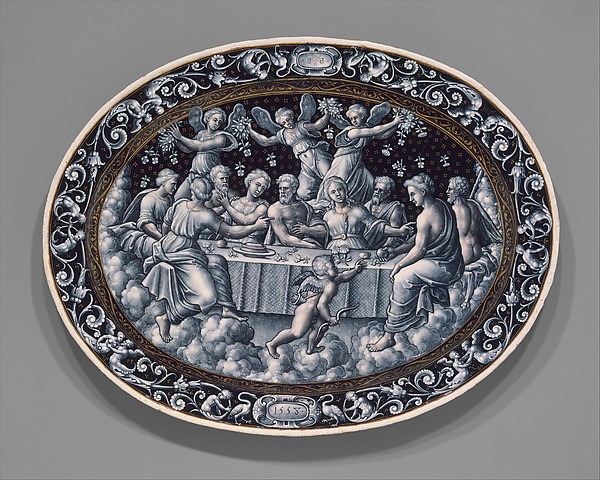
Image title: The Wedding Feast of Cupid and Psyche
Medium: Painted enamel on copper, partly gilt
Date: 1558
Source: The Met Collection
“
It is through science that we prove, but through intuition that we discover.
”
— Henri Poincaré
Digital Renaissance: The Evolution of Classical Techniques Through Digital Media
Introduction: Bridging Centuries in Pixels
The digital age is not the death knell for classical art; rather, it heralds a renaissance in which traditional techniques find new life through digital platforms. In this blog post, we embark on a journey to explore how the prestigious practices of old masters are experiencing a revival in the digital realm. We will delve into key transformative eras and unearth the cultural, philosophical, and technological currents engendering this intersection of time-honored art and digital innovation.
Chapter 1: The Classical Foundations
Our saga begins with the giants of classical art, such as Leonardo da Vinci and Michelangelo, whose works are synonymous with the Renaissance period. These artists developed techniques like chiaroscuro, sfumato, and perspective, pioneering a revolution in how humans render reality. The use of light and shadow, mastery over anatomy, and an obsession with realism became strategies artists employed to infuse life into static images. These classical techniques set the foundations for visual storytelling, transcending time and geography.
Chapter 2: The Advent of Photography
Moving into the 19th century, the advent of photography challenged the artistic world by capturing reality through mechanical means. Initially seen as an industrial threat to traditional art forms, photography swiftly became an ally. Artists began leveraging the medium to study light, composition, and both human and geographical subjects in new and dynamic ways. The manipulation of photographic techniques inspired new movements within fine art, proving that technological elevation does not obliterate the past—it expands it.
Chapter 3: The Digital Convergence
Fast forward to the late 20th century: the advent of digital technology revolutionized the landscape once more. Tools such as Adobe Photoshop became staples among digital artists seeking to recreate or modify classical techniques. The democratization of art creation and distribution—fueled by the internet—allowed historical skills to become accessible to a vast audience. Simultaneously, digital platforms hosted global exhibitions, unfurling vast digital canvases for global spectatorship.
Chapter 4: Traditional Skills in the Digital Arena
Today, digital artists incorporate classical techniques within the virtual realm effortlessly, adding layers of depth and realism to their work. Tools such as Corel Painter allow for brush-stroke replication, while others simulate the texture of oil on canvas, zenithal lighting, and more. Artists can emulate Baroque chiaroscuro or Dutch still-life arrangements with precision unseen outside traditional studios. The digital space enables meticulous experimentation, merging intricate detail with expansive creativity.
Chapter 5: The Philosophical Intersection
Underlying this modern-day renaissance is a philosophical intersectionality of time and technology. Art is at once historical accountability and innovative exploration. In experiencing digital artworks employing classical techniques, viewers engage in a dialogue that spans centuries. They draw on collective nostalgia while touching the edge of futuristic vistas. The dialogue between past and future reveals not a departure from tradition but a cyclical dance where each medium enhances the other, resulting in an art form as dynamic as it is timeless.
Conclusion: A New Brush on Classic Canvases
In conclusion, the marriage of classical techniques with digital media is a testament to the eternal nature of artistic evolution. As we adapt to the digital epoch, we continue to find beauty in our cultural heritage, its innovations shaped not by what is currently obsolete, but by the infinite possibilities that technology provides. The result is a digital renaissance—an ever-evolving canvas inviting us to rethink art’s narratives across the corridors of time.

Image description: File:Augustins – La renaissance des arts et des lettres – Henri Sieurac D 1857 2.jpg
Artist: Didier Descouens
Credit: Own work
License: Public domain
Source: Wikimedia Commons
Useful links: